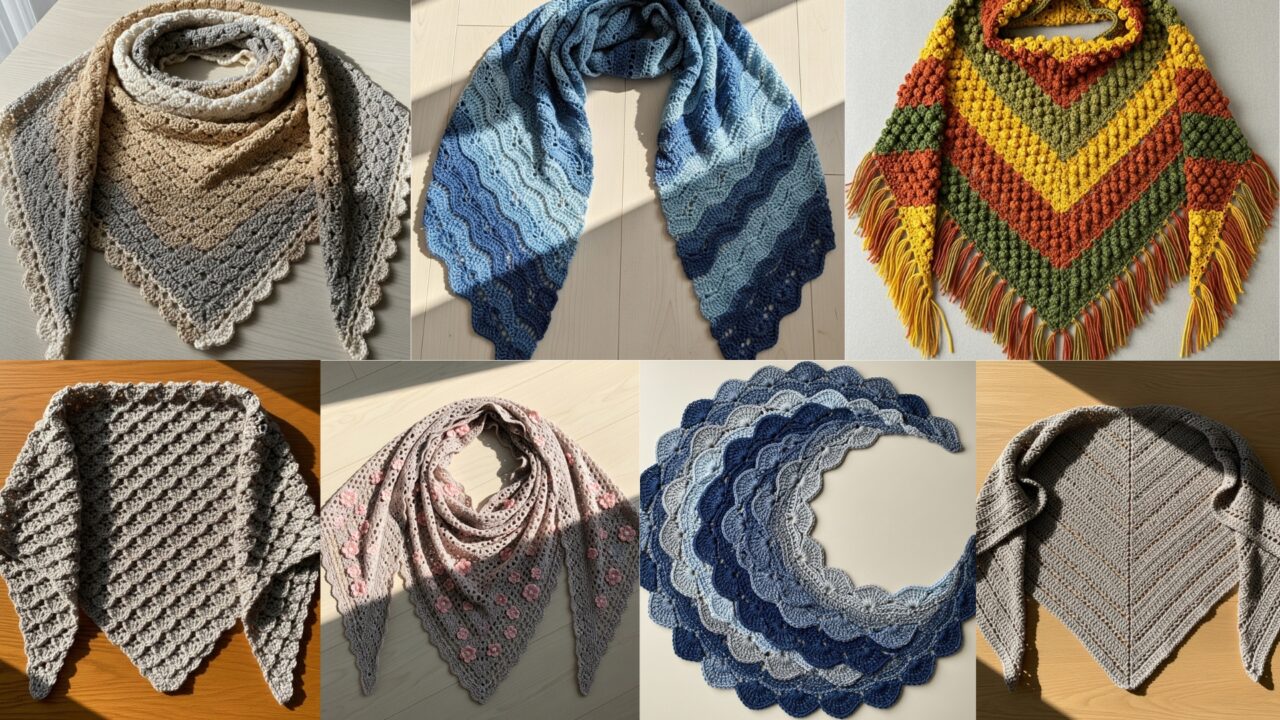
Crochet shawls are the perfect marriage of style and comfort: wearable pieces that let a single skein or a carefully chosen palette sing. A shawl can be an introductory-sized project for a confident beginner or a complex labor of love for an experienced maker. In this post you’ll find seven modern shawl designs — each with a clear design idea, materials and gauge guidance, a step-by-step construction (including the repeat and how to scale), helpful variations, finishing and blocking notes, and project ideas for where each shawl shines.
All instructions use US crochet terms. Before you start a shawl, read the quick notes below (abbreviations, sizing, and how to test gauge) — they’ll help you adapt each pattern to your yarn and preferred finished size.
Quick notes (abbreviations, sizing, & tools)
Common abbreviations: ch = chain, sc = single crochet, hdc = half double crochet, dc = double crochet, tr = treble crochet, dtr = double treble, sl st = slip stitch, sk = skip, rep = repeat, RS = right side, WS = wrong side, BLO/FLO = back/front loop only, MR = magic ring, sp = space.
Sizing & shape basics:
- The patterns below are predominantly triangle shawls worked either top-down from a small center or sideways from one side to the other, plus one Tunisian panel style. I give sample finished sizes and how to scale.
- Typical finished sizes (approx):
- Small/neck scarf: 18–34 in wingspan (shorter, more like a scarf)
- Medium/shoulder shawl: 50–62 in wingspan (wraps comfortably)
- Large/wrap: 70–84 in wingspan (dramatic, very drapey)
- To scale: make a gauge swatch in the pattern stitch and measure stitches-per-inch (width) and rows-per-inch (height). Multiply to reach desired wingspan and depth.
Tools & yarn: Choose yarn that suits the stitch openness: lace-weight or fingering for delicate shawls, sport/DK for modern drapey designs, worsted for cozy wraps. Hooks indicated per pattern are recommendations — adjust to match gauge and desired drape.
Blocking: Most shawls benefit hugely from blocking. Detailed blocking notes are included with each pattern.
1. Crochet Shells Shawl Pattern
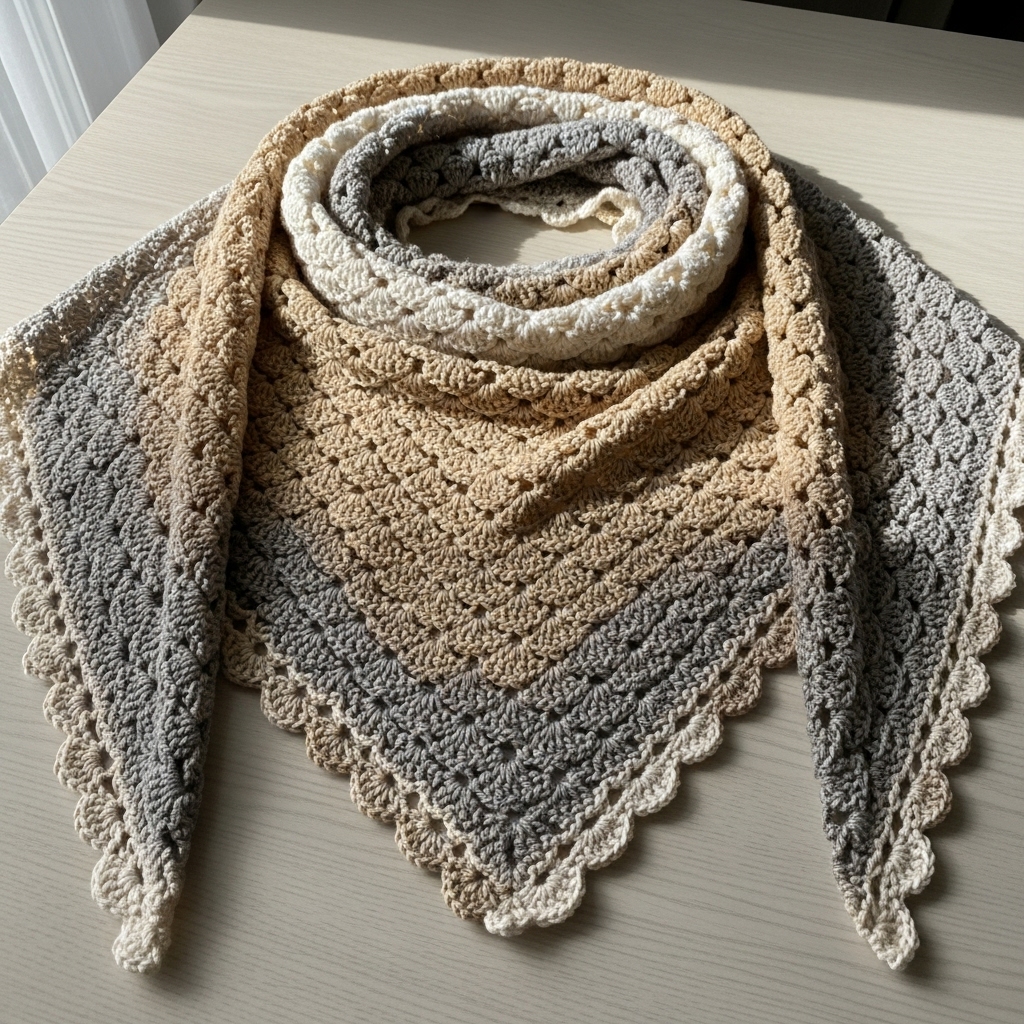
Overview & mood: A classic, feminine shawl built from repeating shell motifs. It reads modern when worked in a single neutral or gradient yarn and stacked into bands for subtle texture.
Skill level: Confident beginner — shells and simple increases.
Materials & sample size
- Yarn: Fingering to DK (sample uses DK, 400–800 yds depending on size).
- Hook: 4.0 mm (G) for DK; use 3.5 mm for a firmer fabric or 4.5 mm for a drapier shell.
- Finished sample (medium): wingspan ≈ 58 in; depth ≈ 24 in.
Gauge (in shell rows): ~16 sts × 8 shell rows = 4 in (DK sample). Make a 4″ sample to calculate for your yarn.
Stitch character: The shell is (5 dc shell) separated by chain spaces and anchored into previous row shell centers. Increasing at triangle edges uses paired shells at ends.
Construction — top-down triangle (center-top start)
Foundation: Start with a small V or center chain. Example: ch 4, dc in 4th ch from hook to make a small foundation of 3 dc that act as the first shell. Or start with MR + chain 3 to make three dc.
Row pattern (worked right side visible):
- Row 1: ch 3 (counts as dc), 2 dc in foundation (creates a small center shell), turn.
- Row 2: ch 3 (counts as dc), 2 dc in same stitch, ch 2, sk next shell center, (5 dc) in next shell center repeat across, end with 3 dc in last stitch. This is a simplified conceptual line — the actual row depends on how you anchor shells into chain spaces or centers. The core repeat is: shell, chain space, shell.
- Row 3: ch 3, turn, work shells into the chain-2 spaces from previous row and sc/hdc into shell tops as necessary to form a staggered shell grid.
Edge increases: Each row adds two shells (one at each end). Keep counting shells across so your wingspan grows evenly.
Repeat: Continue the 2–3 round shell repeat until you reach the desired depth. End with a tidy finishing row: sc across the top edge and work a shell or picot edging along the long straight edge for a scalloped finish.
Sample row-by-row short pattern (for a 14-shell center start)
- Ch 4, work 3 dc into 4th ch to make small center cluster.
- Row 2: ch 3, 2 dc in same st (begin increase), ch 2, 5 dc in ch-space (or center), repeat until row end, end with 3 dc in last st.
- Row 3: ch 3, 2 dc in same st, work shells into ch-2 spaces, etc.
Variations & design notes
- Use taller shells (7 dc) for a dramatic scallop and more drape.
- Work stripes by switching colors every 4–6 rows for modern banding.
- Add a lacy picot or shell border for a more heirloom look.
Finishing & blocking
- Wet block while pinning scallop edges evenly; shells pop after blocking. Use blocking wires across the wingspan for straighter edges if desired.
Project ideas: beach wrap in cotton DK, winter shoulder shawl in alpaca DK, gift shawl in a softly variegated yarn.
2. Crochet Treble-Stitch Triangle Shawl Pattern
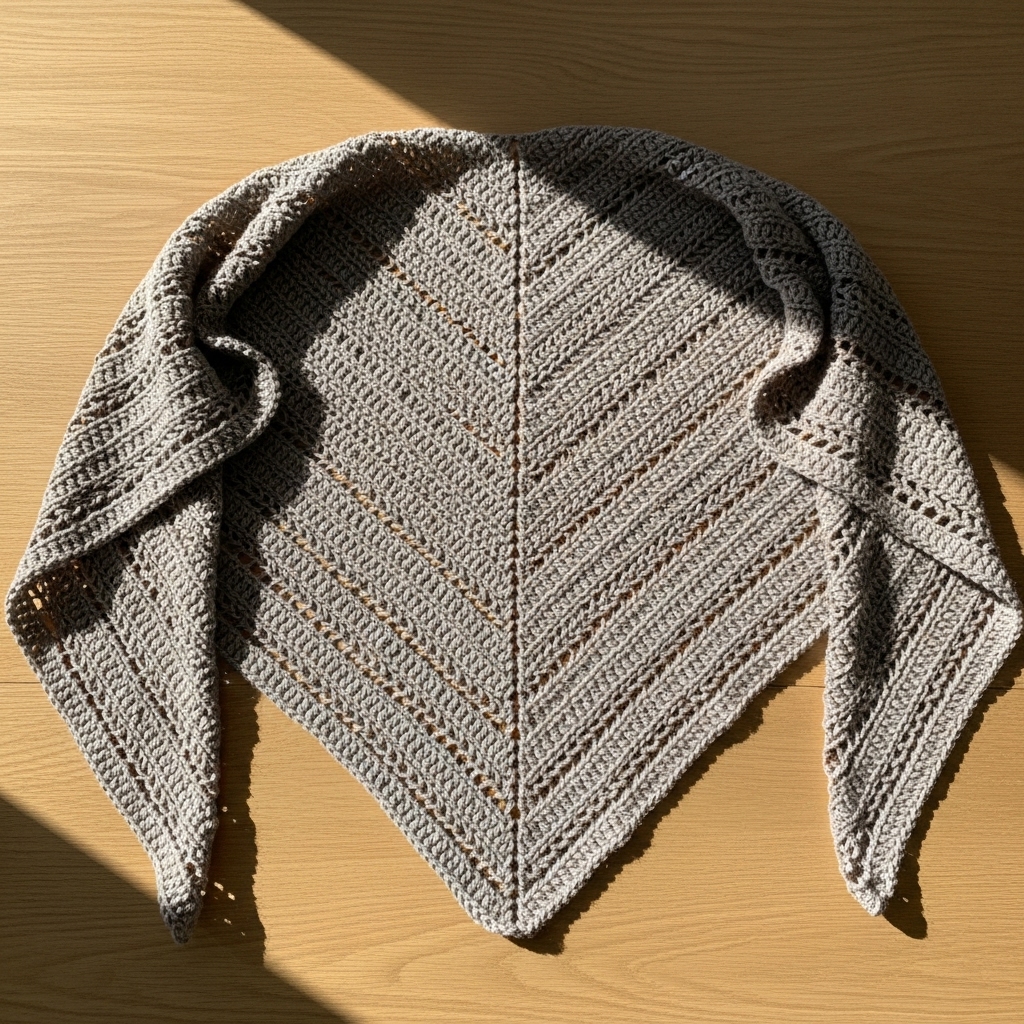
Overview & mood: Open, modern triangle using treble (tr) stitches for long vertical lines and excellent drape — looks contemporary in a neutral or single-color hand-dyed yarn.
Skill level: Beginner → confident beginner (long stitches and counting).
Materials & sample size
- Yarn: Fingering or DK (sample uses fingering for elongated drape), 450–900 yds by final size.
- Hook: 4.0 mm (adjust smaller for tighter fabric or larger for more drape).
- Finished sample (medium): wingspan ≈ 60 in; depth ≈ 26 in.
Stitch character: Treble stitches give tall stitches and an airy fabric. Combine with chain mesh rows for an open ladder effect.
Construction — top-down triangular increase (center chain start)
Foundation: ch 2, tr in 2nd ch from hook (or MR with ch-3). Many crocheters prefer to start with ch 4, tr in 4th ch to create a small starting point. Each row increases by adding chains or extra tr at the ends.
Core repeat (two-row unit):
- Row A (solid treble row): ch 3 (counts as tr), tr in same st, tr across to end, at row end tr 2 in last st (increasing).
- Row B (open ladder row): ch 4 (or ch 3 depending on stitch height), sk 1, dc or sc in next or tr in next, ch 1, produce vertical ladder chain spaces that align beneath the taller treble stitches of Row A.
Working example (conceptual):
- Start: ch 4, 3 tr into 4th ch. Turn.
- Row 2: ch3, tr in same, tr across, tr2 in last to increase. Turn.
- Row 3: ch4, [working chain spaces and single/double crochets anchored to previous row tops to create the lace ladder]. Turn.
- Repeat Row 2 and Row 3 alternating until desired depth.
Shaping & increase note: Make sure you add two stitches per row (one at each end) to keep the triangle symmetrical. This is commonly done by working 2 tr into the first and last stitch of each solid row.
Variations & design notes
- Try working alternating rows of tr and dtr (double treble) for a vertical rib effect.
- Add a border of shell clusters in a contrast color for a modern frame.
Finishing & blocking
- Block by stretching chain-ladder rows slightly; the treble rows will relax into long verticals, creating an elegant drape. Use pins along the lower edge and across the wingspan to achieve a clean triangle.
Project ideas: minimalist everyday shawl, light layering piece for spring.
3. Crochet Everblue Shawl Pattern
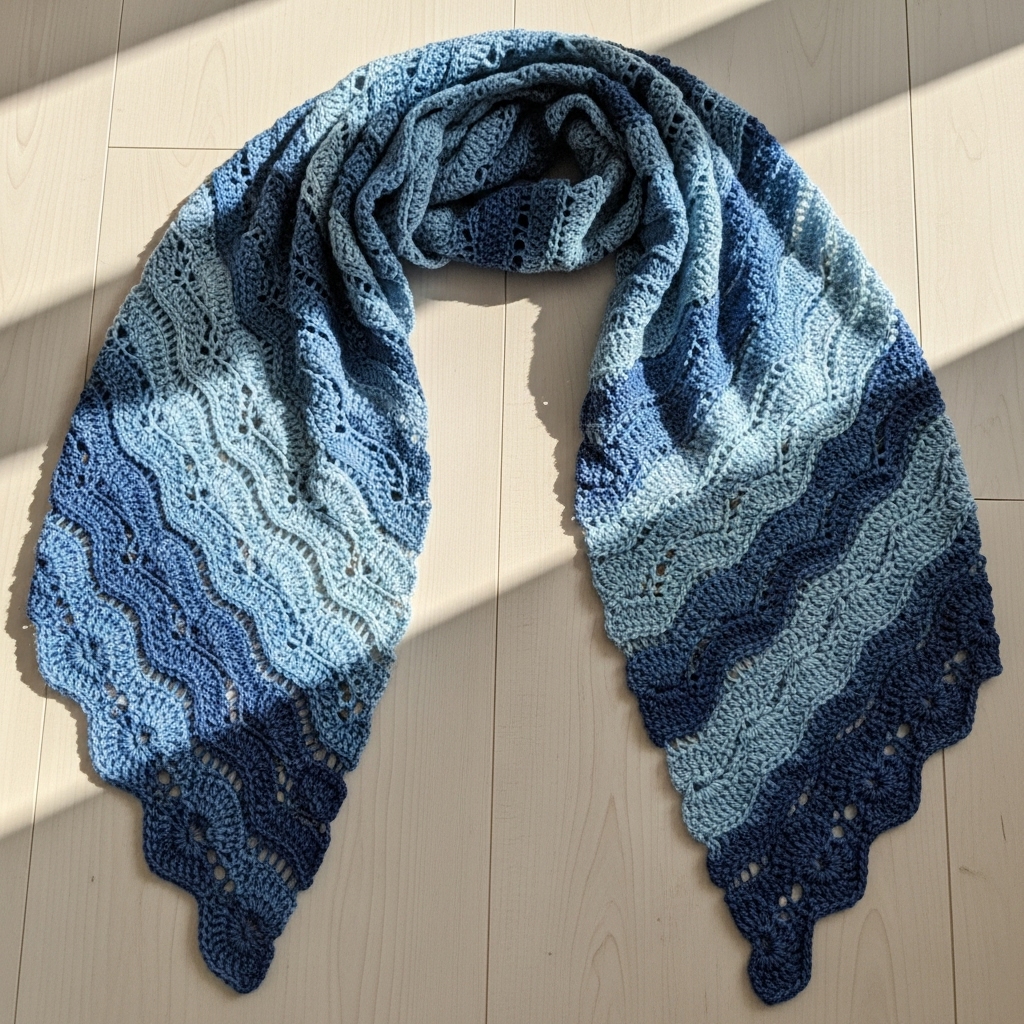
Overview & mood: An original-feeling, modern shawl inspired by watery gradients and textured stitches — “Everblue” blends small eyelets, wavy shells, and a flowing asymmetrical shape.
Skill level: Intermediate — stitch combinations and shaping for asymmetry.
Materials & sample size
- Yarn: Fingering- or sport-weight gradient or one main color + contrast (sample uses gradient 400–550 yds for medium).
- Hook: 4.0 mm (or match yarn for desired drape).
- Finished sample (asymmetrical crescent or elongated triangle): wingspan ≈ 64 in (measured long edge), depth ≈ 22–28 in at deepest point.
Shape & stitch character: Asymmetrical shawls are worked starting with a short row half-triangle or wedge and increasing on one side each row to build an elongated crescent. The Everblue uses shells and eyelets in alternating bands to simulate waves.
Construction — asymmetric top-down (one-side increases)
Foundation (short row or wedge): ch 4, turn, work a wedge of dc rows with increases on one side only to form the short starting triangle.
Repeat pattern (example band sequence):
- Band A (eyelet band): Row of dc/hdc with 1-2 chain spaces spaced evenly — creates subtle lace lines.
- Band B (wavy shell band): Row of shells worked into eyelet spaces to make waves.
- Band C (solid spacer): 2 rows of sc or hdc to provide weight.
Example sequence: Start with 4 rows of dc wedge to get a stable base. Then alternate: 3 rows eyelet, 4 rows shells, 2 rows solid — repeat entire sequence, working increases along one edge on each row (for crescent expansion). If you’d prefer triangular shawl, increase at both edges.
How to increase for asymmetry: On RS rows increase by working 2 sts at the outer edge whenever you want the shawl to grow faster on that side. For a gentle curvature, increase every other row; for dramatic sweep increase every row.
Color & gradient tips: Use a gradient cake or change colors every few bands to get the oceanic Everblue effect.
Variations & styling
- Make the shawl triangular by mirroring increases at both edges.
- Work additional picot or tassel fringe on the long edge for boho styling.
Finishing & blocking
- Because of bands of shell, blocking will open wave shapes beautifully. If using gradient yarn, block gently to avoid pooling of color.
Project ideas: statement wrap for an evening dress, cozy travel shawl.
4. Crochet Cherry Blossoms Shawl Pattern
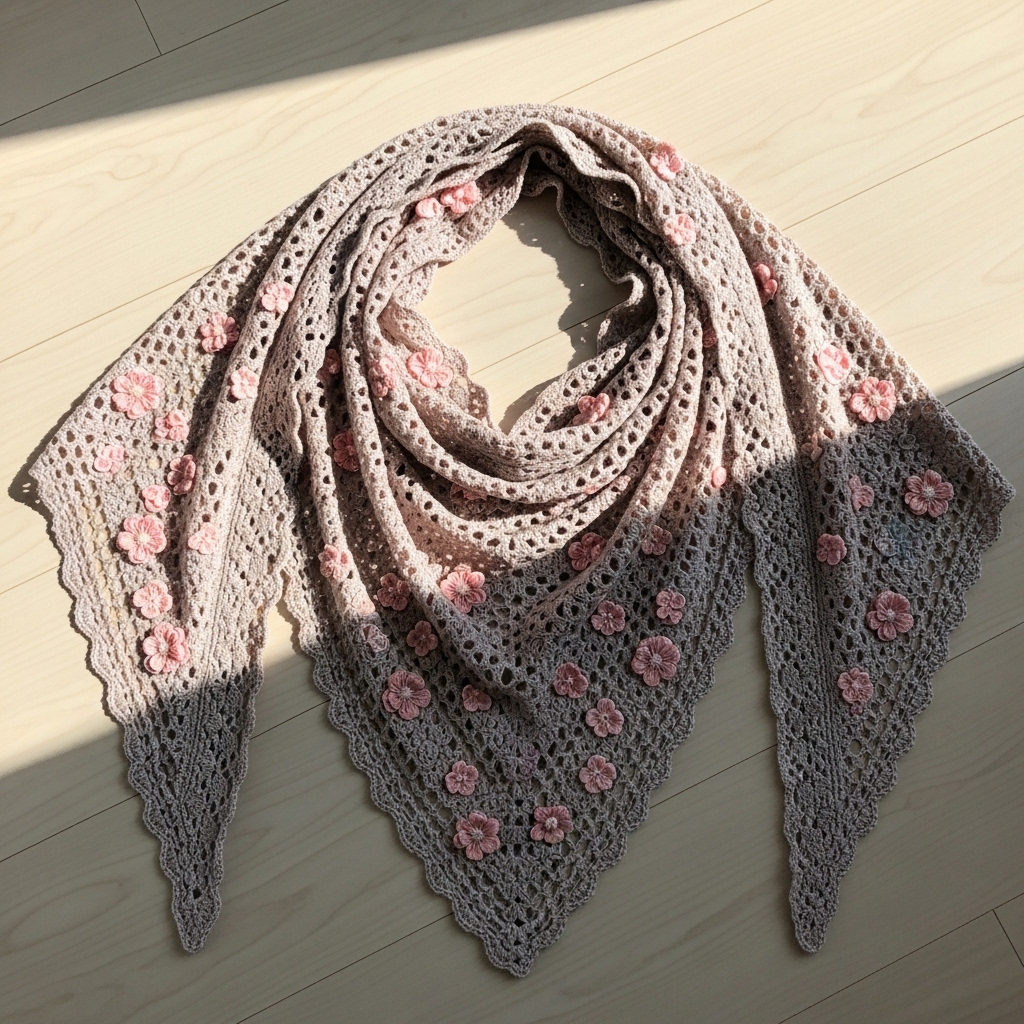
Overview & mood: A romantic lace shawl with scattered floral motifs — Cherry Blossoms uses small 3D or flat flower appliqués worked directly into or onto the fabric so the shawl reads like a garden.
Skill level: Intermediate — lacework plus applique attachment.
Materials & sample size
- Yarn: Fingering or lace weight for delicate lace, or DK for more statement blossoms. Choose a soft neutral for the ground and blush tones for blossoms. Sample yardage: 600–900 yds depending on size.
- Hook: 3.5–4.5 mm for lace; adjust to yarn.
- Finished sample (medium): wingspan ≈ 60 in; depth ≈ 24 in.
Stitch character: Open filigree ground (V-stitch or diamond mesh) with small cherry blossom motifs either worked on the fly as you crochet or made separately and sewn on.
Construction — triangular lace ground with worked or appliquéd flowers
Ground (diamond mesh or v-stitch): A pleasant, drapey ground comes from alternating rows of V-stitch and dc rows. For a top-down triangle, increase both sides of the triangle and maintain mesh grids that create diamond spaces for flower placement.
Simple mesh repeat (conceptual):
- Row A: ch 3, dc into next, ch 2, sk 2 — creates mesh spacing.
- Row B: v-stitch rows worked into chain spaces. Repeat and increase edges until desired size.
Flowers (tiny cherry blossom motif)
- Small blossom: MR, ch1, 6 sc in MR; R2: ch3, sl st in next sc around to make 6 loops; in each loop work (sc, hdc, dc, hdc, sc) = small petals. You can flatten or puff slightly. Make 12–30 blooms depending on desired scatter.
- Option: use a tiny 3-round pattern for layered blossom: center (6 sc), r2 small petals, r3 tiny picot edge.
Placement options:
- Sew flowers to the shawl at intersections of the diamond mesh for a natural scattered look. Tuck petals slightly under to avoid snagging.
- Alternatively, incorporate small floral clusters by replacing a mesh center with a petal cluster as you work, for on-the-fly flowers that are integrally attached.
Variations & design notes
- Make the flowers slightly raised by adding a small dot of batting or extra rounds under petals. For garments or frequent use choose flat appliqués and secure stitching.
- Use metallic thread for flower centers for a subtle twinkle.
Finishing & blocking
- Block the shawl into an open triangular shape; pin blossoms gently so petals are visible but not over-stretched. For mounted appliqués added after blocking, pin to decide layout then sew.
Project ideas: bridal or party shawl, feminine everyday wrap.
5. Crochet Tunisian Honeycomb Shawl Pattern
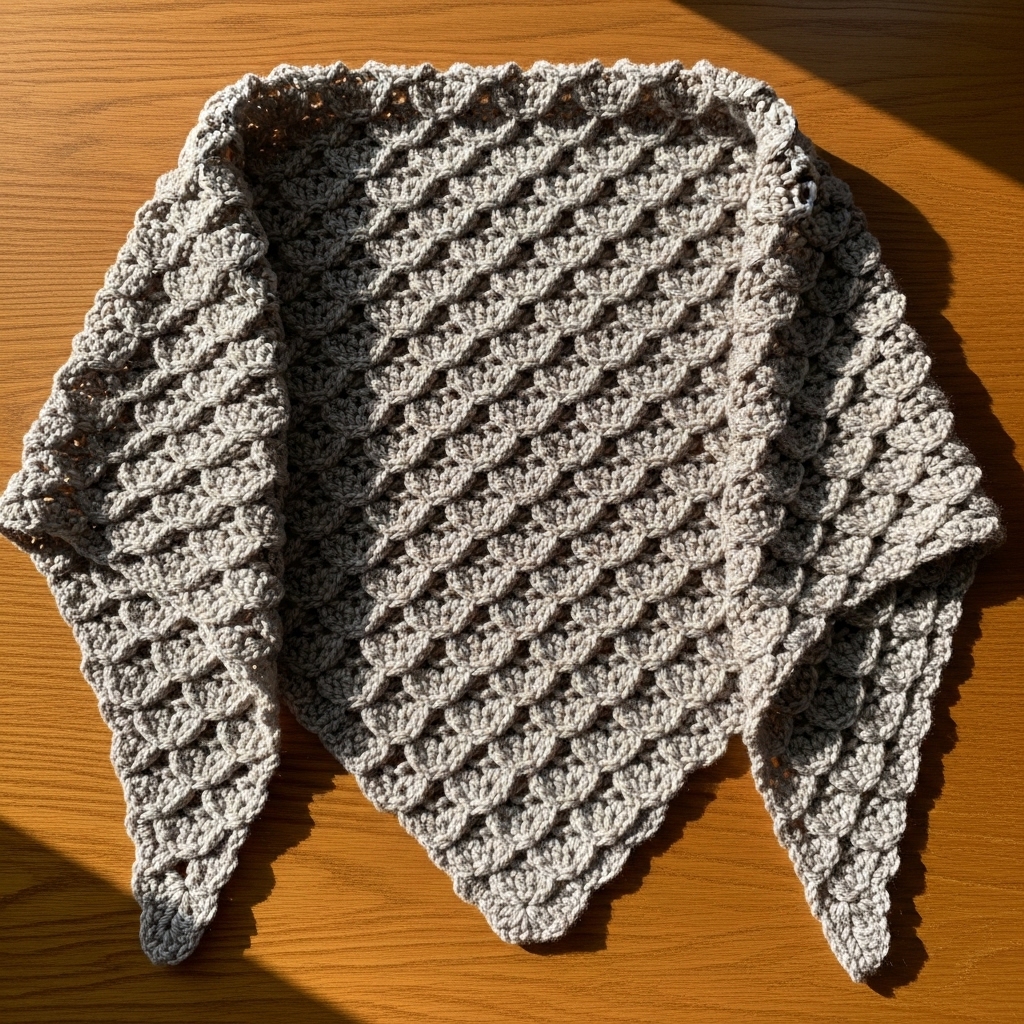
Overview & mood: A luxuriant Tunisian shawl featuring honeycomb texture. Tunisian work gives a fabric that is substantial yet flexible — honeycomb cells built from front- and back-post stitches create a dimensional surface.
Skill level: Intermediate — requires knowledge of Tunisian stitches and working on a long/cabled Tunisian hook.
Materials & sample size
- Yarn: Sport-weight to DK recommended for honeycomb clarity (sample uses DK).
- Tunisian hook: size per yarn label (5.5–6.5 mm typically).
- Finished sample (rectangular or triangular): a rectangular wrap approx 20 × 70 in or a triangular variant of similar complexity.
Stitch character: Honeycomb uses Tunisian front post and back post stitches arranged in offset columns so the cells appear. Because Tunisian stitches are worked on the forward pass and returned on the return pass, the pattern is built in vertical columns.
Construction — rectangular panel or triangular with tunisian increases
Panel approach (recommended for beginners with Tunisian): Work a long rectangular panel in the honeycomb stitch and finish edges with an angled cut or join two panels on bias to make a triangular shawl. This avoids complex diagonal increases in Tunisian.
Tunisian honeycomb repeat (conceptual):
- Forward pass: pick up loops across foundation using TSS/TKS per chosen pattern.
- Working rows: alternate between rows of front-post and back-post to create columns. For example, Row A: fpdc around next st, bpdc around next st repeat across to form columns. Row B: work through tops of previous posts in pattern to secure columns.
Triangular method (advanced): For a true triangular Tunisian shawl, you must increase on the forward pass by adding a chain at the beginning or picking up extra loops at one or both ends and maintain row counts consistently; this is advanced and requires careful counting.
Variation & texture tips
- Combine honeycomb panels with a lacy Tunisian border (Tunisian simple stitch with chain-spaces) to lighten the edges.
- Work honeycomb in alternating colors for a carved-effect look.
Finishing & blocking
- Tunisian fabric benefits from blocking to relax the post stitches. Pin the honeycomb slightly to open the cells and flatten panels before seaming or adding borders.
Project ideas: luxurious wrap, textured stole, heirloom gift.
6. Crochet Stormy Seas Shawl Pattern
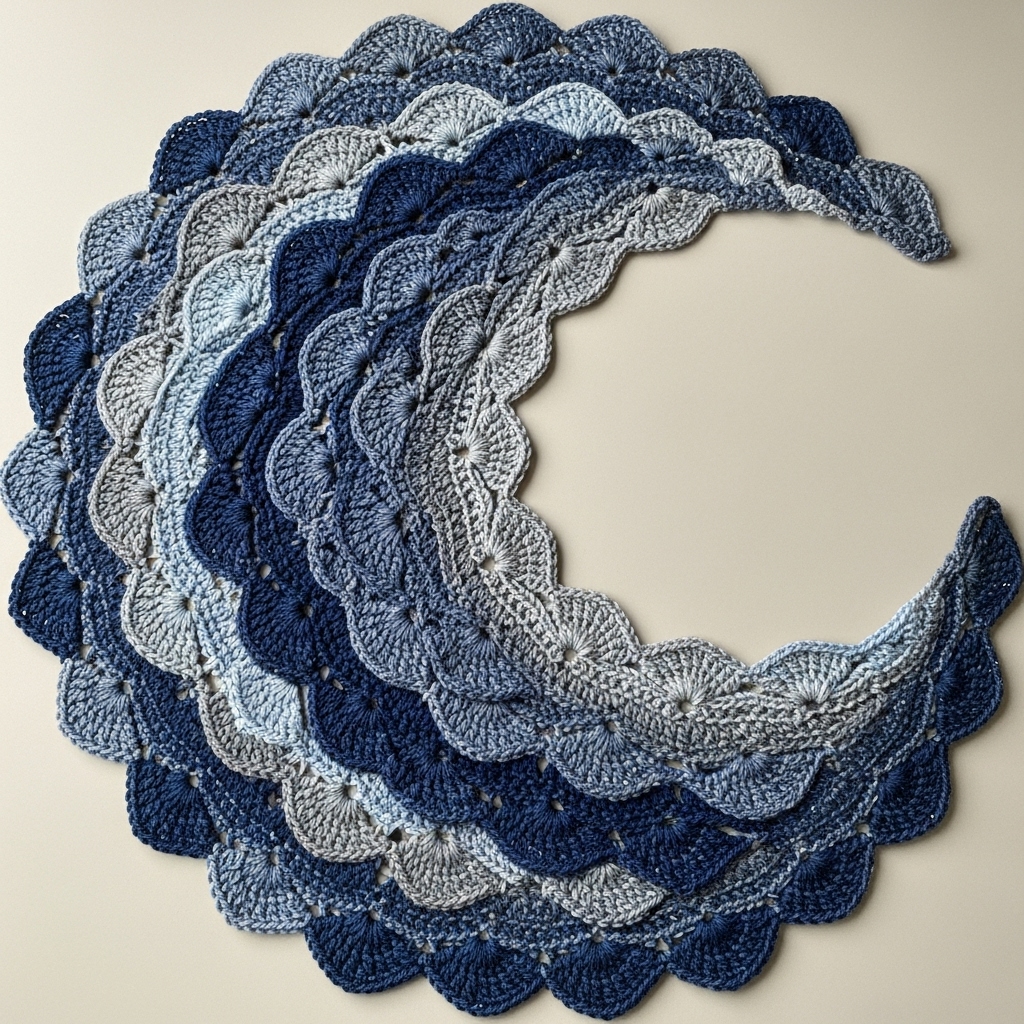
Overview & mood: Dramatic wavy shawl using alternating textured lines and eyelet bands to evoke stormy sea movement. Works beautifully in blue/gray tonal yarns with a bold crescent or triangular silhouette.
Skill level: Intermediate — stitch mixing and shaping.
Materials & sample size
- Yarn: Fingering to DK (sample uses gradient fingering), ~600–900 yds.
- Hook: 3.75–4.5 mm depending on yarn.
- Finished sample (crescent): long edge ≈ 72 in; depth ≈ 24–30 in.
Stitch character: The stormy effect is achieved with deep shell waves and staggered eyelet bands that create a sense of motion.
Construction — crescent or half-moon (short-row or side-increase)
Crescent method (short-row): Work from the center back downwards using short rows to build curvature; increases on one side create the crescent arc.
Band repeat (example):
- Wave row: large shells (7 dc) worked in offset columns to create cresting waves.
- Eyelet row: dc, ch3, sk2 repeated to create streaks of foam.
- Texture row: fpdc/bpdc columns for vertical ripple.
Short-row increase tip: To create the crescent: increase on the long edge only and work partial rows (short rows) across the center to shape the curve. Another common technique is to work a long triangle and then do short-row shaping across the spine to make it crescent.
Variations & color
- Emphasize movement with tonal gradient cake yarn or two contrasting blues.
- Add eyelash or metallic strand for a shimmering wave crest.
Finishing & blocking
- Block in a crescent arc and use many pins to shape the wave peaks for a dramatic blocked silhouette.
Project ideas: theatrical accessory for evening wear, beach cover-up.
7. Crochet Golden Harvest Shawl Pattern
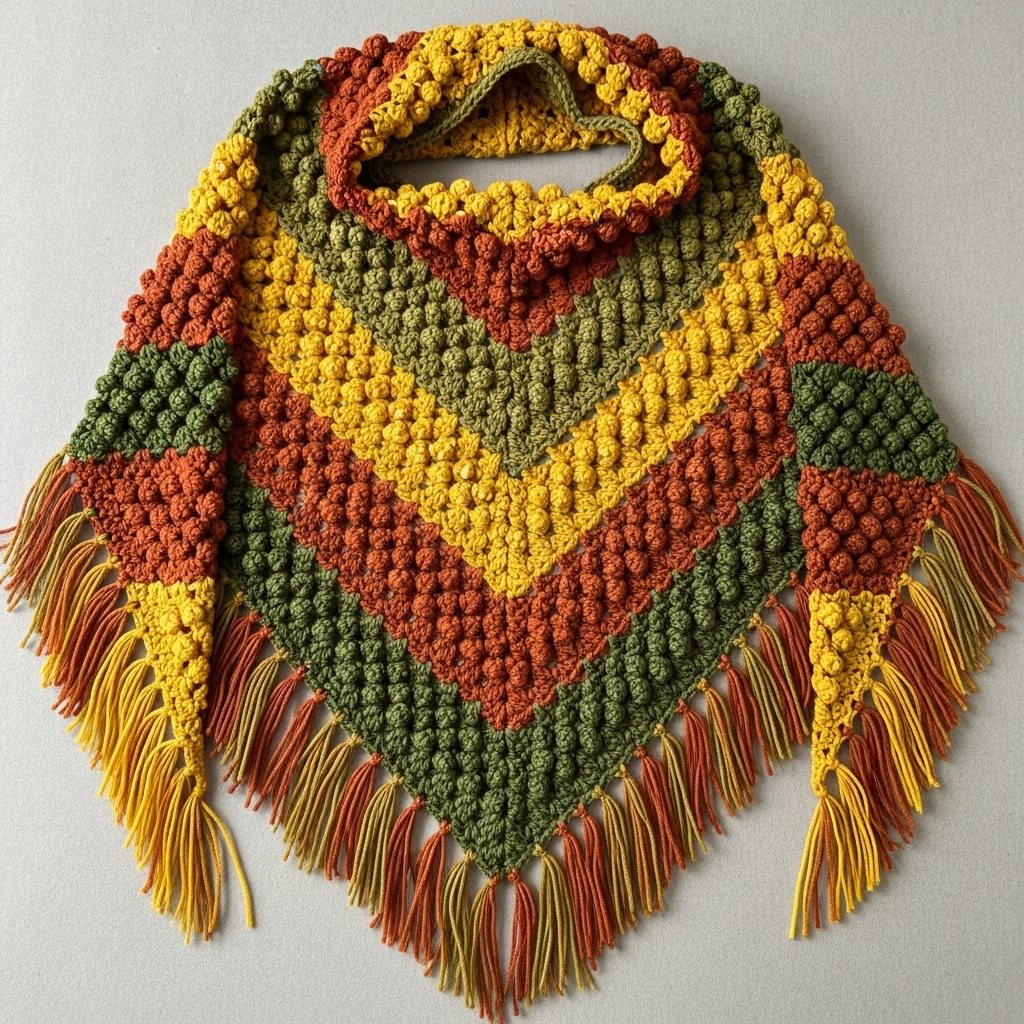
Overview & mood: Autumnal, textured shawl inspired by grain and harvest — uses popcorn, bobble, and seed-stitch panels for a tactile, cozy wrap in warm golds, rusts, and olive greens.
Skill level: Intermediate (bobbles and texture management).
Materials & sample size
- Yarn: DK to worsted (sample uses DK in a triad of harvest colors), 700–1100 yds depending on size.
- Hook: 4.5–5.5 mm.
- Finished sample (wrap): wingspan ≈ 68 in; depth ≈ 26 in.
Stitch character: Popcorns and bobbles give three-dimensional texture, balanced by seed or moss-stitch bands for stability.
Construction — triangular, bottom-up or top-down
Top-down triangle with textural bands: Start with a small top V and widen by adding textured bands. Alternate bands of seed stitch (moss stitch), bobble bands, and open lacy strips to balance density and drape.
Example band sequence:
- 6 rows seed stitch (stable)
- 4 rows bobble/popcorn band (accent)
- 3 rows lacy mesh (breathing room)
- Repeat, changing color every 2–3 bands for harvest palette.
Bobble/popcorn instruction (example):
- Popcorn: work 5 dc in same stitch, remove hook, insert hook into first dc of the 5, put loop back and sl st to close pop = creates popcorn bump. Or use bobbles (5 dc together on hook) depending on preference.
Variations & finishing
- Work the popcorn bands in a single accent color for dramatic effect.
- Add a wide woven fringe in complementary colors for harvest movement.
Blocking & care
- Block gently to flatten seed bands and allow popcorns to sit properly. Fringe should be weighted and trimmed post-blocking.
Project ideas: autumn wrap, gift for someone who loves texture and warmth.
Final finishing: edging, blocking, and care for shawls
- Edging options: Single crochet round (neat), shell scallop (feminine), picot (delicate points), or a crocheted lace trim. Choose an edge that complements your stitch scale.
- Blocking: Always block shawls that include lace or textured stitches. Wet-block natural fibers and steam-block synthetics according to yarn instructions. For triangular shawls, pin the top edge straight along a line and then fan out points along the lower edge for a scalloped finish. Use rust-proof pins and blocking wires for long edges.
- Lining & use: Shawls rarely need lining. If making a heavy Tunisian or honeycomb shawl and you want a softer inside, consider a lightweight fabric backing but test for breathability.
- Care: Follow yarn-specific care instructions. Generally, hand-wash delicate shawls and lay flat to shape. Machine-washable yarns can go in a mesh bag on delicates.
Conclusion
These seven shawl designs — Shells, Treble Stitch Triangle, Everblue, Cherry Blossoms, Tunisian Honeycomb, Stormy Seas, and Golden Harvest — cover a wide stylistic range: from sheer and modern to richly textured and cozy. Each pattern can be scaled, recolored, or hybridized (for example, use honeycomb panels with shell scallops, or scatter cherry-blossom appliqués across a treble-stitch base) so your finished piece is unmistakably yours.