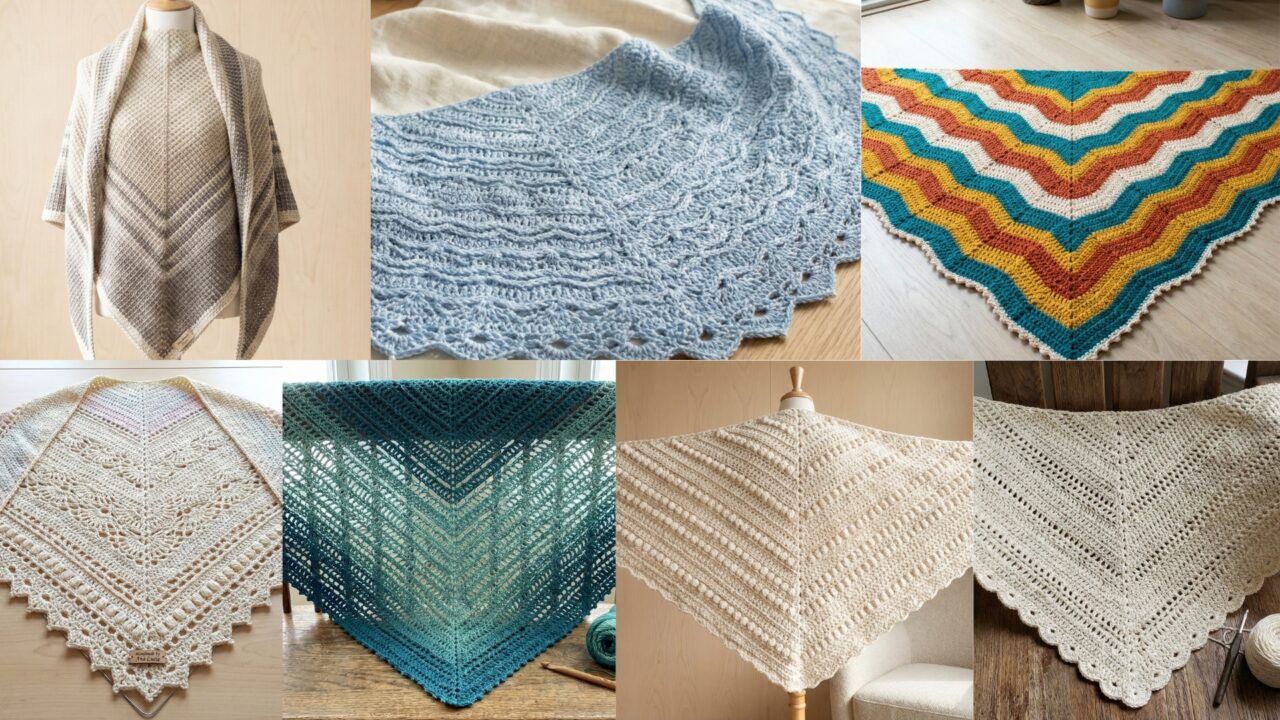
A crochet shawl is one of the most versatile handmade garments: it can be a breezy wrap for summer evenings, a dramatic lace for special occasions, or a warm triangular shawl you’ll reach for all winter. Shawls let you practice interesting stitches while making something instantly useful. Because they’re worn, gauge and drape matter — but shawls are forgiving: small adjustments to hook or yarn give noticeably different results, and that’s part of the fun.
Yarn & hook choices (quick guide)
- Fingering / Sport weight yarn (and 3.0–4.0 mm hooks) → delicate, lacy shawls; great for spring/summer or bridal.
- DK / Light worsted (4.0–5.0 mm hooks) → everyday lightweight wraps with structure and drape.
- Worsted / Aran / Bulky (5.5–8.0 mm hooks) → warm, cozy triangle shawls and heavily textured statement pieces.
- Fiber choices: wool & wool blends = warmth + blocking ability; cotton = crisp stitch definition (less elasticity); silk/linen blends = drape and sheen.
Short sizing & finishing primer
Decide the shape (triangle, crescent, rectangular) and a target measurement. For a triangle shawl we often set the final wingspan (across the top) and depth (center front vertical).
Common target sizes:
- Small shawlette / scarf: wingspan ≈ 40 in, depth ≈ 15–18 in
- Medium everyday shawl: wingspan ≈ 56–64 in, depth ≈ 22–26 in
- Large wrap: wingspan ≈ 72–84 in, depth ≈ 28–34 in
Swatch & math (worked example)
- Make a 4″ × 4″ swatch in your chosen stitch and block it the same way you will block the finished shawl. Measure stitches per inch (spi) and rows per inch (rpi).
- To convert a desired wingspan to stitches across a triangular top worked in edge-to-edge increases (typical triangle start at center and increases each row), the basic relationship is: each increase row adds a fixed number of stitches — but simplest for most top-down triangles is: stitch count at top = (number of stitches in last full row) which you determine by measuring as you go (try-on / measure across). A practical method is to set an increase rate and stop increasing when the wingspan measures what you want. Below, each pattern gives a sample gauge and a concrete step method so you can adapt without heavy math.
Important: I’ll include sample gauges and exact counts for a typical medium-sized shawl in each pattern so you can get started fast. If you want printable row-by-row counts for multiple sizes, tell me which pattern and which sizes (swatches vary).
1. Crochet Blue Belle Shawl Pattern
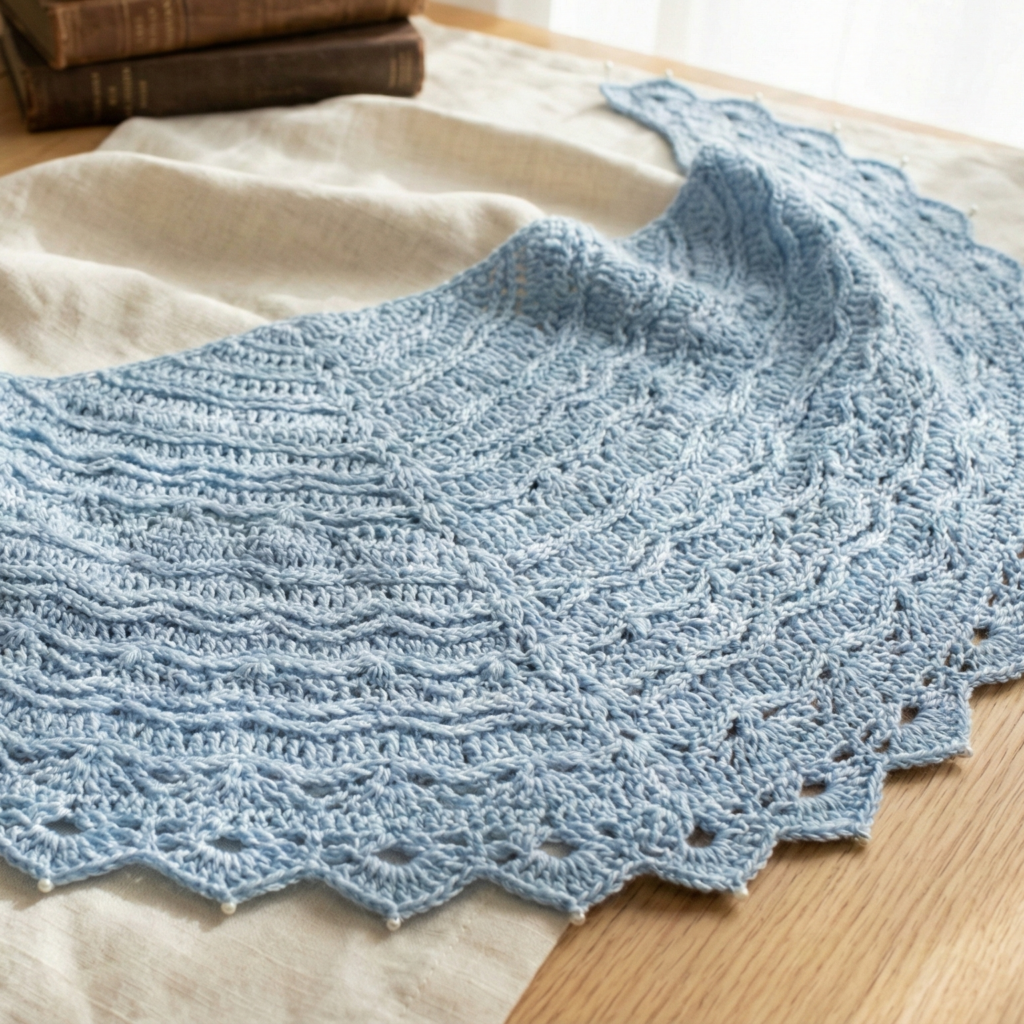
Style & shape: Elegant crescent shawl with lacy scalloped edging and gentle crescent shaping that hugs shoulders.
Skill level: Intermediate (lace, increases, short rows for crescent shaping).
Materials (sample medium crescent):
- Fingering or sport weight yarn (approx 600–800 yards).
- Hooks: 3.5 mm (main) and 3.25 mm (for edging if you want tighter finish).
- Notions: stitch markers, tapestry needle, blocking pins.
Sample gauge (in lace pattern, blocked): 6 sts × 8 rows = 1 in (spi = 6 sts/in, rpi = 8 rows/in) — do a swatch!
Finished size (sample medium): wingspan ≈ 62 in, center depth ≈ 24 in.
Concept
A crescent shawl typically uses short rows or a center-back increase method so the top edge is long and slightly curved. The Blue Belle uses a repeating lace motif in the body and finishes with a scalloped shell border.
Stitch multiple
Body repeat is multiple of 8 + 3 (edge stitches included). I’ll show how to adapt.
Step-by-step
Foundation (light short-row crescent start)
- Chain 7 (this gives a small central base) or start with a small starting row: ch 3, dc in first ch to form a small base. The Blue Belle begins with a narrow center and grows outward with short rows to achieve the crescent curve.
- Row 1 (RS): sc in 2nd ch from hook, sc across to end; turn. Mark center point if you prefer symmetry.
Main lace motif (example 8-row repeat)
3. Lace repeat (worked across each row; show one 8-row block):
- Row A: ch3 (counts as dc), ch2, skip 2, dc in next, repeat to last st, dc in last.
- Row B: ch2, dc in ch2 sp, ch1, dc in same sp (V-stitch), repeat.
- Row C: a row of anchored sc/chain to stabilize.
- Rows D–H: repeat V-stitch and shell/puff combinations to create waves.
(Full row-by-row text would be translated into final pattern PDF; here we focus on concept and progression.)
Short-row shaping for crescent
4. Work pattern across most of the row, then turn early (wrap & turn) leaving a small gap near one edge; on reverse row, work across slightly fewer stitches. Each pair of short rows increases depth on one side and forms the crescent. Continue increasing by a defined number of stitches per short-row “bank” — e.g., add 4–6 stitches every two rows on both edges to maintain curve.
Repeat
5. Continue repeating lace motif and short-row increases until center depth reaches target (sample: 24 in). Because rpi and gauge vary, measure as you go: convert target depth to rows with digit-by-digit example if rpi = 8 and target depth 24 in: 24 × 8 = (20 × 8) + (4 × 8) = 160 + 32 = 192 rows (but short rows and motif rows complicate direct row counting — measure physically).
Edging
6. After stopping increases, add one round of sc to tidy, then work 2–3 rounds of scalloped shell edging: (5 dc in same st, skip 2, sc) repeat to produce Blue Belle scallops.
Blocking
7. Wet-block strongly: pin the scallops open to emphasize shape and let dry. Crescent shape benefits from careful blocking to set curve.
Variations & tips
- For a lighter spring shawl use a mohair halo held with the main yarn for shimmer.
- For a larger wrap, use a heavier yarn and larger hook — adapt by sampling and measuring as you go.
Care
- Block gently for fibers like wool and silk blends; hand wash recommended for delicate fibers.
2. Crochet Easy Triangle Shawl Pattern
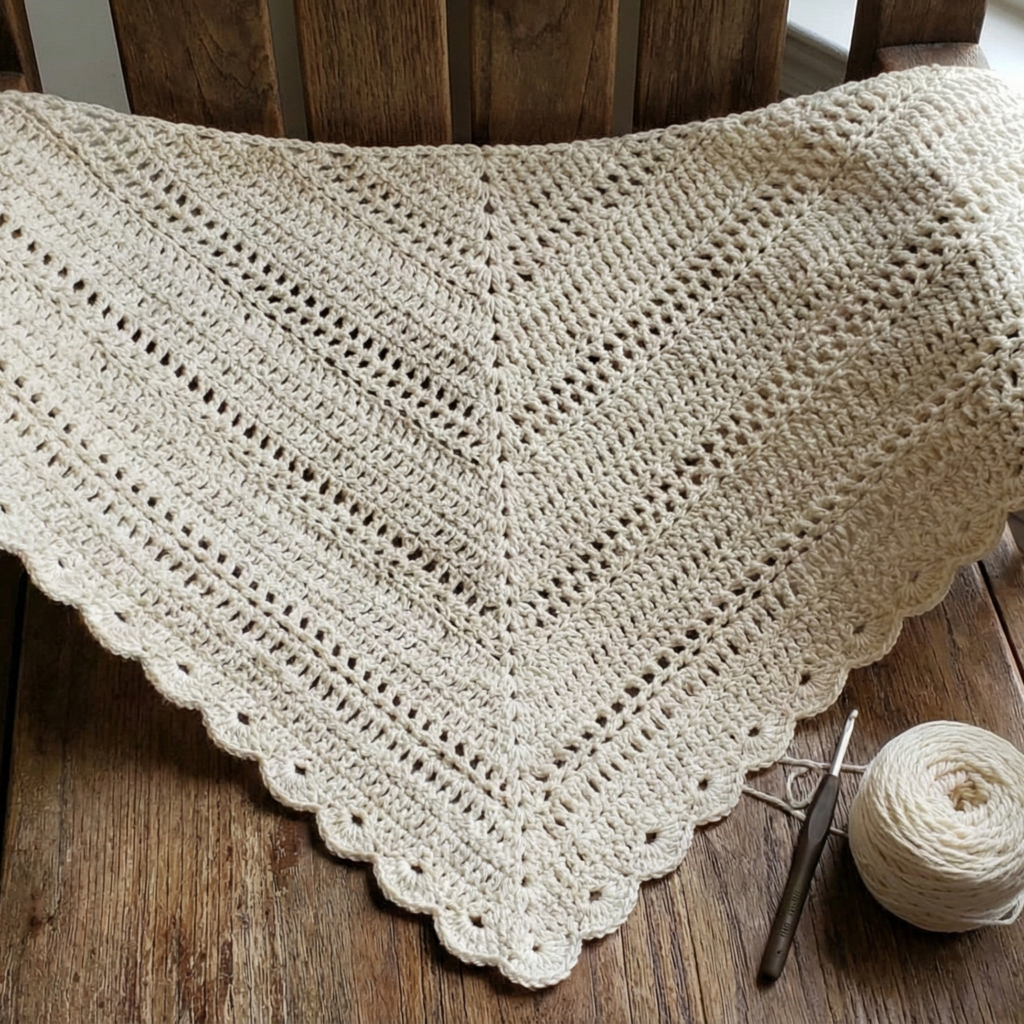
Style & shape: Classic equilateral triangle shawl, great for beginners — worked top-down from neck point or center-out for a symmetrical triangle.
Skill level: Beginner → Confident beginner (basic increases each side of center).
Materials (sample medium triangle):
- DK / Light worsted yarn ~700–900 yards.
- Hook: 4.0–5.0 mm depending on yarn.
- Notions: stitch markers.
Sample gauge: 5 sts × 7 rows = 1 in in the selected stitch (spi = 5).
Finished size (sample): wingspan ≈ 64 in, depth ≈ 28 in.
Concept
Top-down triangle method: start with a small central triangle at the neck and increase at two points (both edges) and optionally the center spine to produce a growing triangular shape.
Stitch multiple
If using a repeated stitch like (dc, ch1, dc) V-stitch, your foundation is simply the central triangle: ch 2, row 1 3 dc in 2nd ch, etc. No strict multiple required — main rule: increases at edges and center must be consistent.
Step-by-step (top-down classic)
Start
- Make a small triangle: ch 4, dc in 4th ch from hook to form a small base: maybe better to begin with a short foundation: row 1: 3 dc in the 3rd ch from hook (counts as small triangle).
- Row 2: ch3, turn, dc in first dc; ch1, dc in next dc across, add int increases at center: insert increase (2 dc, ch1, 2 dc) into center chain space.
General increase rule
3. Each right-side row add increases at both outer edges and in the center spine: after each row, you’ll have 2 more stitches (one per side) plus center seam increase if your motif uses one. Practically: at the end of each row: work pattern to center, make (2 dc, ch1, 2 dc) in center, continue to end, make agreed edge increase at last stitch*, turn.
Main body
4. Work your chosen stitch pattern (e.g., alternating rows of V-stitch and a textured sc round) across the triangle, increasing each row (or every other row for slower growth) until the wingspan reaches desired measurement. Measure as you go across the top edge.
Edging
5. Add an edging: a simple scallop of shell stitches or a lacy picot to give a feminine finish. Example shell: sc 2, 5 dc in next st, sc 2 repeat across.
Blocking
6. Pin the triangle open to required wingspan and depth, stretching evenly to match measurements.
Variations
- Work a denser textured triangle (herringbone, waffle) for warmth.
- Add long fringe for a boho effect.
Care
- Follows yarn care: wool may felt if agitated; block and hand-wash.
3. Crochet Ana Lucia Shawl Pattern
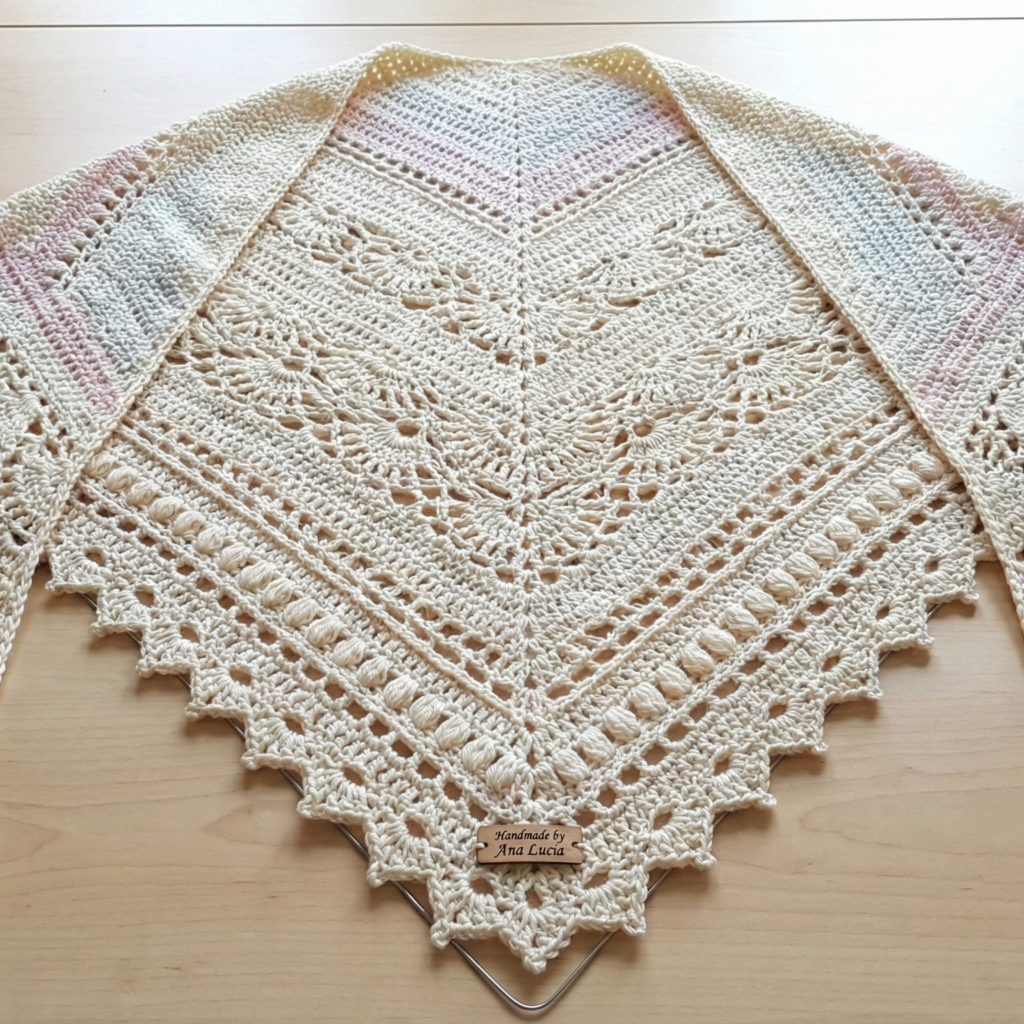
Style & shape: Rectangular-to-wedge shawl with alternating lacy motifs — named here for a romantic, feminine aesthetic with mid-weight yarn.
Skill level: Intermediate (multi-row lace panels and joining)
Materials (sample medium):
- Fingering held doubled or DK yarn ~900–1100 yards.
- Hooks: 3.5–4.5 mm.
- Notions: tapestry needle, blocking wires optional.
Sample gauge: 6 sts × 9 rows = 1 in in lace pattern.
Finished size (sample): width ≈ 64 in, height ≈ 24–28 in.
Concept
Ana Lucia is built from repeat panels: a central lace panel flanked by mirrored lace borders. This creates elegant vertical lines when worn. It is worked rectangularly with increases at the selvedge to widen.
Stitch multiple
Panels are multiples of 12 + 2 (per lace chart). I’ll present text equivalent.
Step-by-step
Foundation
- Chain foundation to form central panel base. For a medium shawl target width 64 in × spi 6 = 64 × 6 = (60 × 6) + (4 × 6) = 360 + 24 = 384 stitches. Because panel repeat is large and we build in panels, a practical method is to work center panel and then add mirrored borders until wingspan approximates your target — doing precise colossal stitch math is unusual for this complex pattern, so start by building length across then knit/measure.
Panel work
2. Central panel: work a 12-row lace chart repeat across rows: examples of rows include clusters of dc separated by chain spaces and small puff stitches to create texture. Repeat the 12-row block until desired height.
Add mirrored borders
3. At both ends add symmetrical lace border repeats, joining with single crochet to central panel or working in one piece if you planned wide foundation.
Edging
4. Finish with 1–2 rounds of sc to tidy and a scalloped or pointed lace edging (picots, shells).
Blocking
5. Strong block: this pattern benefits greatly from blocking wires to create long, clean points across edge.
Variations & notes
- Use gradient yarns for ombré panels.
- For a lighter summer version use linen blend yarn held single.
Care
- Hand wash for delicate fibers; block flat.
4. Crochet Tunisian Shawl Pattern
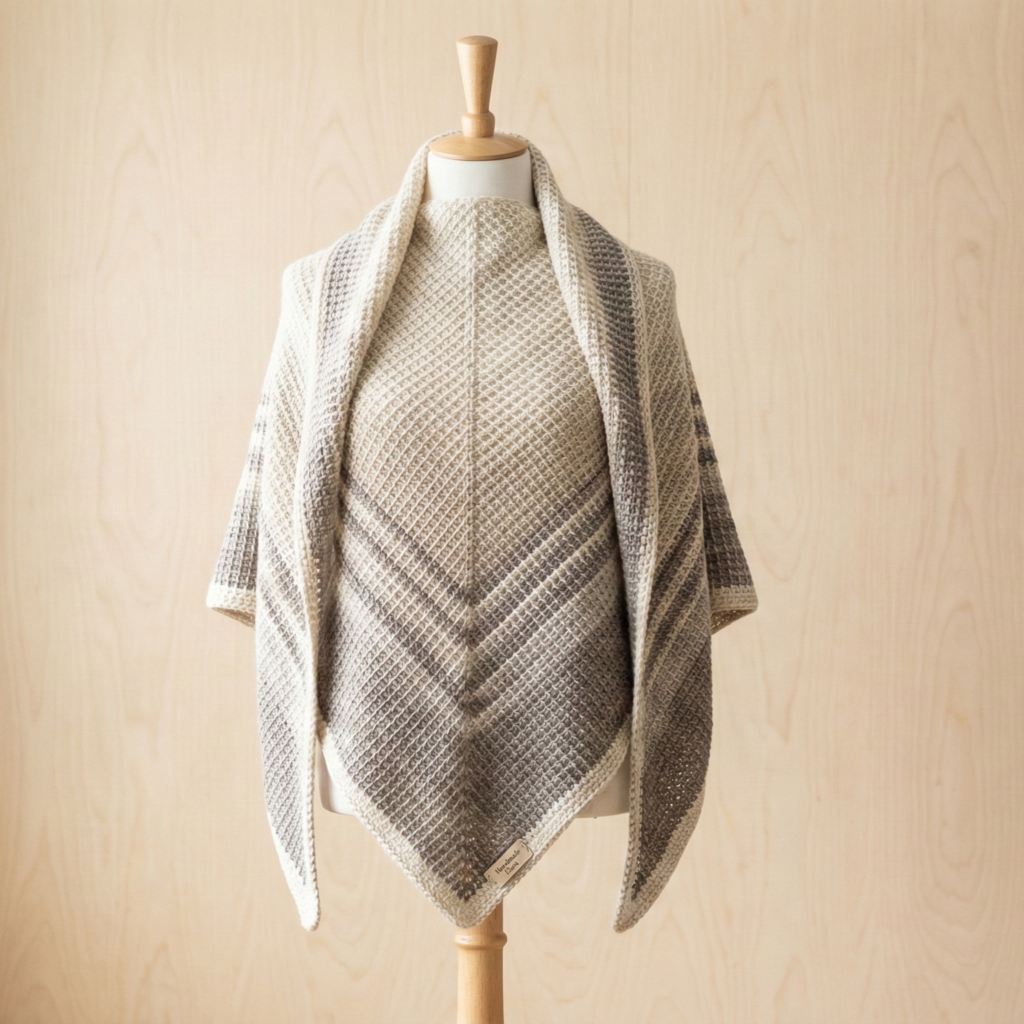
Style & shape: Warm, fabric-like shawl made with Tunisian (afghan) crochet texture — excellent for structured warmth and modern geometry.
Skill level: Intermediate (Tunisian techniques & returning rows)
Materials (sample medium):
- Aran / worsted or DK held double for denser fabric ~800–1100 yards.
- Tools: Tunisian crochet hook (length appropriate for wide stitches), cable or long hook 5.5–6.5 mm.
- Notions: yarn needle, blocking pins.
Sample gauge (Tunisian simple stitch – TSS): 6 TSS × 8 rows = 1 in (approx — depends on yarn & hook length).
Finished size (sample): wingspan ≈ 66 in, depth ≈ 24 in.
Concept
Tunisian crochet produces a woven fabric using a forward pass (pick up loops) and a return pass (work loops off). For shawls you can work narrow vertical panels joined, or a large rectangular piece that’s trimmed into a triangle. Here we give a classic rectangular Tunisian wrap that ends up shaped as a triangular shawl by folding/creasing or by working triangular increases in the pick-up loops.
Stitch multiple
Tunisian patterns often work in multiples of 2 or free counts. The TSS is easy: work even number of stitches across.
Step-by-step (rectangular panel folded into triangular wrap)
Foundation
- Chain foundation to match desired short edge width (e.g., if planning a final wingspan of 66” and you’ll fold into triangle, chain accordingly). In practice, many Tunisian shawls are worked as a long rectangle then blocked and folded.
Tunisian body
2. Work TSS repeats: forward pass — pick up loops across, return pass — work k1, p1 style across to return. Alternatively use Tunisian simple stitch (TSS) or half-Tunisian variations to create ribbings.
Panel shaping
3. Option A: Make a long rectangular panel (wingspan length across). Option B: Work triangular shaping by adding stitches at one end every second forward pass to create an angled edge (advanced).
Edging
4. Tunisian edges can be stiff; add a crocheted border: 2–3 rounds of sc or hdc in regular hook to soften edge and allow blocking.
Blocking
5. Block heavily; Tunisian fabric relaxes and gains drape after steaming.
Variations
- Use alternating textures on stripes: TSS then Tunisian knit stitch to create subtle rib.
- For modern geometry, use color-blocked stripes or hold two colors for marled look.
Care
- Check yarn label; wool may require hand wash.
5. Crochet Easy Chevron Shawl Pattern
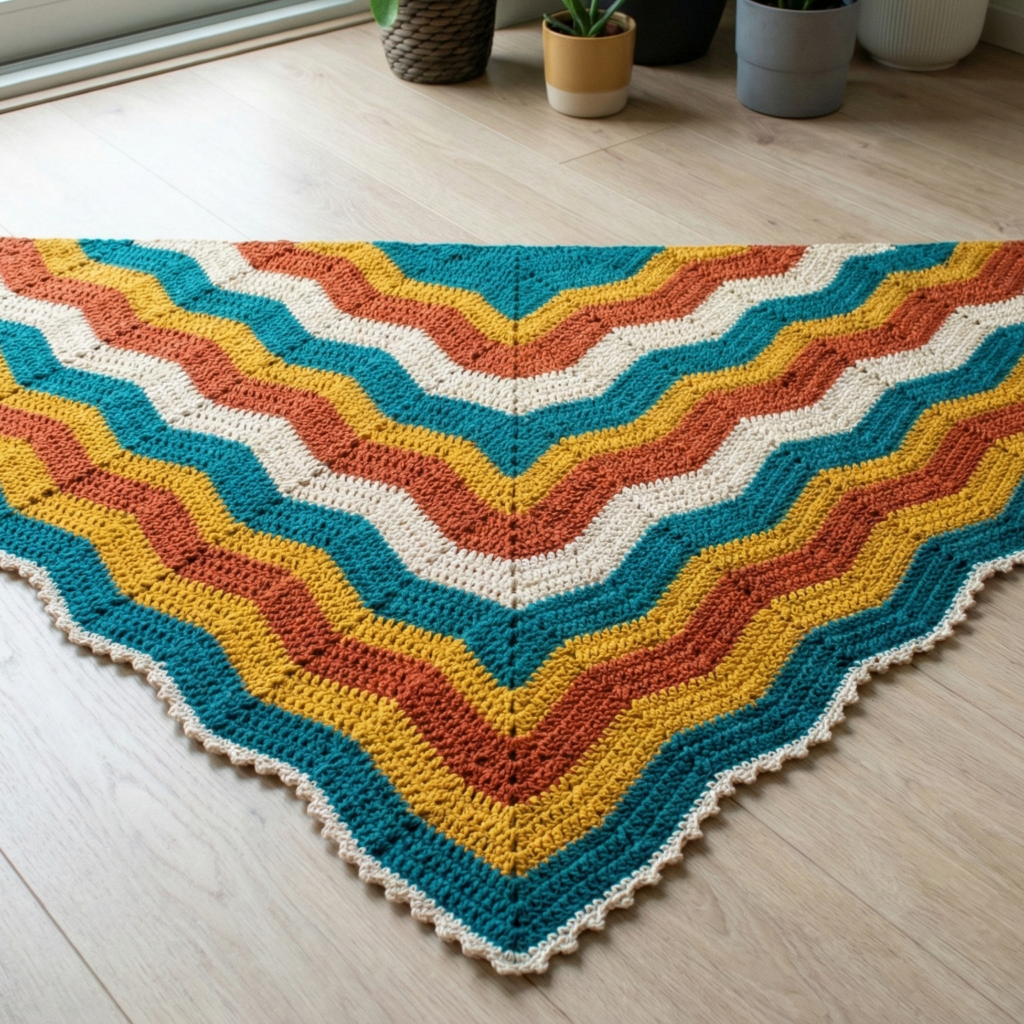
Style & shape: Triangle shawl with bold chevron stripes, great for showcasing color changes and textured chevrons.
Skill level: Confident beginner (repeat increases + decreases across rows)
Materials (sample):
- DK / worsted weight yarn 700–900 yards.
- Hook: 4.5–5.5 mm.
- Notions: stitch markers.
Sample gauge: 4.5 sts × 6 rows = 1 in in pattern.
Finished size (sample): wingspan ≈ 60 in, depth ≈ 26 in.
Concept
Chevron is a classic slip-stitch or V-stitch repeat where you increase at the peaks and decrease in the valleys to create zig-zags. Worked top-down as a center-out triangle or bottom-up as rows of peaks depends on your preference. We’ll present top-down center start.
Stitch multiple
Chevron classic repeat is multiple of 14 + 1 (example) — but simpler: you’ll create increases/decreases centered on a repeat. I’ll give a concrete 14-st repeat.
Step-by-step (center-top start)
Foundation
- Start with a small chain to form center point: ch 3, turn, work a few stitches to create a small base.
Chevron repeat (example 14-st repeat)
2. Row structure (RS rows): [dc in next 3, 2 dc in next 2 sts (peak increase), dc in next 6, dc2tog over next 2 (valley decrease), dc in next 1] repeat across. Center stitch forms center spine and get a 2-st increase each repeat for triangle growth.
Growth
3. On every right-side row you work full repeats with the increases at peaks and decreases at valleys so the piece grows evenly.
Stripe plan
4. Change color every N repeats (e.g., every 4 rows) for bold stripe chevrons.
Edging
5. Finish with a picot or shell to accent peaks: sc in next 2, shell in next st along top edge.
Blocking
6. Pin peaks and valleys straight to set chevrons.
Variations
- Make asymmetrical chevrons by shifting color boundaries.
- Add fringe at the bottom points for boho look.
Care
- Yarn dependent; block to set shape after washing.
6. Crochet Caron Textured Triangle Shawl Pattern

Style & shape: Textured triangle using plush yarn (the Caron-like texture reference denotes soft, squishy, textured yarn) — ideal for cold seasons.
Skill level: Confident beginner / intermediate (texture stitchwork)
Materials (sample):
- Bulky / chenille style yarn (Caron-type) ~500–700 yards.
- Hook: 6.0–8.0 mm depending on yarn.
- Notions: tapestry needle.
Sample gauge: 3.5 sts × 4 rows = 1 in (approx — chunky yarn needs swatch).
Finished size (sample): wingspan ≈ 64 in, depth ≈ 28 in.
Concept
Use a textured stitch (e.g., raised cluster stitch or staggered bobbles interspersed with dc rows) to create a soft, warm triangle that works up quickly in bulky yarn.
Stitch multiple
Pattern repeat we’ll use is multiple of 6 + 3.
Step-by-step
Start
- Start top-down with ch 3, row 1: 3 dc in 3rd ch from hook to make small center. Row 2: turn, 2 dc in first st, ch1, 2 dc in last; this forms central spine.
Textured repeat
2. Alternating rows:
- Row A: dc across with central increase (2 dc, ch1, 2 dc in center stitch).
- Row B (texture): sc in next 2, bobble in next (make small puff), sc in next 2 repeat across — bobbles offset every other row to create texture.
Growth
3. Continue until wingspan meets target — bulky yarn grows fast so watch measurement rather than count.
Edge
4. Finish with 2 rounds sc to stabilize and a larger shell round if desired for soft drape.
Blocking
5. Minimal blocking for chenille; reshape gently.
Variations
- Use a single color for cozy neutrals or stripes for visual interest.
Care
- Many chenille yarns are machine washable, but follow yarn label; avoid high heat.
7. Crochet Treble Stitch Triangle Shawl Pattern

Style & shape: Triangular shawl that uses treble (UK)/double-treble (US treble) stitches for tall, open rows — creates airy vertical ribs and dramatic drape.
Skill level: Beginner to confident beginner (long stitches, simple increases)
Materials (sample):
- DK or fingering held double for lofty drape ~700–900 yards.
- Hook: 5.0–6.5 mm (depends on yarn) to keep fabric open.
- Notions: stitch markers.
Sample gauge: 4 treble sts × 6 rows = 1 in (very open—swatch required).
Finished size (sample): wingspan ≈ 70 in, depth ≈ 30 in for a dramatic wrap.
Concept
Treble stitch rows make very open, long-stitch fabric. We’ll employ a top-down triangle with increases at the center spine and edges, working rows of treble with chain spacers to control openness.
Stitch multiple
No strict multiple; central increase rule required.
Step-by-step
Start
- Ch 3, work 3 treble into 3rd ch to establish small central group. Mark center.
Row pattern
2. Each right-side row: ch4 (counts as tr + ch1), turn, tr in next st, ch1 across until center, work (tr, ch1, tr) into center site for increase, continue to end finishing with tr. This increases the stitch count steadily.
Lacy options
3. For more open lace, replace some treble stitches with V-stitch groups (tr, ch1, tr) to create airy columns.
Length
4. Continue until depth reaches target. Because stitches are long, length grows quickly.
Edging
5. Work a tall scallop or picot to give a delicate, lofty finish.
Blocking
6. Block aggressively to stretch open long stitches and set drape.
Variations
- Add beads in center increases for a sparkle shawl.
- Work in gradient yarn for flowing vertical color.
Care
- Block wet and dry flat; long stitches can stretch — handle gently.
conclusion
Crochet shawls are deceptively simple projects that reward you with maximum wearability and creative expression. Whether you prefer the lacy romance of the Blue Belle, the approachable simplicity of the Easy Triangle, the refined panels of Ana Lucia, the warm structure of Tunisian, the graphic movement of Chevron, the plush comfort of the Caron textured triangle, or the airy drama of the Treble Stitch triangle — each pattern in this collection gives you a clear path to a finished piece you’ll actually wear.
Before you begin, pick the shawl that fits the season and the recipient: lightweight fingering and lace for spring and summer; DK or worsted for versatile year-round wraps; bulky yarns for quick, cozy winter shawls. Swatch first, measure as you go, and block carefully — shawls transform in blocking, and a little time with pins and steam will make lace sing and textured stitches sit beautifully.
If you’re gifting, include care instructions and a short note about the fiber you chose — recipients appreciate the practical details. And if you’re keeping the shawl, wear it often: shawls soften and grow more beautiful with use.