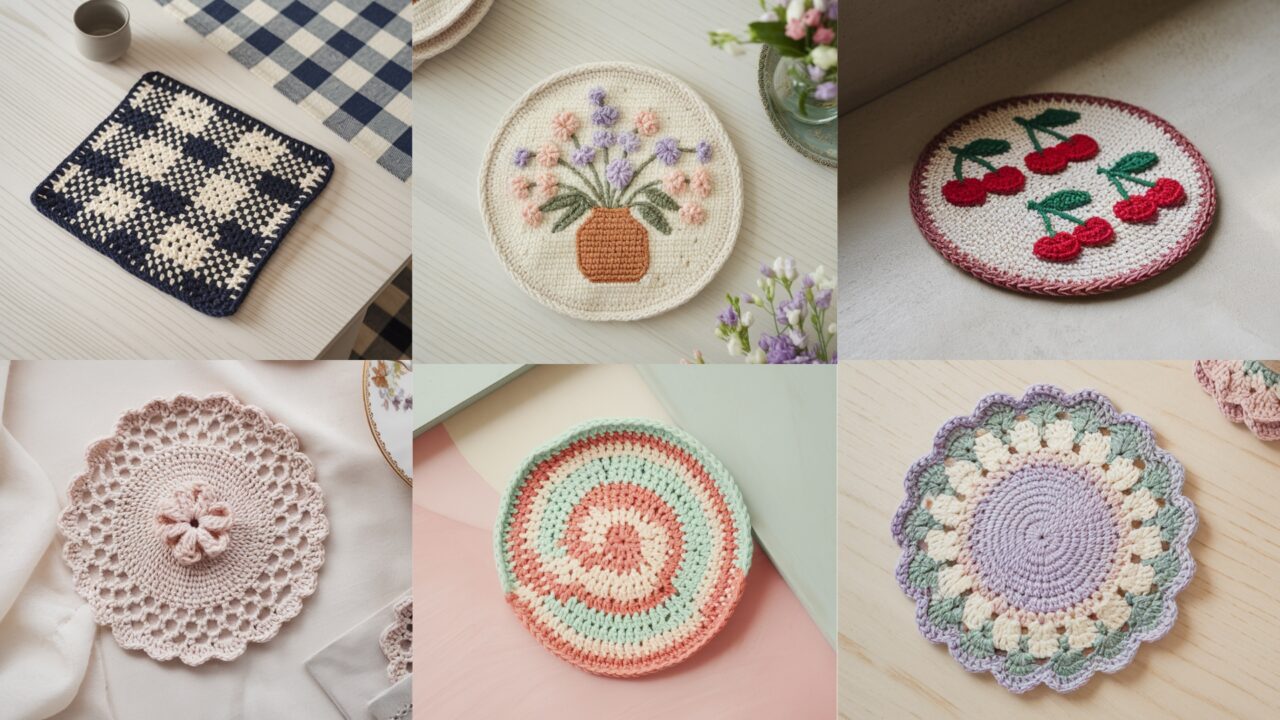
Crochet coasters are one of the most rewarding small projects: quick to make, forgiving on gauge, and highly useful around the home. This collection of six coaster patterns blends playful color, soft florals, graphic gingham, and charming fruit motifs so you can craft a whole set that suits your table setting — from casual brunches to afternoon tea. Each pattern below includes: an overview, skill level, suggested materials and finished size, a clear step-by-step construction guide, color palette suggestions, variations you can try, finishing & care tips, and styling ideas. Read the introduction, pick a pattern (or make them all), and enjoy making a set that’s cheerful and handmade.
Quick common notes (read first)
- US crochet terms are used throughout (ch, sc, hdc, dc, tr, sl st, st(s), inc, dec, MR = magic ring).
- Yarn choice: cotton or cotton-blend yarns are recommended for coasters because they’re absorbent and wash well. DK / sport weight gives a refined look; worsted weight gives a chunkier, more rustic coaster.
- Hook: choose the hook recommended on your yarn label, or go down a size for denser fabric. Coasters work best with a fairly tight gauge so water won’t soak through to the table.
- Finished sizes below are samples — adjust foundation chains or rounds to change size.
- Blocking: block coasters lightly after finishing to flatten and set shape.
- For heavy-use sets, consider lining with thin cork or felt glued to the underside to protect wood furniture.
1. Crochet Candy Swirl Coaster Pattern
Overview
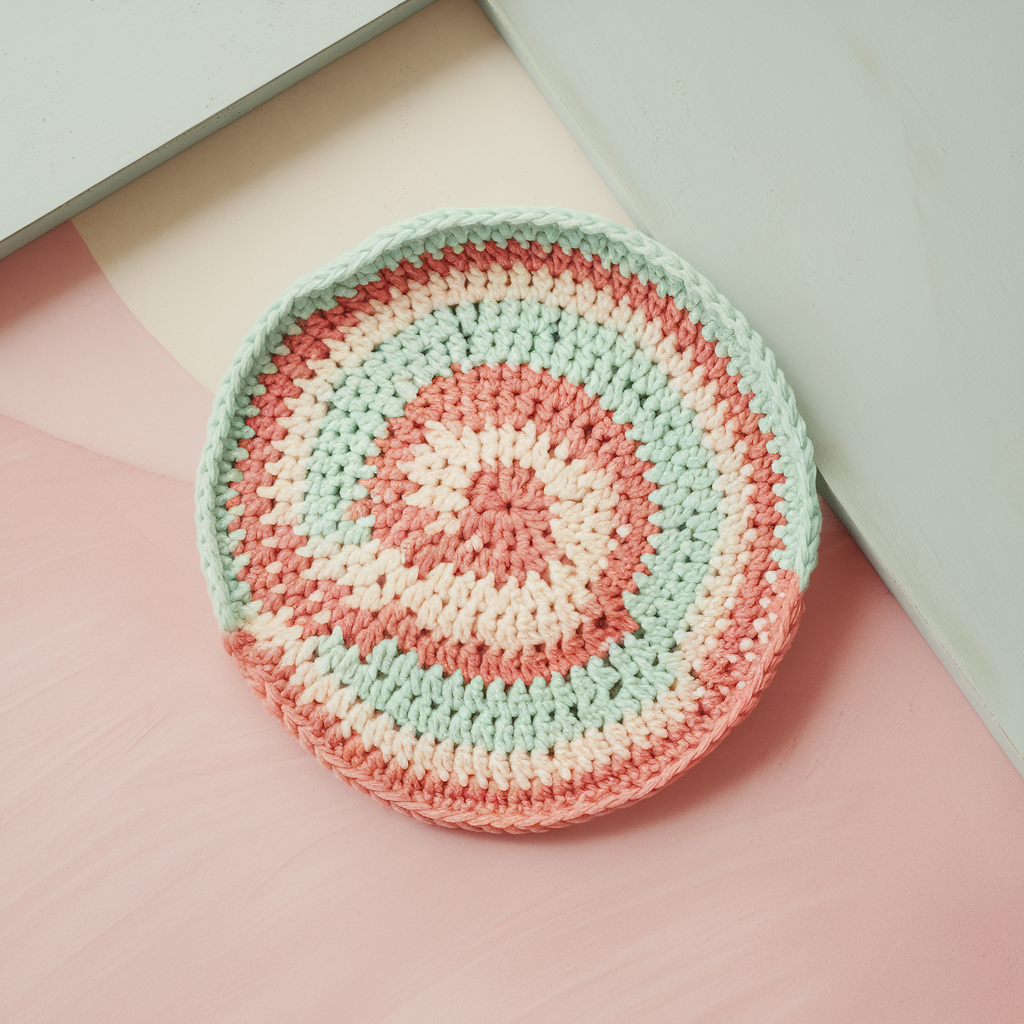
A playful, spiral-style coaster that reads like an old-fashioned candy swirl. This design uses color changes in concentric rounds to create a lively spiral motif; it’s cheerful, modern, and works beautifully in mixed-color sets.
Skill level
Beginner → confident beginner (basic rounds + color changes).
Materials & finished size
- Cotton DK or sport weight in 3–4 contrasting colors.
- Hook: 3.5 mm (adjust for yarn).
- Finished diameter: ~4.5 in (11.5 cm). Adjust by adding rounds.
Step-by-step guide
- Start with a magic ring in Color A. Work R1: 8–10 sc in MR; join with sl st. (8–10 sts)
- R2: Change to Color B — inc in each st (16–20 sts). Join.
- R3: Change to Color A — (sc in next st, inc) around to increase evenly (24–30 sts). Join.
- Continue working single crochet rounds, alternating colors in a planned sequence. To create a visible swirl rather than concentric bands, offset where you change color by slip-stitching forward one or two stitches before beginning the next color round so the colors curve.
- Increase evenly each round where needed to keep the coaster flat (e.g., add 6–8 increases per round depending on your stitch count). Keep an eye for cupping — if cup occurs, add increases sooner; if ruffle occurs, reduce increases.
- When the coaster reaches desired diameter, finish with a round of crab stitch or reverse single crochet for a tidy twisted edge. Fasten off and weave in ends.
Color palette suggestions
- Candy set: soft mint, pale pink, cream, and warm coral.
- Classic set: teal, mustard, cream.
- Muted set: dusty rose, sage, ivory.
Variations
- Work the spiral in half-double crochet for a taller, thicker coaster.
- Make matching mug mats by stopping earlier and adding a small central coaster for cups.
- Add a tiny outer scallop round for a lace-like edge.
Finishing & care
- Block flat on a towel while damp. For protection, glue a cork backing or sew on a felt circle. Machine wash in a laundry bag on gentle cycle; reshape and dry flat.
Styling tips
- Stack two contrasting spirals for layered table settings. Use bright candy swirls for outdoor summer parties.
2. Crochet Floral Elegance Coaster Pattern
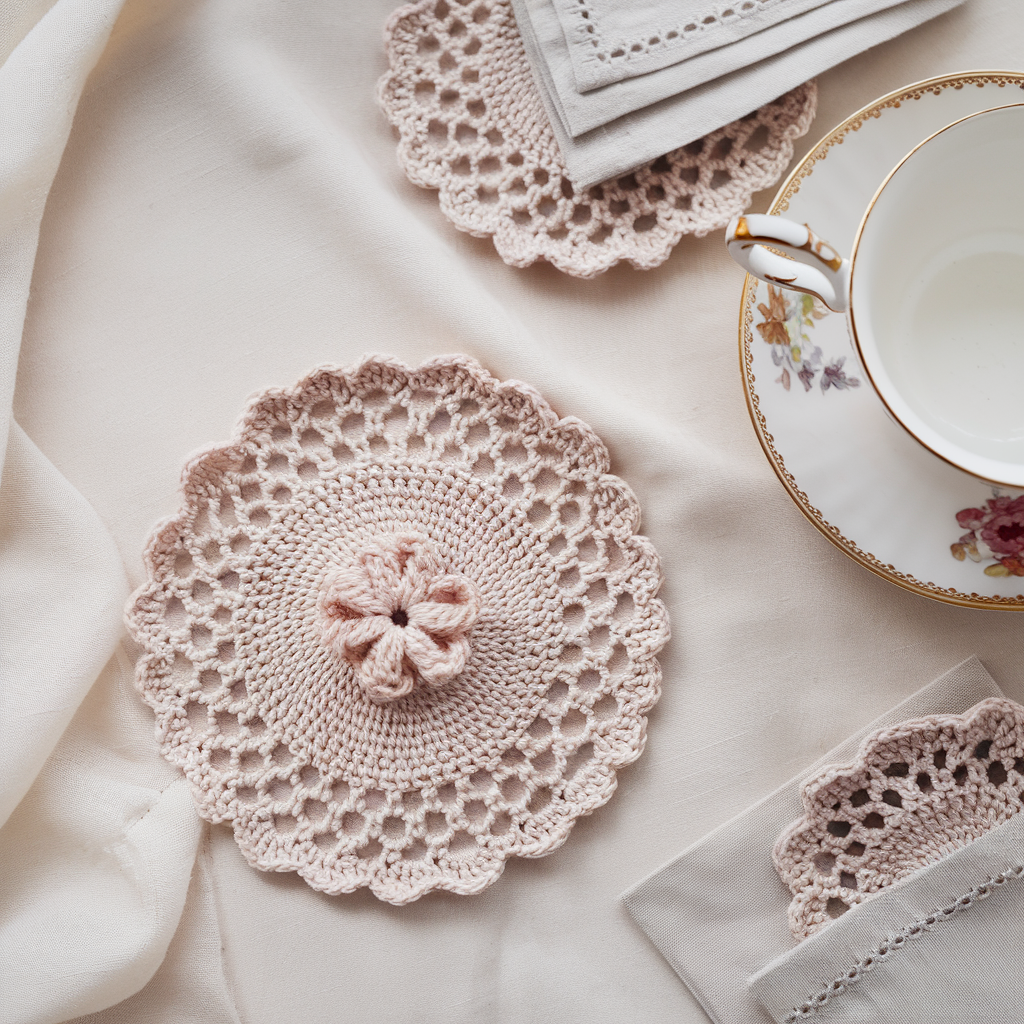
Overview
A refined, delicate coaster with a small floral medallion at the center and a lacy ring around it. This pattern reads elegant and feminine — perfect for tea trays and bridal showers.
Skill level
Intermediate (small motifs, joining, and lace rounds).
Materials & finished size
- DK cotton in a soft main color and a contrast for the floral center.
- Hook: 3.0–3.5 mm.
- Finished diameter: ~4–5 in (10–12.5 cm).
Step-by-step guide
- Crochet a small floral medallion: MR, small cluster rounds to form a 6-petal flower (e.g., MR, 6 sc; petal loops; fill petals with (sc, hdc, dc, hdc, sc) in each loop). Fasten off.
- Join the flower to a working round that forms a base — sc evenly around the flower to make a small disc.
- Work lacy rounds: alternate shell stitches and chain spaces to create an airy border (e.g., 3 dc, ch 3, sl st into next sp). Increase evenly so the border lies flat.
- Add 1–2 rounds of close single crochet to maintain a strong outer edge, then a decorative picot or scallop round for elegance. Fasten off and weave ends.
Color palette suggestions
- Cream center + dusty blush border.
- Ivory + sage green.
- Soft lavender + pearl.
Variations
- Use metallic thread for a single outer round to add a subtle sheen.
- Make a set with alternating floral centers and plain scallop coasters for variety.
Finishing & care
- Lightly block to open the lace. Consider a thin felt backing for cups that might condense. Hand wash recommended for lace; dry flat.
Styling tips
- Group three floral coasters in the center of a tea table. Pair with bone china and linen napkins for a delicate vignette.
3. Crochet Gingham Coaster Pattern
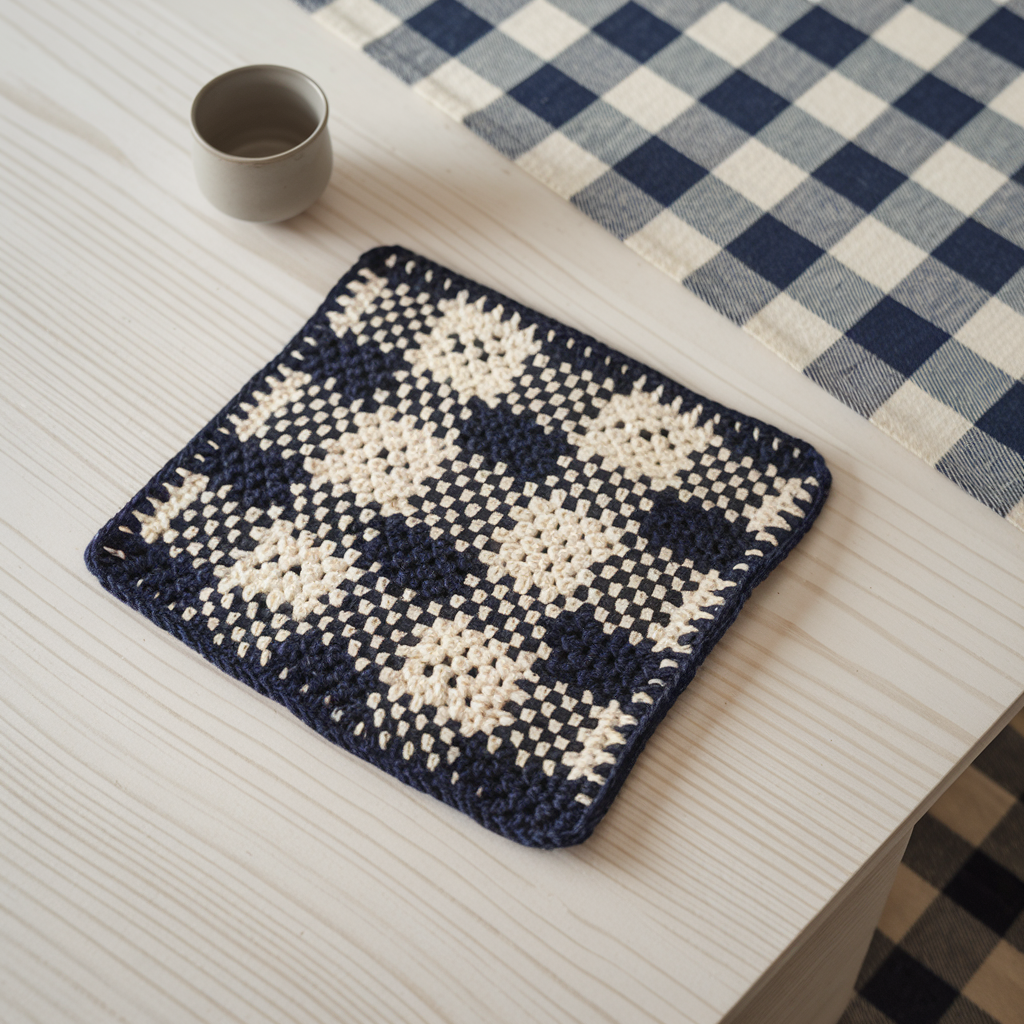
Overview
Graphic and homey, the gingham coaster uses tapestry or tapestry-like crochet colorwork to create the checked pattern reminiscent of classic gingham tablecloths. It’s bold, modern, and perfect for farmhouse or retro kitchens.
Skill level
Intermediate (color changes & carrying floats) — tapestry technique recommended.
Materials & finished size
- Cotton DK in two contrasting colors (e.g., cream + soft red or cream + navy).
- Hook: 3.5 mm or slightly smaller for crisp color edges.
- Finished size: ~4 in (10 cm) square or round (worked in square grid).
Step-by-step guide
- Plan a grid: decide how many stitches and rows form your check size (e.g., 20 sts = 4 in). Sketch a small 8×8 or 10×10 grid for four checks across.
- Use tapestry single crochet (sc into each stitch, carrying unused color along the top of the previous row, catching floats every 3–4 sts) to fill the grid following your chart. Keep even tension.
- Work rows until square is complete; optionally round corners with a small scallop row if you prefer a circular edge.
- Finish with a tidy border: 1–2 rounds of sc in a neutral color to frame the plaid.
Color palette suggestions
- Classic red + cream, navy + cream, olive + cream for muted modern gingham.
Variations
- Make placemat-sized versions by scaling the grid.
- Use variegated yarn for one color to create a soft, blended check effect.
Finishing & care
- Block gently for square edges. Tapestry pieces are sturdy and machine-washable on gentle; reshape while damp.
Styling tips
- Pair gingham coasters with matching napkins or a gingham runner for picnics or casual dining.
4. Crochet Flower Bouquet Coaster Pattern
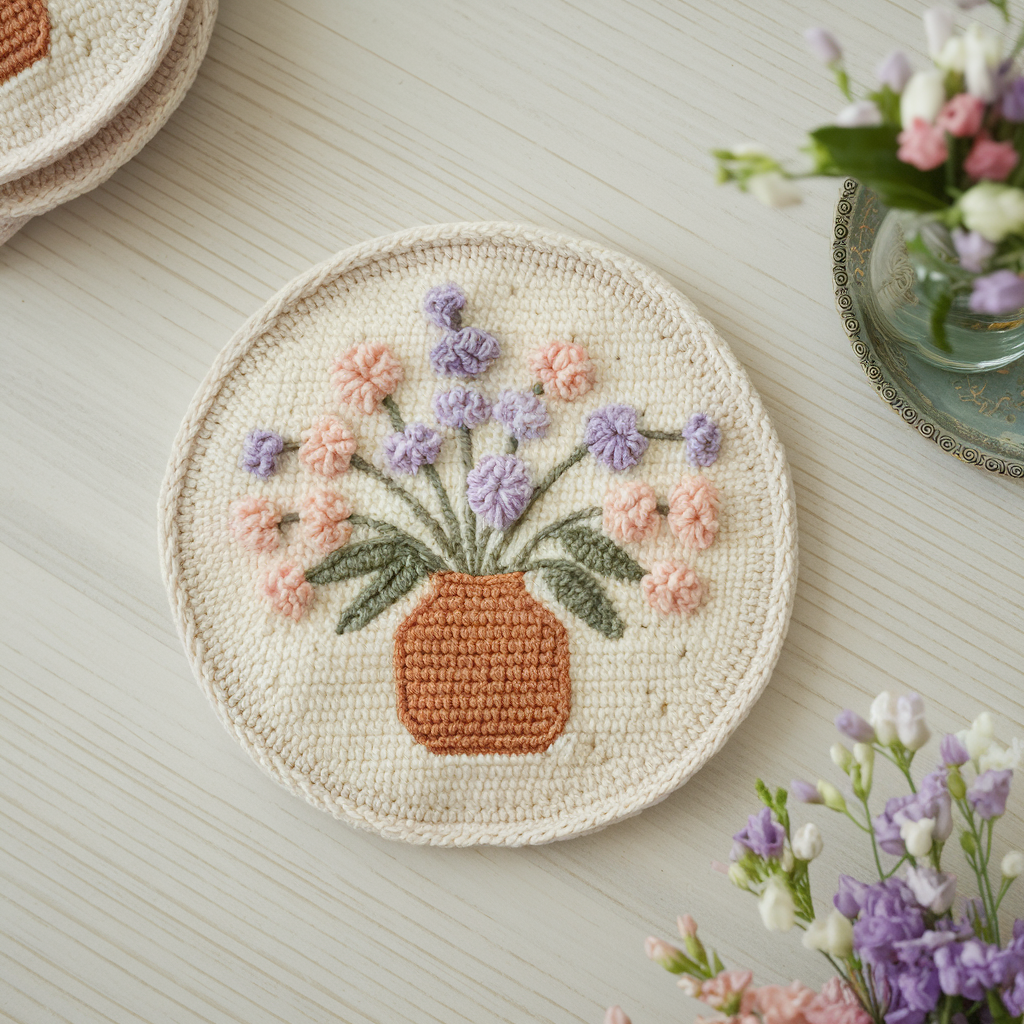
Overview
A small tapestry-style coaster that features a tiny bouquet — a central vase or ribbon with little flower sprigs arranged above. The design feels like a miniature still life and makes a lovely hostess gift.
Skill level
Intermediate (colorwork or appliqué; small motif assembly).
Materials & finished size
- Cotton DK in 3–5 colors for flowers, stems, and background.
- Hook: 3.0–3.5 mm.
- Finished diameter: ~4.5 in (11.5 cm).
Step-by-step guide
- Option A — tapestry method: map the bouquet on a small grid and use tapestry sc to crochet a flat disc with the bouquet motif embedded. Start from center or one edge and carry colors across rows, catching floats neatly.
- Option B — appliqué method: crochet a plain round base in a neutral color. Separately make tiny flower motifs (tiny circles or 5-petal shapes) and small straight stems (tiny chains sewn down) and stitch them to the base in bouquet arrangement.
- For a 3-D accent, slightly stuff one flower or add a French knot of contrasting yarn at flower centers.
- Finish with a neat outer round of sc and a decorative edging (shell or crab stitch).
Color palette suggestions
- Vase in warm terracotta or soft gray; flowers in blush, butter, lavender; stems in sage green.
Variations
- Make seasonal bouquets — tulips for spring, sunflowers for summer, warm-toned blooms for autumn.
- Create a matched coaster + mug cozy set using the same bouquet motif.
Finishing & care
- Appliqué pieces should be sewn with hidden stitches and reinforced. Block lightly. Hand wash or machine wash gentle.
Styling tips
- Display a small set in a decorative tray with a vase of fresh flowers to echo the motif.
5. Crochet Cherry Motifs Coaster Pattern
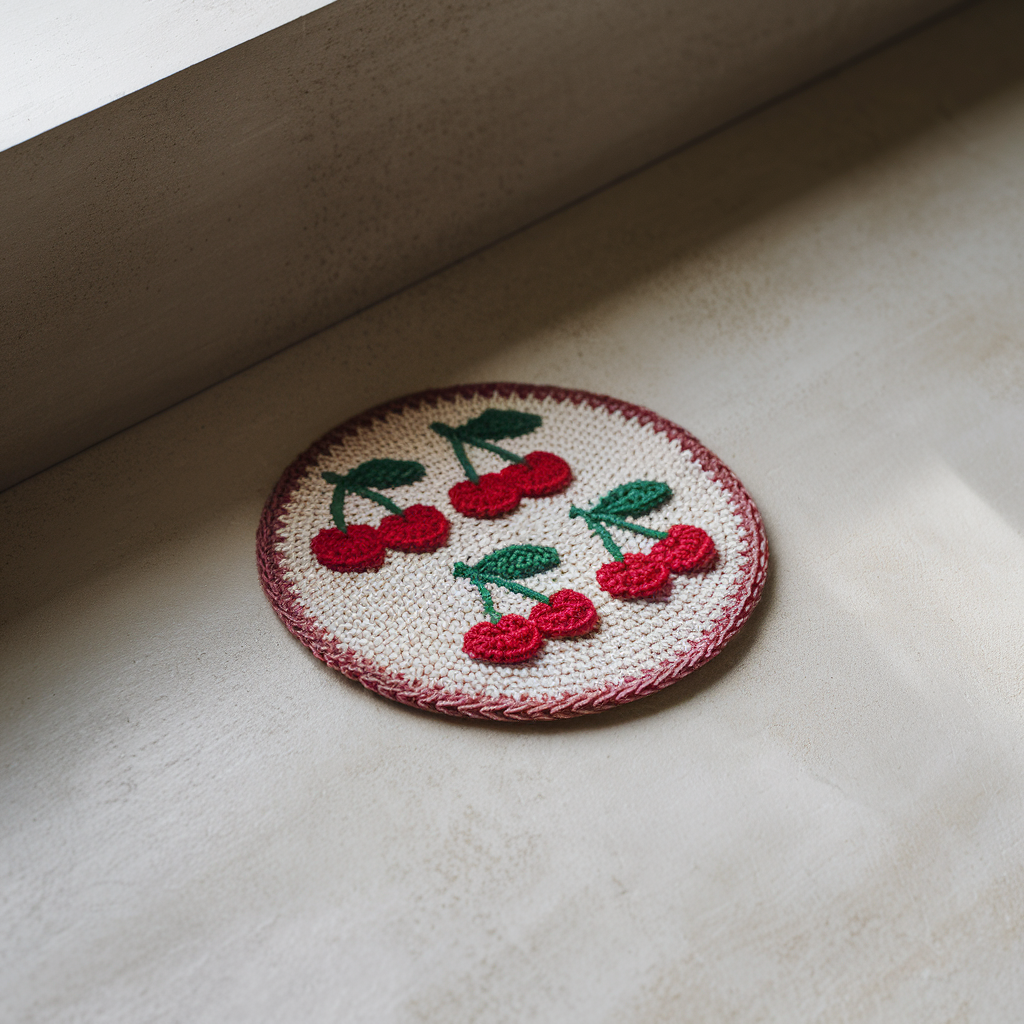
Overview
Playful and retro — a coaster decorated with tiny cherry pairs scattered or placed as a border. This design is perfect for summer tea or for adding a pop of color to dessert tables.
Skill level
Confident beginner — small motifs + simple assembly.
Materials & finished size
- Cotton DK in cherry red, leafy green, and neutral base color.
- Hook: 3.5 mm.
- Finished diameter: ~4 in (10 cm).
Step-by-step guide
- Crochet a simple round base in the neutral color (start MR, expand with even increases to desired size).
- Make cherry motifs: small round cherries (MR, 6 sc; inc round; taper if needed) worked in red and very short green stems (ch 3-4) with a tiny leaf. Make 4–6 pairs.
- Position cherries on the coaster: arrange as a neat border around the edge, or scatter in 3-4 clusters across the surface. Sew cherries on securely at the bases, hiding stitches under petals or the base so they don’t snag glass bottoms.
- Finish outer edge with a single round of sc in a contrasting color if desired.
Color palette suggestions
- Cherry red + sage green on cream.
- Deep cranberry + olive for a vintage look.
Variations
- Make a set with different fruit motifs (strawberry, orange slice) for a fruit-themed series.
- Embroider small white “shine” dots on cherries for realism.
Finishing & care
- Sew cherries tightly and avoid hard embellishments. Machine wash gentle; dry flat.
Styling tips
- Pair with dessert plates and summer placemats. Make matching napkin rings with a single cherry motif.
6. Crochet Multicolored Daisy Flower Coaster Pattern
Overview
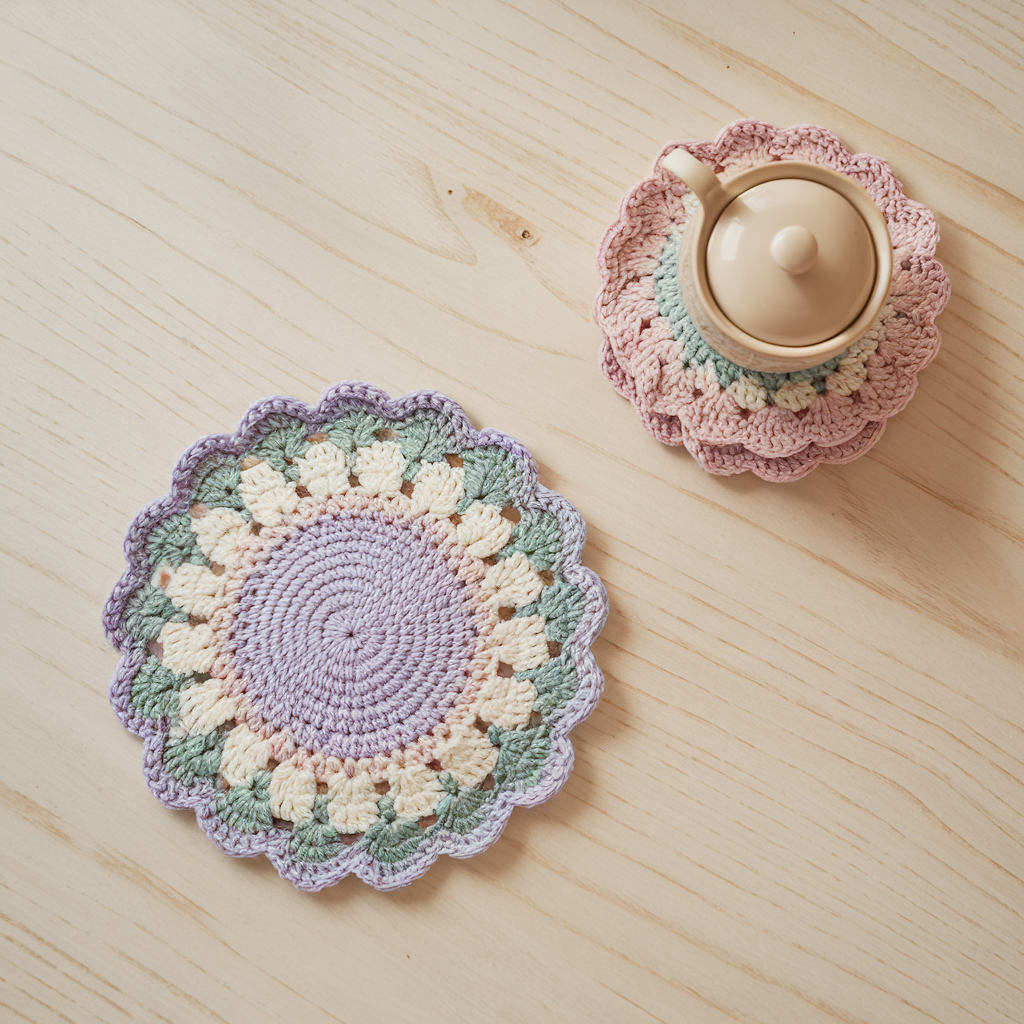
A joyful coaster built around a bold multicolored daisy: a tight center disc and radiating petal rounds in alternating colors. It’s decorative, cheery, and works well in stacked sets.
Skill level
Beginner → intermediate (motif + joining rounds).
Materials & finished size
- Cotton DK in 4–6 colors (center + two or three petal colors + outer ring).
- Hook: 3.0–3.5 mm.
- Finished diameter: ~4.5–5 in (11.5–12.5 cm).
Step-by-step guide
- Work a small, tight center (MR, 8–10 sc) in the chosen center color.
- Create petal loops by chaining short loops around the center (e.g., ch 6 loops), then fill each loop with a petal stitch set like (sc, hdc, dc, hdc, sc) in the petal color. Repeat around for the first petal round.
- Add a second petal round offset between first round petals if you want a fuller bloom; use a different color for contrast.
- Work a few rounds of sc around the petal base to create a flat foundation, then finish with a tidy outer edge (sc or crab stitch). Fasten off and weave in ends.
Color palette suggestions
- Sunshine set: butter yellow center, white petals, mint and coral accents.
- Pastel garden: soft lavender center, pale pink + cream petals, sage outer ring.
Variations
- Make large-centered daisies with smaller petal rounds for layered texture.
- Use the same technique to make coaster sets in gradated color themes (ombre daisies).
Finishing & care
- Block to flatten petals slightly. Because petals add thickness, consider a thin felt backing to stop glass abrasion. Hand-wash or machine wash gentle.
Styling tips
- Stack two daisies under a large teapot to anchor a centerpiece. Mix colors for a seasonal set.
Conclusion
These six coaster patterns — from playful candy swirls and retro cherries to elegant florals and graphic gingham — give you a broad range of styles to match any table and mood. Coasters are quick wins: they’re quick to make, great for stash-busting, and useful year-round. For durability, choose cotton or cotton-blend yarns, weave in ends securely, and consider adding a felt or cork backing for furniture protection.