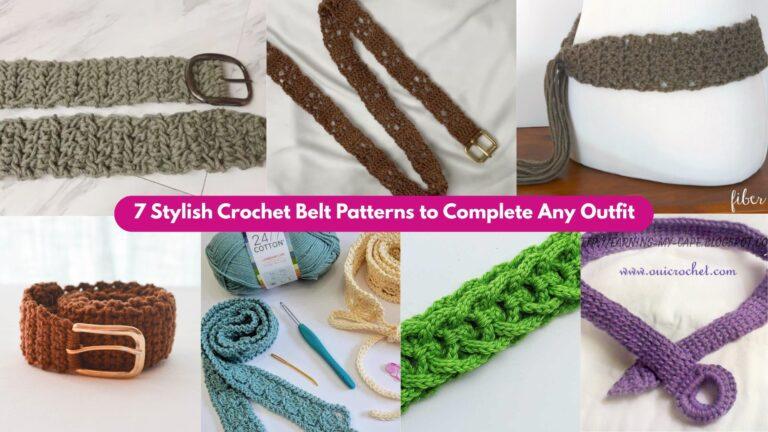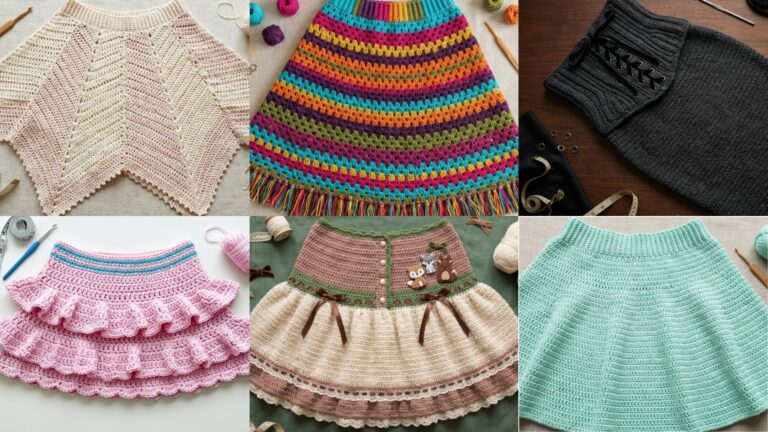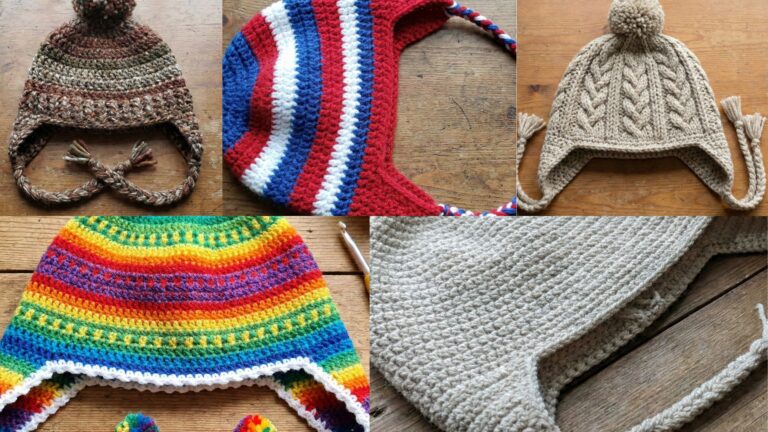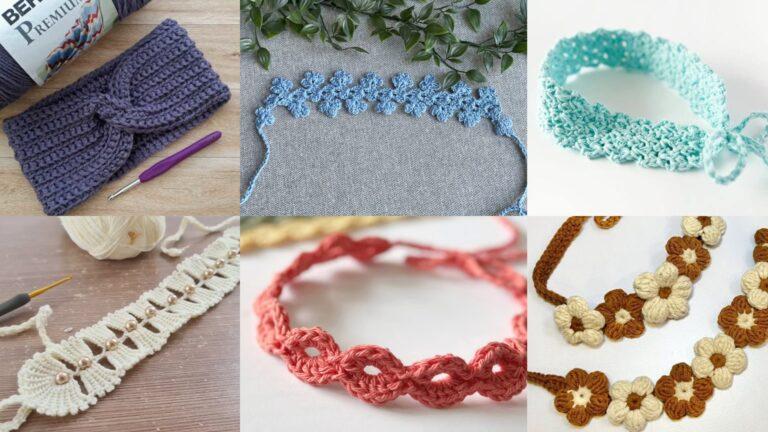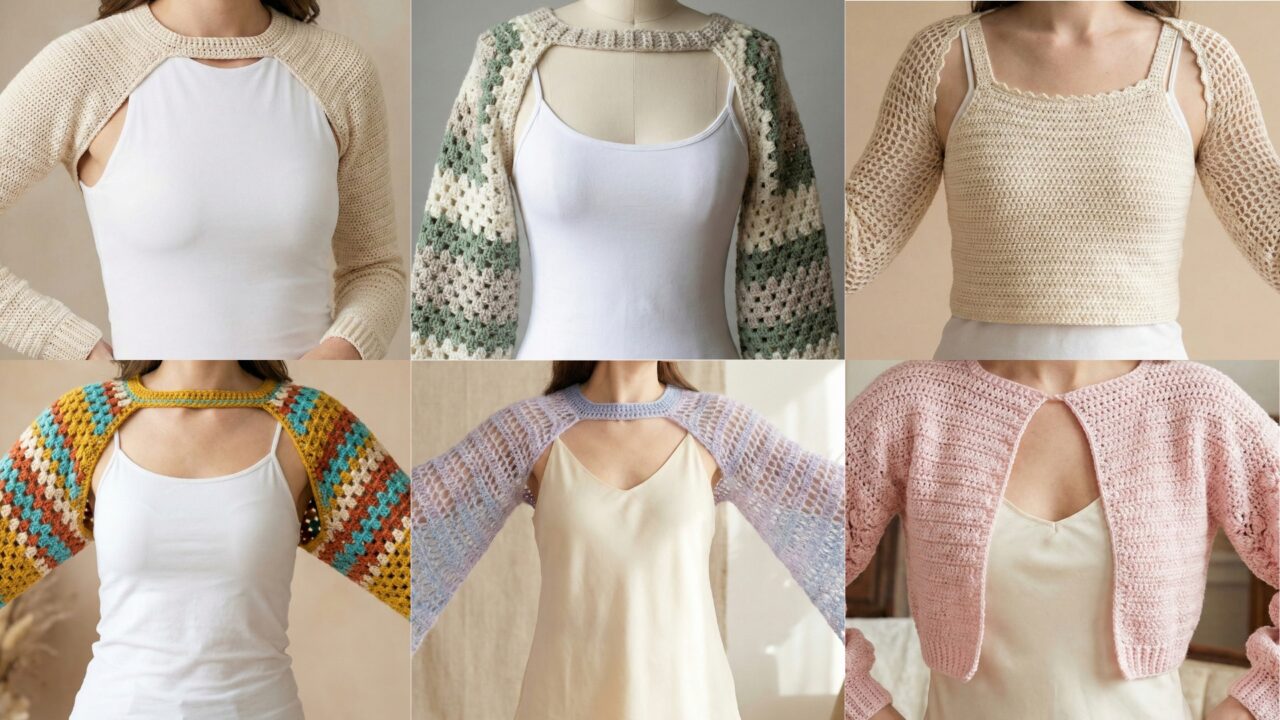
Crochet shrug sleeves are a stylish way to add warmth, texture, and personality to outfits without committing to a full sweater. Below are six full, long, detailed patterns — each with skill level, exact materials and yardage for sample sizes, gauge guidance and how to calculate stitches for your measurements, step-by-step construction with stitch-by-stitch and row-by-row options, shaping notes, finishing, variations, and care. I give sample counts and work through the arithmetic clearly so you can adapt these to S / M / L. Read the sizing + gauge notes at the start and then jump to the pattern you want.
Sizing & gauge primer (use this for every pattern)
- Take two measurements you need: desired finished back width W (across back between sleeve seams) and desired sleeve length L (shoulder to wrist or to elbow).
- Make a 4″ × 4″ swatch in the main stitch. Measure stitches per inch (spi) horizontally and rows per inch (rpi) vertically. Use this to convert inches to stitch counts and rows. I’ll show digit-by-digit examples below whenever I calculate stitches or rows so you can follow exactly.
- Example conversion (digit-by-digit): suppose desired finished back width W = 18 inches and spi = 4 sts/in. Multiply: 18 × 4 = (10 × 4) + (8 × 4) = 40 + 32 = 72 stitches needed across the back. If the stitch needs a repeat (say multiple of 4) round 72 to nearest multiple — here 72 ÷ 4 = 18 remainder 0, so 72 is fine.
- For lengths: if L = 18 inches and rpi = 6 rows/in, multiply: 18 × 6 = (10 × 6) + (8 × 6) = 60 + 48 = 108 rows.
Use the above method to adapt pattern stitch counts to your gauge, yarn, and preferred fit. Each pattern below includes a sample gauge and sample stitch counts for S / M / L to help you start quickly.
1. Crochet Raglan Granny Shrug Bolero Sleeves Pattern
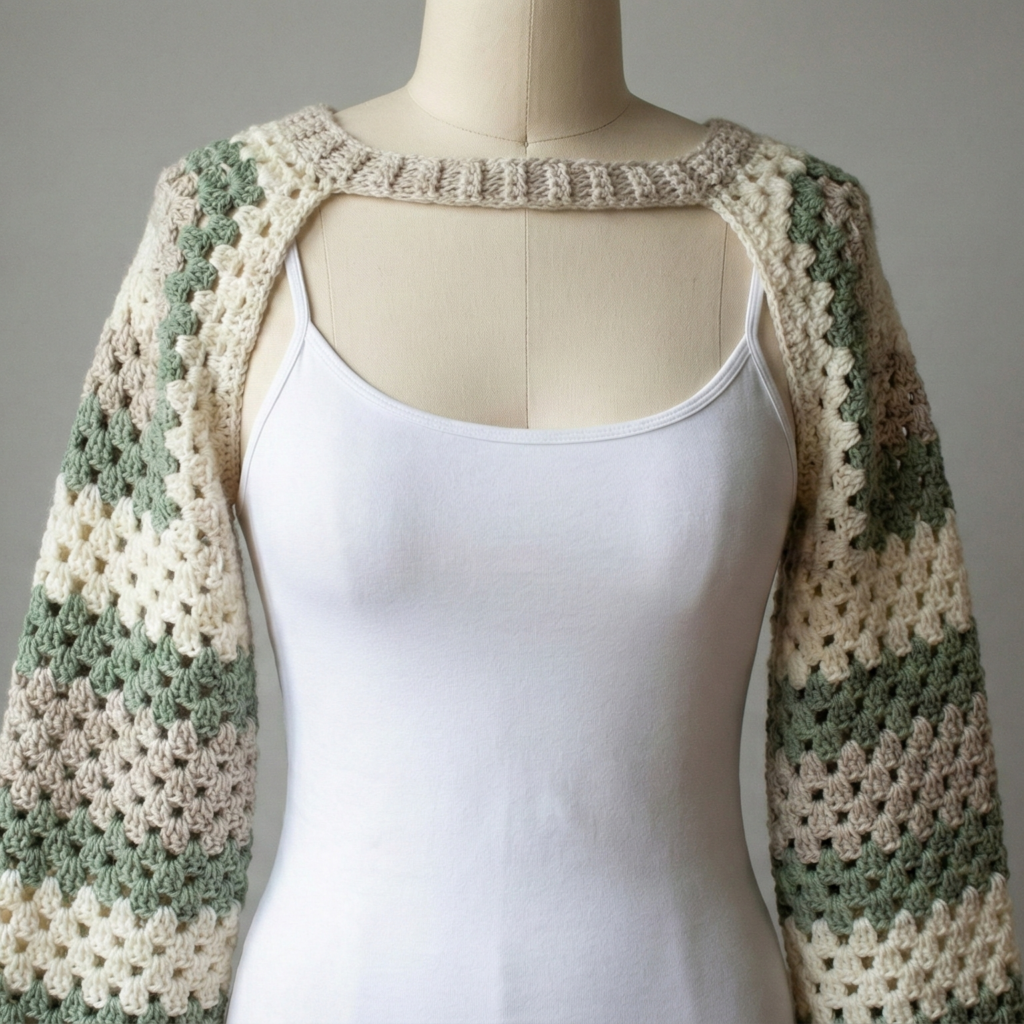
Skill level: Confident beginner. Works well in worsted or aran yarn; classic granny clusters give a boho-chic bolero. This version is written top-down raglan so you can try it on as you go.
Materials (sample adult sizes)
- Yarn: worsted (Weight 4). Sample yardage: S ~850 yd, M ~1000 yd, L ~1150 yd. Use acrylic or a wool/acrylic blend if you want machine washable.
- Hooks: 5.0 mm and 6.0 mm (for edging/looser texture).
- Notions: stitch markers, tapestry needle, measuring tape, blocking pins.
Sample gauge (in granny cluster pattern): 3 granny clusters = 1 inch across (measured after blocking). For conversions I’ll convert clusters-per-inch to stitches-per-inch where needed.
Pattern concept and construction overview (top-down raglan)
- Work a continuous round yoke built from long-row granny clusters with obvious raglan increase points (4 corners). When the yoke reaches the targeted back width W_yoke, separate sleeve openings and work body rounds, and then join front edges with an optional single button or leave open. Rejoin for sleeves and work sleeves in the round to desired length.
Sizing math examples (digit-by-digit)
- Suppose you want finished back width W = 16 inches (for a cropped bolero). With gauge 3 clusters = 1 inch, clusters needed across back = 16 × 3 = (10 × 3) + (6 × 3) = 30 + 18 = 48 clusters across the back. Because raglan uses 4 panels with increases, plan the yoke circumference so the back between raglan seams is this 48-cluster measurement. For stitch-level conversion: 1 cluster = 3 dc (a 3-dc cluster), so 48 clusters × 3 dc each = 144 dc-equivalent across the back. I’ll present sample starts below using cluster counts.
Start (neckline & yoke)
- Decide neck circumference (for a loose neckline allow 8–10″ more than head circumference). Example start chain: for sample M use a small neckline ring built from 12 clusters: MR, ch3, (3 dc cluster, ch2) × 12, sl st to join. This gives a modest neckline. If you prefer to begin from a narrow chain ring, chain 48 and slip-join to a ring and begin clusters into the ring.
- Round 1 (establish clusters): ch3 (counts as first dc), (3 dc cluster, ch2) into next chain/space repeat to end; sl st to top of ch3. Place markers at four quarter points (these will be raglan seams).
- Round 2 (form raglan corners): At each quarter marker, instead of single cluster, work (3 dc, ch2, 3 dc) into the ch2 corner space to create a defined corner. Elsewhere continue (ch2, 3 dc cluster) in each ch2 space. Join.
- Repeat Round 2 (increase round) until the back measurement between the two back raglan seams equals your desired W_yoke. Measure across back flat between those two raglan seams (not around). Example: desired back width 16″ → reach that point when measuring. Because each repeated round adds roughly one cluster in each section, check measurements every 2–3 rounds. Use the clusters-per-inch conversion: if 3 clusters = 1″, to reach back width 16″, you need 16 × 3 = 48 clusters across back section — but because the raglan geometry distributes clusters to four sections, you’ll watch overall counts.
Armhole separation and body
5. When yoke equals desired width, separate sleeves: On the next round, work clusters across front-right, then place next N clusters on a stitch holder (these will be sleeve stitches) or chain a number of stitches to create an underarm gap (equivalent to sleeve circumference). Practical approach: count clusters for each sleeve; chain a number of stitches equal to the sleeve opening required and skip those clusters when continuing body rounds. Example: desired sleeve opening = 8″ and clusters-per-inch = 3 → need 8 × 3 = (8 × 3) = 24 clusters for the sleeve opening — you chain a chain length equivalent to 24 clusters or place 24 clusters on hold.
- Continue to work body rounds in granny pattern (no more increases) until body reaches desired length—cropped ~9–10″ from underarm, regular ~12–14″.
Sleeves (worked after armhole separation)
7. Rejoin yarn at underarm opening, pick up or rejoin the sleeve clusters (if you placed them on a holder) and work in rounds: chain 3, continue cluster rounds in the round for sleeve. Candidate shaping: for a tapered sleeve, decrease 1 cluster every 6–8 rounds until desired sleeve narrowness is reached; for a relaxed sleeve, work even.
- Work to desired sleeve length (measured using rows-per-inch). Example: L sleeve length 18″ and rpi in sleeve pattern = 6 rows/in → 18 × 6 = (10 × 6) + (8 × 6) = 60 + 48 = 108 rounds (that’s long; adjust to your measurement). You can instead aim for elbow or 3/4.
Finish and edging
9. Finish neckline and cuffs with 1–2 rounds of sc or crab stitch (reverse sc) for tidy edges. Block lightly if needed.
Variations & finishing details
- Add a front button or hook if you want closure. Sew in a fabric backing if your yarn is open to snags. For a more delicate look, use a lighter-weight yarn and smaller hooks, recalculating gauge.
- Care: wash per yarn label; acrylic can be machine washed gentle.
2. Crochet Gloved Puff Sleeves Shrug Pattern
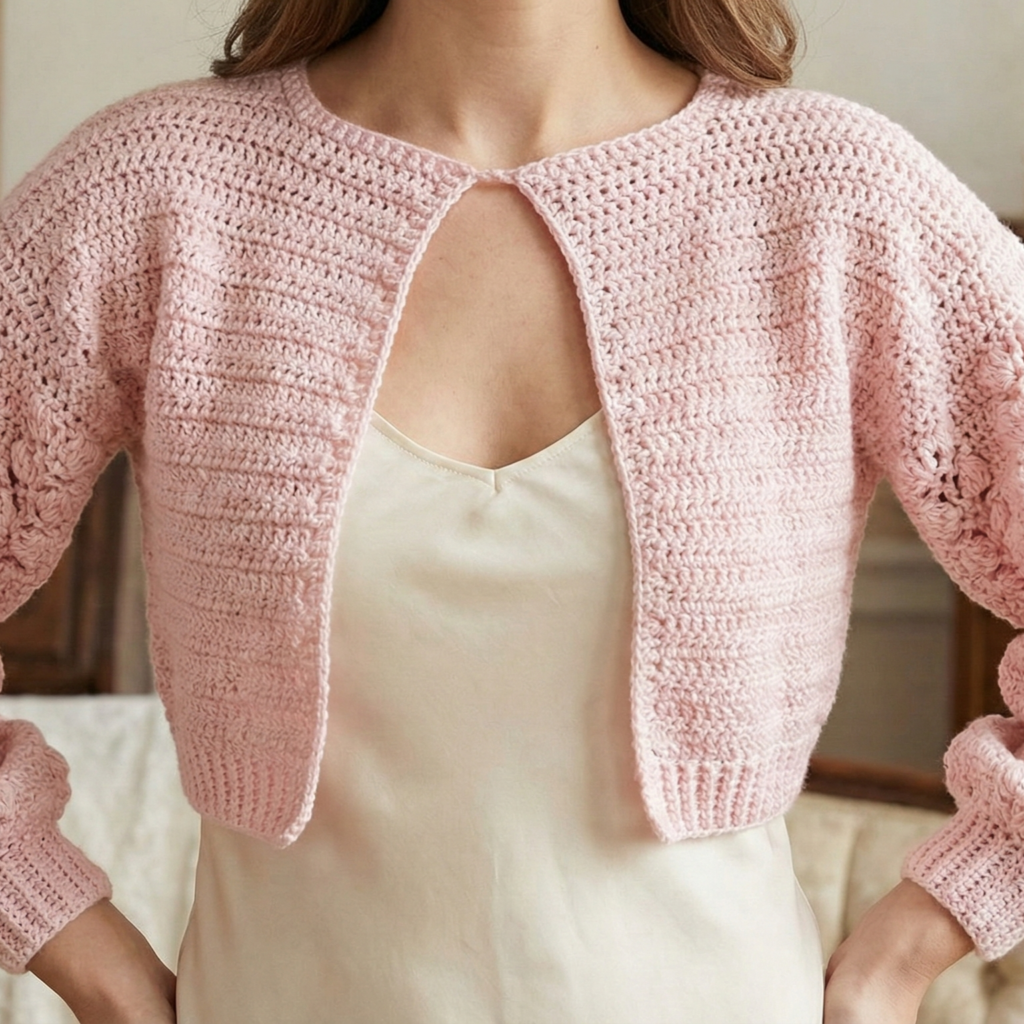
Skill level: Intermediate. This pattern creates a fitted wrist/glove cuff and a puffed upper sleeve that attaches to the bodice either by set-in seam or as part of a top-down yoke. Use a touch of elastic in the cuff for a secure glove-like fit.
Materials (sample)
- Yarn: aran/worsted. Yardage: S ~900 yd, M ~1050 yd, L ~1200 yd.
- Hooks: 4.0 mm for cuff, 5.0 mm for puff body.
- Elastic thread or narrow elastic for inner cuff (optional), stitch markers, tapestry needle.
Sample gauge (cuff rib): 5 sc = 1 inch when using cuff hook 4.0 mm. Puff stitch pattern gauge (puff clusters) will be different — measure both.
Pattern concept and construction overview
- Work cuff in ribbing (hdc in back loop only or fp/bp post stitch to create stretch). After cuff is made, increase for puff volume using puff stitches, shells or clusters, then shape the sleeve cap to attach to the bodice.
Step-by-step — making one sleeve, then make body
Cuff (glove portion)
- Measure wrist circumference Ww. Example wrist circumference = 7 inches. With cuff gauge 5 sc/in multiply: 7 × 5 = (7 × 5) = 35 stitches. That gives the number of foundation chains if you plan to join in the round. For a snug cuff, reduce by 0.5–1 inch of ease: if you want 6.5″ snug try 6.5 × 5 = (6 × 5) + (0.5 × 5) = 30 + 2.5 = 32.5 → round to 32 or 33 as practical. Use 32 for a neat count.
- Chain 32, join to work in the round. R1: ch1, sc in BLO in each st around; join. R2–R6: repeat R1 to create 1–1.25 inch cuff. If using elastic thread, split length of elastic into cuff and weave inside later or hold elastic with thread while stitching.
Create the puff
3. At top of cuff, increase to form puff body: one method — work a round of [2 sc in next st, sc in next 2] across to add approx 1/3 extra stitches. Example: If cuff is 32 sts, after this increase round you’ll have approximately 32 + (32 ÷ 3) ≈ 42–44 sts (these are approximate because increases are rounding). This additional room creates the basis for puff expansion.
- Puff body rounds: choose a puff stitch pattern. Example puff round: make a 3-loop puff (yo, insert, pull up loop) × 3 times in same st, yo pull through all loops, ch1, sl st to secure, skip next 1 stitch, sc in next 1 — this creates islands of puff. Alternatively use clusters: ch1, (3 dc cluster) in next st, ch1 repeating gives softer puff.
- Work repeats of the puff round interspersed with anchor rounds (sc or hdc) to stabilize. For a generous puff, work puff rounds for 4–8 inches above cuff depending on puff height desired.
Sleeve shaping toward shoulder
6. To shape sleeve cap or puff cap that will join to the bodice: gradually reduce puff counts by decreasing every 6th stitch on a few rounds so the top portion sits nicely into the armhole seam. If you plan to attach sleeve to a set-in opening, leave sleeve top raw and ease into armhole with small gathering stitches.
Bodice — set-in or top-down options
7. If you’re making a fitted shrug with set-in sleeves, construct bodice pieces (front and back panels) and seam sleeve caps into armholes using even small stitches and easing. If you prefer top-down, construct a yoke and separate sleeves as raglan (similar to raglan granny pattern) but use puff shaping where sleeve attaches (more advanced).
Finish
8. Edge with 1–2 rounds of sc around wrist and armhole. Block as needed to define puff shape.
Variations
- Make bishop sleeves by adding extra length below the puff and finishing with a narrow cuff.
- For summer version use lighter yarn and smaller puff clusters.
Care
- Hand wash to keep puff elasticity; steam lightly when blocking.
3. Crochet Granny Striped Shrug Sleeves Pattern
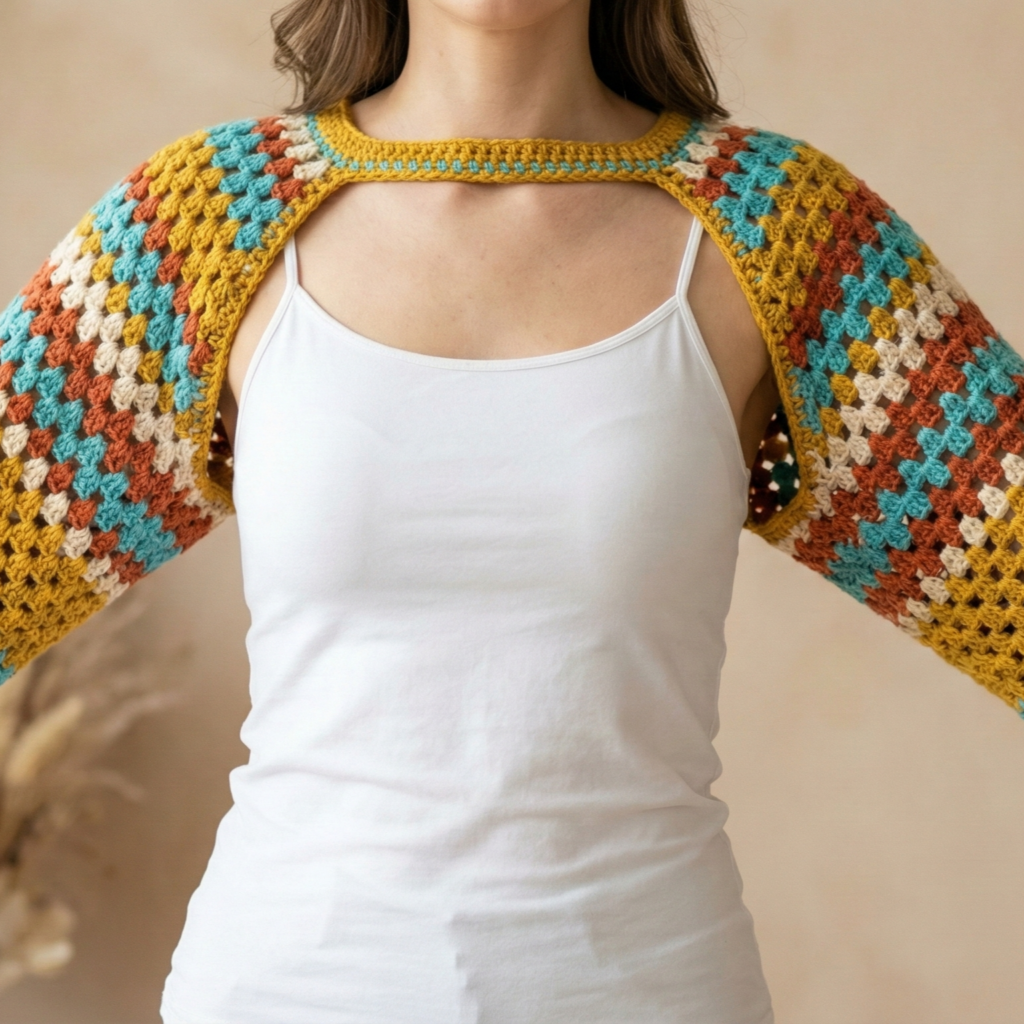
Skill level: Confident beginner. Combines long-row granny cluster panels with clean color-striping.
Materials (sample)
- DK yarn in 3 colors (Main Color A, Accent B, Accent C) — sample yardage S ~700 yd, M ~850 yd, L ~1000 yd.
- Hook: 4.0–5.0 mm.
- Notions: stitch markers, yarn needles.
Gauge and multiples
- If a granny cluster (3 dc cluster) pattern gives 3 clusters = 1 inch, convert desired back width to clusters using multiplication.
Construction overview
- Panel construction is straightforward: make a rectangular back panel in long-row granny and then either drop-shoulder sleeves or set-in sleeves. Stripes: change colors every 2–4 rows, or place stripes between granny rounds to give crisp bands.
Step-by-step — back panel method (flat panels, seamed)
Back panel
- Determine back finished width W (half of bust if you want the front edges to meet partially — shrugs often are measured across back only). Example W = 18″. With 3 clusters/inch you need 18 × 3 = (10 × 3) + (8 × 3) = 30 + 24 = 54 clusters across. Each cluster uses 3 dc twice etc.
- Foundation chain (flat rectangle): For granny rows worked in rows use a multiple which allows clusters: chain [(clusters across × 2) + foundation buffer]. A simple practical approach: for 54 clusters across, and each cluster sits across 3-4 chains depending on your cluster structure, start by chaining S = 54 × 2 = 108 chains then create cluster rows across — but the easier approach is to work in multiples of 3+2 (for ch-spaces): for this pattern you might chain 160 stitches, work first row to shape clusters until you measure the width W across with a tape.
Granny stripe rows
3. Row pattern: Row A (granny): ch3, skip 2 sts, (3 dc, ch2, 3 dc) in indicated ch-spaces across (this is a wide granny cluster row). Row B (stripe anchor): change color and work 2–3 rounds of sc or hdc in the stripe color to create a bold bar. Continue alternating.
- Continue until desired back height H (use rpi to calculate). Example desired back height from underarm 12 inches and rpi 3 rows/inches: 12 × 3 = (10 × 3) + (2 × 3) = 30 + 6 = 36 rows—adjust to full-row counts.
Sleeves (drop-shoulder simple approach)
5. For a drop-shoulder shrug (easiest for beginners) extend the back panel width beyond armhole to create shoulder fabric; cut front panels and seam shoulders; seam side edges leaving an armhole opening; for sleeve create a rectangle sized to sleeve circumference and seam into armhole.
Set-in sleeves (optional more tailored)
6. Make two sleeve panels in matching granny stripe and seam into armholes. Shape sleeve caps by decreasing cluster counts at edges to fit armhole curve.
Finish
7. Add border of sc around neckline and cuffs. Keep yarn color consistent with stripes or contrasting.
Variations
- Use color gradation for subtle stripe transitions.
- Add a large central band of solid color for emphasis.
Care
- Machine wash gentle if yarn allows; wash separately first to test colorfastness.
4. Crochet Long Fairy Shrug Flowing Sleeves Pattern
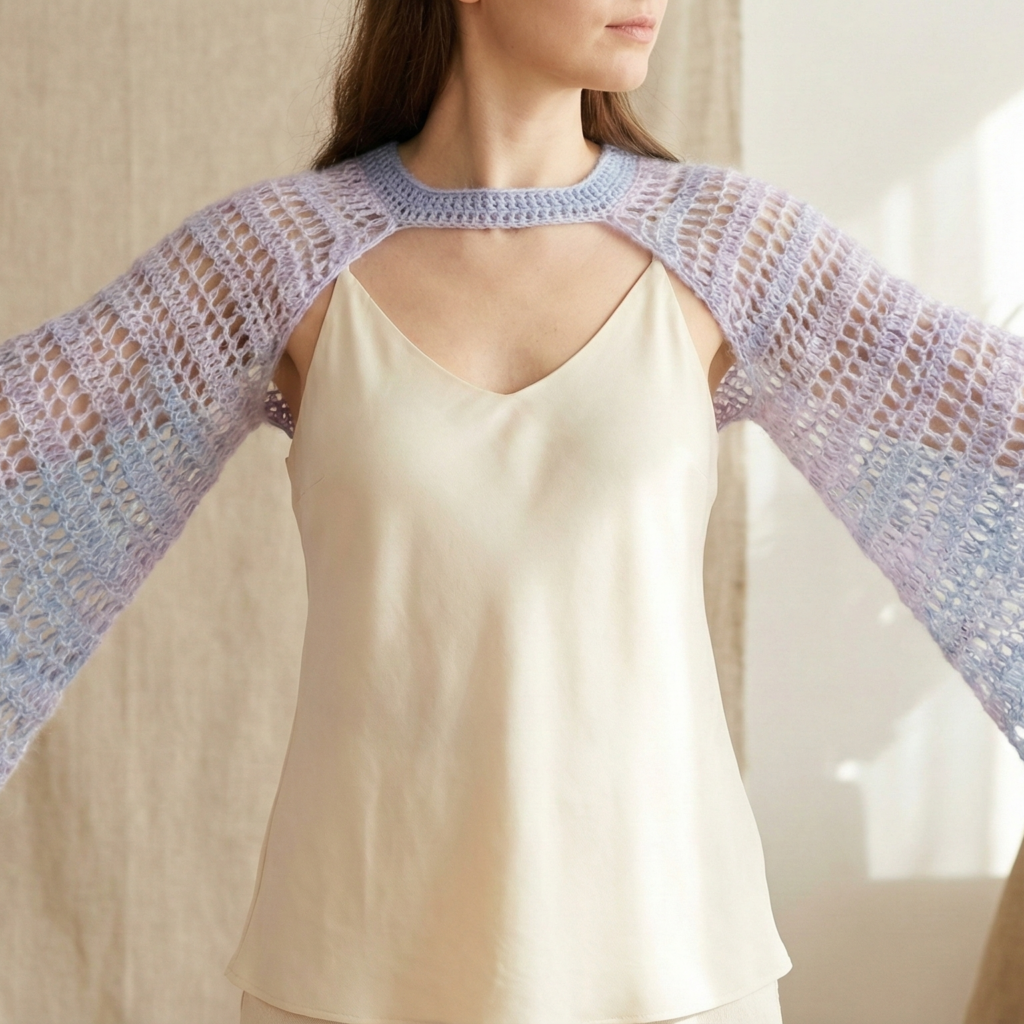
Skill level: Intermediate. This is the romantic, ethereal shrug with very long draping panels; best in lightweight yarn (fingering / sport / light DK) for drape.
Materials (sample)
- Yarn: fingering or sport weight (silk blend or bamboo for drape). Yardage S ~900 yd, M ~1100 yd, L ~1300 yd.
- Hooks: 3.25 mm and 4.0 mm for edgings.
- Notions: blocking board and pins (blocking is essential).
Pattern concept and construction overview
- Construct as three panels: one back (short) and two long front drapes. The panels attach at the shoulders with small seams; sleeves are created by slit openings in the front drapes or by leaving arm slits in the front panel. Lacy stitches (V-stitch, shell-lace) produce airy, flowing texture.
Gauge & calculation example
- Suppose your lace stitch has spi = 5 sts/in and rpi = 7 rows/in. For a back width W = 20″, stitches needed = 20 × 5 = (10 × 5) + (10 × 5) = 50 + 50 = 100 stitches across.
Back panel
- Chain foundation S = W × spi (rounded to lace multiple). Example S = 100. Work lace pattern in rows until back height H_back = 8–12″ depending on how short you want the back. Example if H_back = 10″ and rpi = 7 → rows = 10 × 7 = 70 rows.
Front drapes
2. Make two identical long rectangles. Determine drape length D: e.g., D = 30″ (a long waterfall drape). Convert D to rows: D × rpi: 30 × 7 = (10 × 7) + (10 × 7) + (10 × 7) = 70 + 70 + 70 = 210 rows (very long — adjust to taste). Width of each drape: 12–18″ (convert with spi).
Arm slits or sleeves
3. To make arm slits: when attaching front panels to back panel at shoulder seam leave a gap at the side seam equal to armhole circumference divided by two — or stitch small buttoned flaps for decorative closure.
Edging
4. Edging is large scallop shells (5 dc shells) around entire outer edge to emphasize flow. Work 2 rounds of sc to stabilize edge then shell round.
Finishing (blocking)
5. Block heavily to open lace and lengthen drape. Use pins to shape scallops evenly. Steaming silk blends lightly will set shape.
Variations
- Add beads to shell tips for sparkle.
- Make shorter drapes for daywear and longer for formalwear.
Care
- Hand wash; silk blend needs delicate handling.
5. Crochet Olivia Shrug Sleeves Pattern Tailored, Elegant Shrug
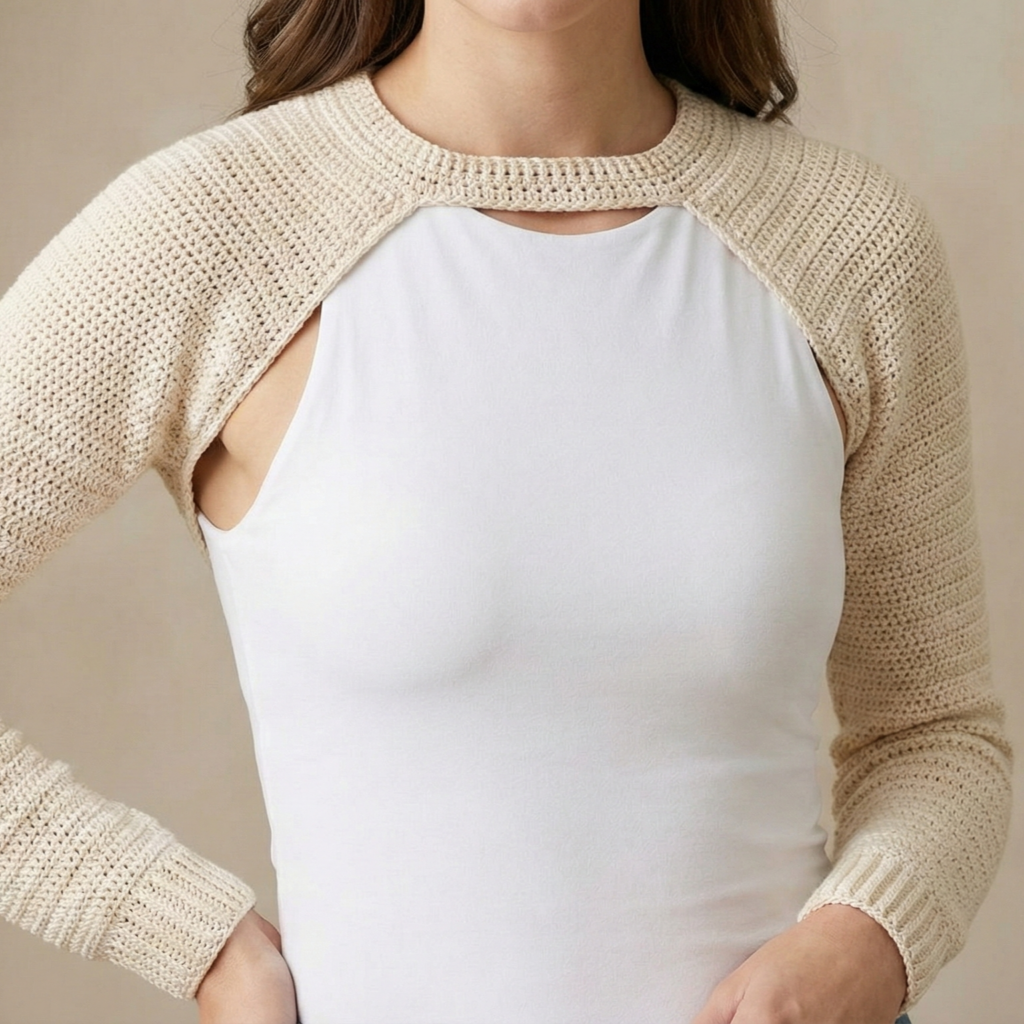
Skill level: Intermediate (tailoring & short rows). Olivia is a sleeker, close-fitting shrug with rib trims and neat seaming for a polished look.
Materials (sample)
- Yarn: sport or DK (soft wool or acrylic blend). Yardage S ~800 yd, M ~950 yd, L ~1100 yd.
- Hook: 3.75 – 4.5 mm.
- Notions: stitch holders, tapestry needle, measuring tape.
Design concept and fit notes
- Olivia aims for a fitted silhouette using short-row shoulder shaping and set-in sleeves. Use a rib stitch for cuffs and neckline (hdc in BLO or front/post rib). This style requires trying-on as you go to fine-tune fit.
Gauge and sample counts
- Example gauge: 16 sts = 4 inches in main stitch (spi = 4). If desired back width W = 18″ then stitches needed = 18 × 4 = (10 × 4) + (8 × 4) = 40 + 32 = 72 stitches.
Construction (top-down with short-row shaping)
Neck and shoulders
- Work a narrow ribbed neck band: ch foundation to fit neck opening (14–16″ depending on head size) and join to work in the round in BLO hdc rib for 4–6 rounds.
- Begin yoke: using short rows to shape shoulders, work partial rows that stop before edge and return (wrap & turn) to build a natural slope. Example: work across 80% of stitches, wrap & turn, work back; repeat building shoulder slope. This avoids bulky seams.
Body
3. After shoulder shaping, join full rounds across body and add small increases near side seams to create A-line drape if desired. Work rounds until body length hits your target (e.g., 12″ from underarm).
Sleeves
4. Separate sleeve stitches and work sleeves in the round, shaping lightly by increases or decreases depending on fit. Use rib cuffs worked in BLO to ensure fitted wrists.
Finishing
5. Pick up stitches around neck and work a narrow ribbed band 1″–2″ wide. Add button if you want slight closure or leave open.
Fitting tips
- Try on at underarm and mid-bust to check fit; adjust shaping with short rows or increases.
Variations
- Olivia looks excellent in neutral palettes and tonal yarns for a modern work-ready shrug.
Care
- Block lightly; follow yarn care instructions.
6. Crochet Mesh Sleeves Shrug Pattern
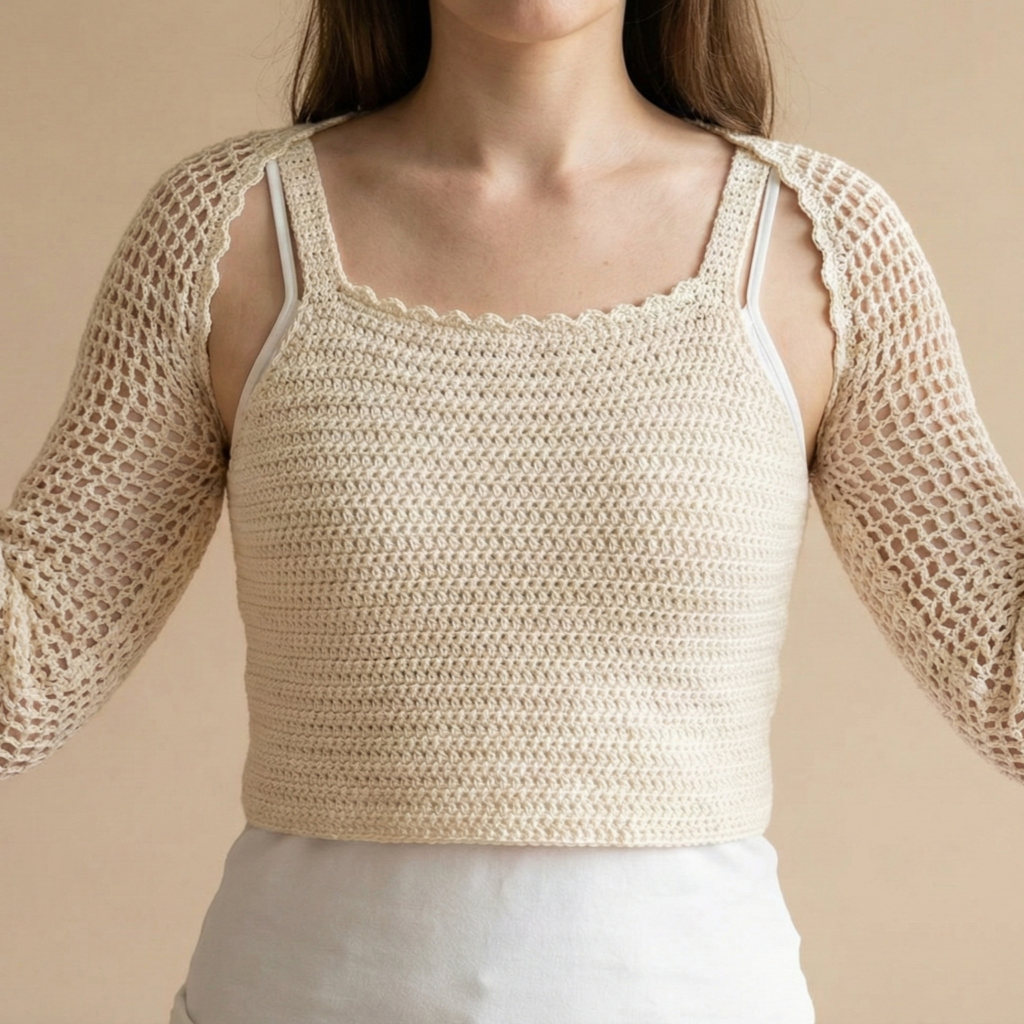
Skill level: Confident beginner. Airy, breathable mesh sleeves with a fitted body; great for warm weather layers.
Materials (sample)
- Yarn: sport or cotton DK. Yardage S ~650 yd, M ~800 yd, L ~950 yd.
- Hook: 3.5–4.5 mm.
- Notions: stitch markers, tapestry needle.
Pattern concept and overview
- Construct a fitted body panel in plain hdc or sc (for structure) and add airy mesh sleeves worked in V-stitch or chain ladder mesh. Work sleeves in the round for a seamless finish.
Gauge and conversion
- Example hdc gauge: 14 hdc = 4 inches → spi = 3.5. If W = 18″ then stitches = 18 × 3.5 = (10 × 3.5) + (8 × 3.5) = 35 + 28 = 63 stitches (round to nearest even count).
Body (tank-like fitted base)
- Chain foundation S = W × spi. For 63 stitches chain 63 and work rows of hdc until desired body height (example 10–12″ from underarm).
Mesh sleeve (work in round or flat and seam)
2. Pick up stitches evenly around armhole — count pick-ups so mesh repeats fit (V-stitch multiple often multiple of 3). Example pick up 84 stitches (multiple of 3), join to work in round.
- Mesh repeat: Round pattern = dc, ch2, dc in next space (V-stitch), skip 1–2 stitches between repeats depending on desired openness. Or ladder mesh: dc, ch2, skip 2 repeating.
- Work even until sleeve length desired. For a flared mesh sleeve, at regular intervals increase by adding extra V-stitches evenly spaced (e.g., increase 4–8 stitches every 8 rounds).
- Finish with one round of sc for cuff or leave raw for airy effect.
Finish
6. Add a narrow band of sc at neck and hem for structure. Block the mesh to open stitches.
Variations
- Use a slightly heavier body with a very open mesh for sleeves to create contrast.
- Add decorative bead intersections by sliding a bead onto dc center stitches while crocheting.
Care
- Machine-wash per yarn label; cotton versions machine-dry low if allowed.
Conclusion
Each of these six shrug sleeve patterns—Raglan Granny Bolero, Gloved Puff Sleeves, Granny Striped, Long Fairy Drapes, Olivia Tailored Shrug, and Mesh Sleeves Minimal—is intentionally written so you can scale by gauge and measurement. Use the sizing math at the top to calculate foundation stitch counts and row counts for your preferred size. Try on as you go for fitted designs (Olivia, Gloved Puff). Block lacy pieces (Fairy, Mesh) to show stitch definition. For busy or gifting projects, choose neutral yarns for broader wardrobe compatibility.