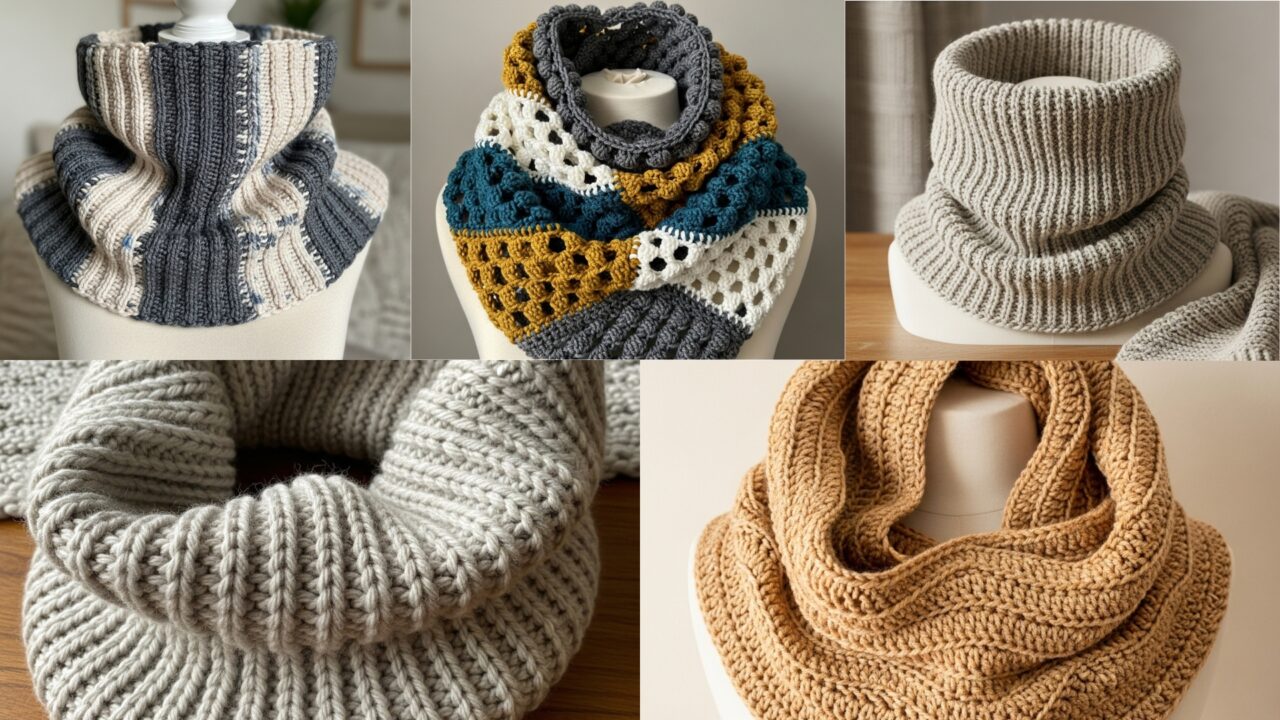
A textured cowl is one of the fastest, most rewarding accessories to crochet: compact, wearable, and endlessly customizable. Below are five full cowl designs — Desert Dunes, Mainstream, Copenhagen, Ribbed, and Tunisian — each with a clear skill level, materials & yardage, sample gauge, finished-size guidance, step-by-step construction (with stitch multiples and sample stitch counts), plus variations, finishing, styling tips, and care. All patterns use US crochet terms.
If you want to make these quickly: pick the pattern that fits your skill level, choose the yarn weight recommended, follow the sample stitch counts for the sample size, and you’ll have a beautiful cowl in an afternoon or two.
General notes (applies to all patterns)
- Abbreviations: ch = chain, sc = single crochet, hdc = half double crochet, dc = double crochet, tr = treble (UK dc), sl st = slip stitch, sts = stitches, rep = repeat, BLO/FLO = back/front loop only, RS/WS = right/wrong side, MR = magic ring.
- Yarn & hook choices: I use worsted-weight (Weight 4) cotton / wool blends and 5.0 mm (H) hooks as my baseline — this gives structured, wearable texture. Swap to DK or bulky yarn and adjust hook for look & drape.
- Gauge sample used throughout (baseline): 16 sc = 4 in (≈4 sc/in) with worsted + 5.0 mm hook. Always make a 4″ swatch in the stitch used for that pattern — textured stitches change gauge.
- Finished circumference: I give a sample adult medium (single-loop cowl) finished circumference ≈ 24 in (comfortable fit across head to slip on) and height 9–10 in. To adjust: multiply or reduce foundation stitches per the stitch multiple I provide.
- Most cowls are worked in rounds (“join and continue”) so they’re seam-free. When I give a sample stitch count it’s calculated from the baseline gauge; change counts proportionally for your gauge.
1. Crochet Desert Dunes Cowl Pattern
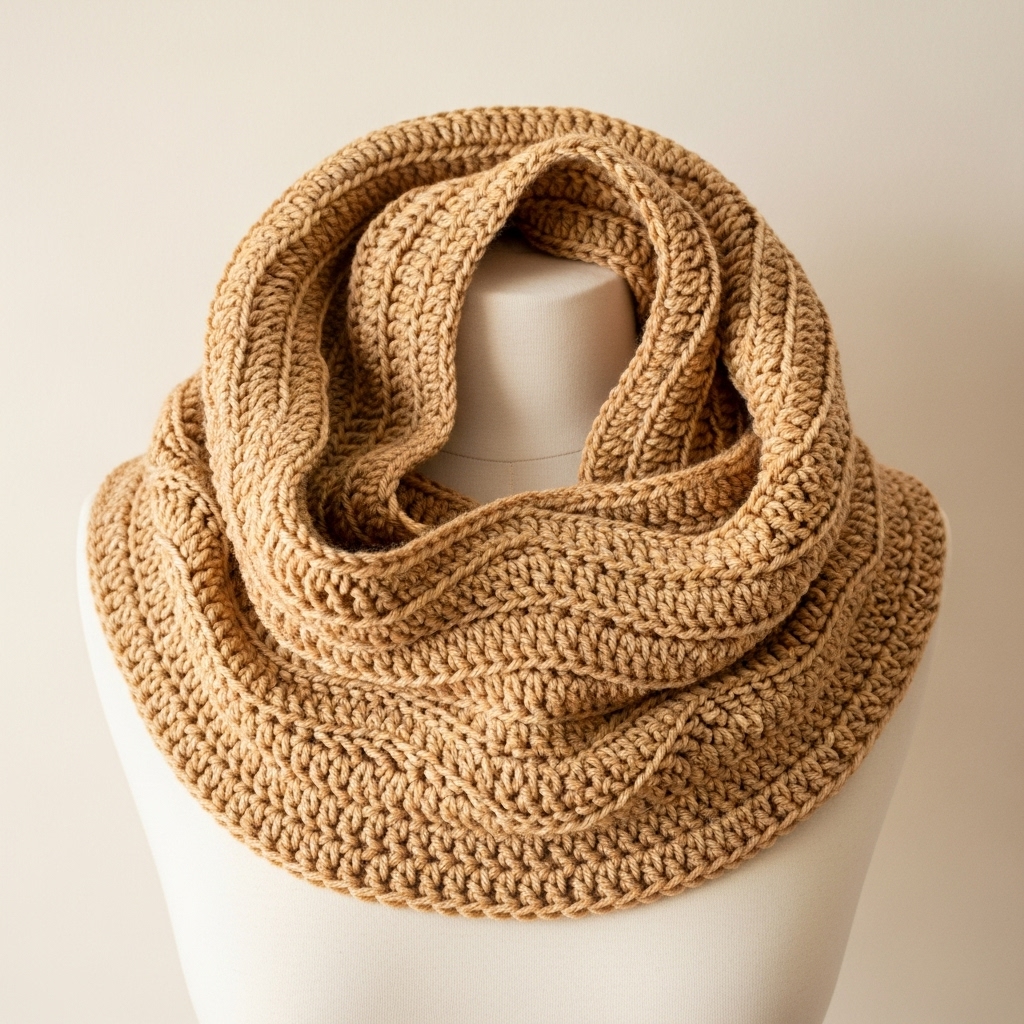
Soft, sculptural waves inspired by sand dunes. Alternating raised ridges and shallow columns create a gently undulating fabric that looks complex but is simple to make.
Skill level: Confident beginner — alternating post stitches and simple repeats.
Materials (sample adult M): approx 200 yds worsted-weight; Hook 5.0 mm; tapestry needle.
Sample gauge: 16 sc = 4 in in sc. In the dune stitch expect slightly taller rows — check a swatch.
Finished size (sample): circumference 24 in (unstretched), height 9.5 in.
Stitch concept & multiple
Desert Dunes stitch = repeating block of (FPDC cluster ridge + 3 dc columns). The round multiple is 8 sts in sample.
Foundation (calculate for your gauge)
Using baseline 4 sc/in, 24 in → 96 sts. Choose multiple of 8 → 96 is perfect.
Pattern — worked in continuous rounds (join if you prefer)
Round 0 (foundation): ch 96, join with sl st to form a ring (do not twist). Mark first st. Alternatively use foundation single crochet 96.
Round 1 (base, sets height): ch1, sc in each ch around. Join with sl st to first sc. (96 sc)
Round 2 (establish dune units): ch2 (counts as hdc), [fpdc around next 3 sts], hdc in next 3 sts rep from * to * around. Join.
fpdc around next 3 sts: yarn over, insert hook from front to back around post of next st, yarn over, pull up loop, complete dc; repeat for 3 posts to make continuous fpdc groups. (Work instructions simplified for clarity in practice.)
Round 3: ch2, (hdc in each of next 3 sts), [bpdc around 3-post group] rep around. Join.
The alternating front- and back-post work forms raised ridges (dunes) and recessed columns.
Repeat Rounds 2–3 until piece height reaches ~8.5 in.
Top finishing rounds: Work 1 round of sc evenly across (into tops of posts and dc) and 1 round of sl st for a neat edge. Fasten off and weave ends.
Optional border: One more round of sc, ch1, sc to create tiny looped edge.
Finishing & tips
- Blocking: Light steam block on wool or wet block cotton — pin slightly to open ridge texture.
- Make it taller by adding 4–6 more dune repeats. For a double-wrap cowl, increase circumference to 40–44 in (10 in larger) and maintain same stitch multiple.
- Variation: Hold a strand of fine mohair with the main yarn for a soft halo.
Styling & care
- Wear over a thin sweater; the ridged surface looks great under a coat collar. Hand wash or machine wash on gentle depending on fiber; reshape damp.
2. Crochet Mainstream Cowl Pattern
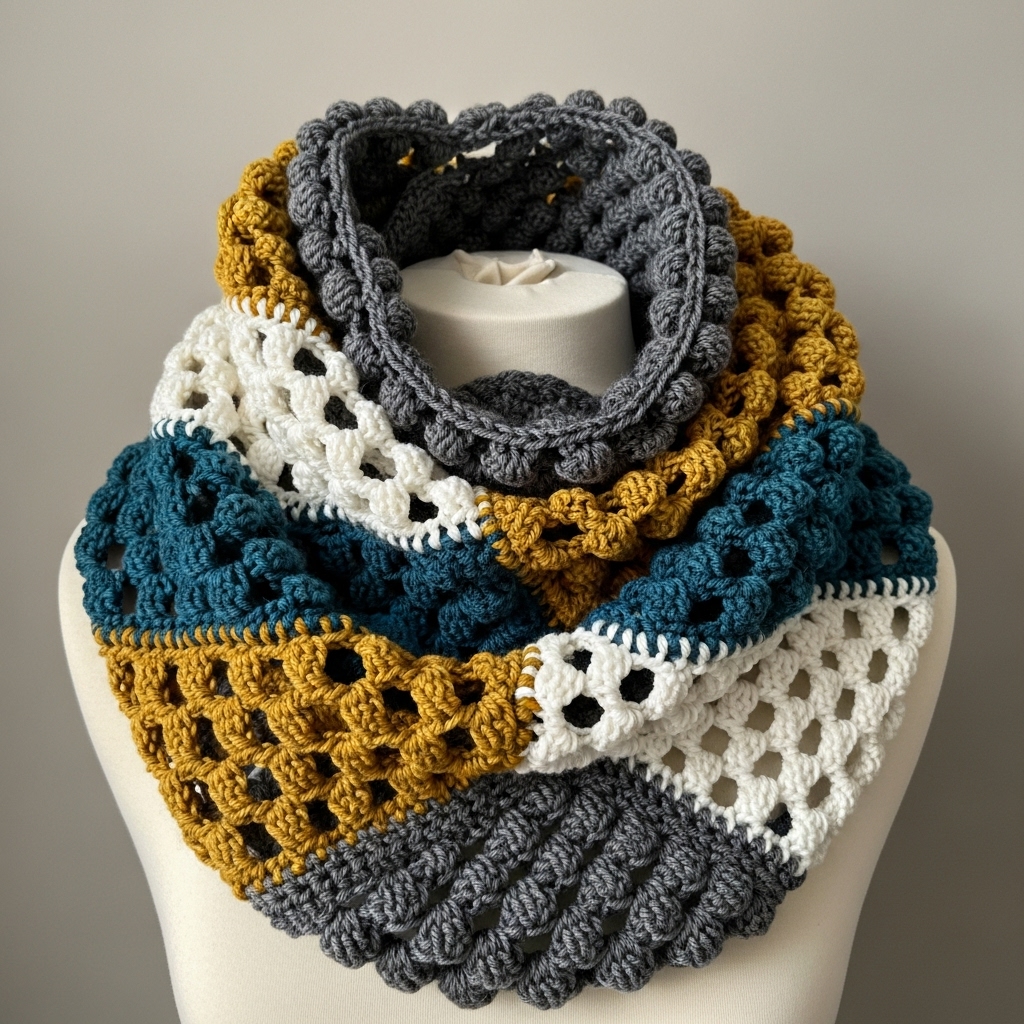
A modern textured cowl built with alternating bobble bands and flat mesh — a statement piece with pop and negative space.
Skill level: Intermediate — includes bobbles (puff/bobble stitches) and openwork.
Materials: 200–250 yds worsted; Hook 5.0 mm; tapestry needle.
Sample gauge: swatch in pattern — aim for ~16 sc = 4 in when measured in the non-bobbled rows.
Finished size (sample): circumference 24 in, height 10 in.
Stitch concept & multiple
Mainstream pattern repeat: multiple of 12 sts + if you want symmetrical bobble placement. I use multiple of 12 for clarity.
Foundation & counts
24 in × 4 st/in = 96 sts; 96 is divisible by 12 → use 96.
Pattern — worked in rounds
Round 1 (foundation): ch96, join. R1: ch1, sc in each st around. Join. (96 sc)
Round 2 (mesh row): ch3 (counts as dc), ch1, sk1, dc in next rep around — this makes airy ladder columns. Join.
Round 3 (evening lock): ch1, sc in each dc and into ch spaces to stabilize (96 sc) — this secures the mesh.
Round 4 (bobble row): ch1, sc in next 3, bobble in next st rep around. Join.
Bobble (puff-style): yo, insert, pull up loop — repeat 4 times (9 loops), yo pull through all, ch1 to close puff; sl st to secure if needed. Alternatively use 5-dc bobble.
Round 5: ch1, sc around to lock bobbles.
Repeat: Work sequence: Mesh row (R2), Lock row (R3), Bobble row (R4), Lock row (R5) — repeat until height ~9 in, ending with a lock round.
Top edge: sc round, then screw-type crab stitch (rev sc) for a rope-like finishing edge.
Variations & tips
- Change bobble sizes: 3-loop puff = small, 5-loop or 7-loop = larger drama.
- Add a band of contrasting color for the bobble rows only for bold graphics.
Finishing & care
- Gently stretch on blocking surface to even mesh. For cotton, hand-wash and dry flat. For wool-blend, follow yarn care.
3. Crochet Copenhagen Cowl Pattern

A structured cowl with mosaic-like block texture inspired by Scandinavian knit motifs: uses small brioche-like slip stitch repeats to create vertical panels and subtle colorwork (optional).
Skill level: Intermediate — slip-stitch mosaic technique, optional 2-color holding.
Materials: 200 yds worsted (single color version) or two small contrast skeins for mosaic; hook 5.0 mm.
Sample gauge: Because slip-stitch squashes fabric, gauge tends to be denser — aim to make a test to hit 24 in circumference; sample 16 sc baseline will be different here; expect ~4–4.5 sts/in.
Finished size: circumference 24 in, height 10 in.
Stitch concept & multiple
Mosaic slip-stitch pattern uses multiple of 6 in sample. For 96 sts, 96 ÷ 6 = 16 repeats.
Pattern — single-color textured version
Foundation: ch96, join.
Round 1: ch1, sc in each st around. Join. (Supports first pattern row.)
Round 2 (texture set): ch1, sl st in next st, ch1, sc in next st rep around. Join. This alternates small slipped ridges with sc anchor stitches.
Round 3 (paneling): ch2 (counts as hdc), [dc in next 2, bpdc around next st] rep around. The back-post doubles create vertical ribs while dc columns create smooth panels.
Round 4: ch1, sc in each st. Join.
Repeat Rounds 2–4 until height is 9–9.5 in. End with 1–2 rounds sc and crab stitch edge.
Two-color mosaic variant (optional)
- Carry a second color and use slip-stitch mosaic rules: only work with one color per round, using sl sts to pick up previously worked contrast stitches to form small geometric blocks. For an easy mosaic, choose a 2-row block pattern (A row: sc2, sl1; B row: sl1, sc2 offset). This creates a woven tile look without complex stranded colorwork.
Variations & tips
- Create a color-blocked mosaic with three narrow vertical stripes by changing contrast color every 10 rounds.
- For breezy Scandinavian look, use undyed natural + charcoal contrast.
Finishing & care
- Because slip-stitch is dense, the cowl will hold warmth. Hand wash or machine gentle based on fibre.
4. Crochet Ribbed Cowl Pattern
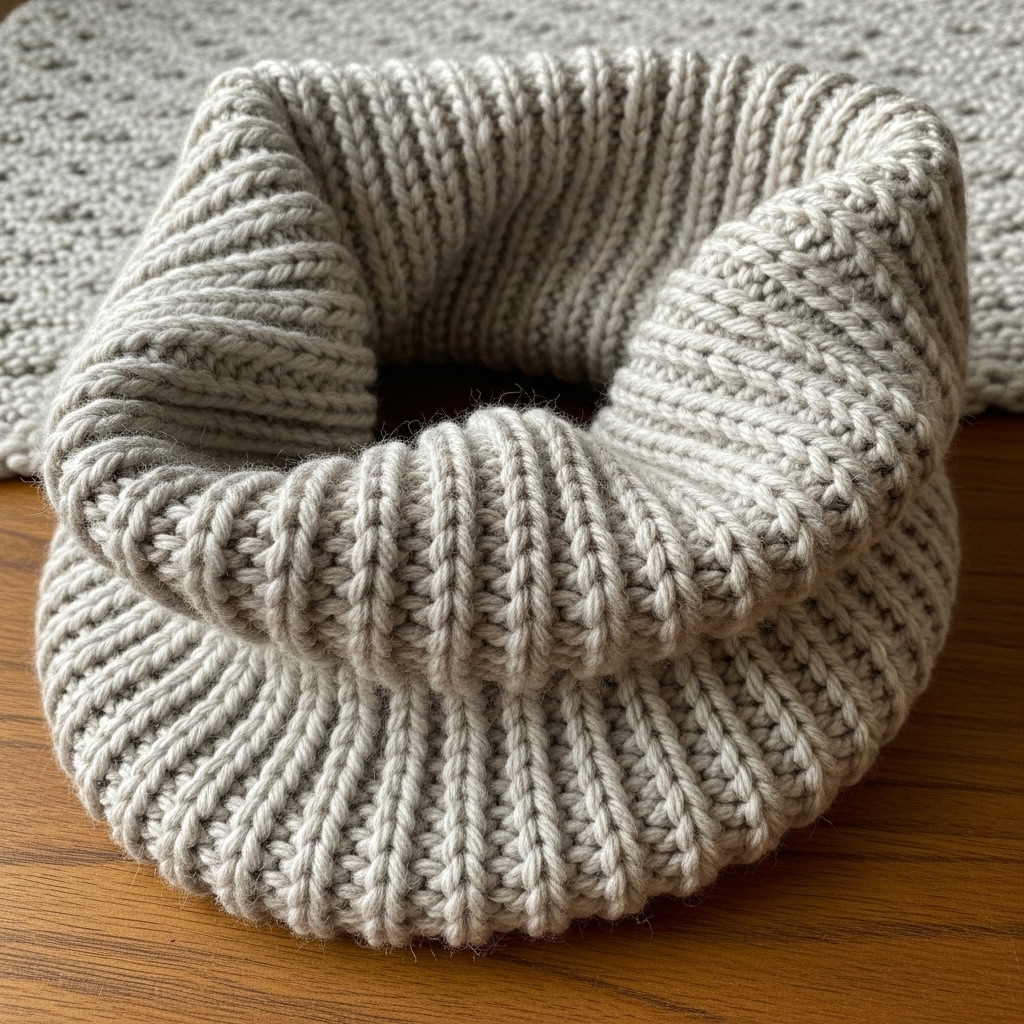
Classic, stretchy, and cozy: deep ribbing created with post stitches gives a knit-like elastic texture that hugs the neck.
Skill level: Confident beginner (post stitches and working in the round)
Materials: 200 yds bulky or worsted depending on desired thickness; Hook 6.0 mm for a bulky rib, or 5.0 mm for worsted.
Sample gauge: For ribbing aim for 3.5–4 sts/in when measured in sc; post stitches reduce stitch width so make a gauge swatch.
Finished size (sample): circumference 24 in (unstretched), height 10 in (deep rib). For a snug neck warmer reduce circumference by 2–3 in.
Stitch & multiple
Rib pattern is a straight forward multiple of 2 (alternating FP and BP stitches). For 96 sts, 96 ÷ 2 = 48 ribs.
Pattern — in rounds
Foundation: ch96, join.
Round 1 (setup): ch1, sc in each st around. Join.
Round 2 (rib start): ch2 (counts as hdc), fpdc around next st, bpdc around next st rep around. Join.
Round 3: ch2, bpdc around next st, fpdc around next st rep around. Join.
Alternating the order in the next round makes the ribs more defined and reversible.
Repeat Round 2 & 3 until height reaches desired ~9–10 in.
Top & bottom edges: Work 1–2 rounds of sc in BLO to give neat fold; fold if you want a double-thickness base (for extra warmth, fold long cowl into two and seam).
Variations & tips
- Double up yarn (held double) for plush, heavy rib.
- Make a toggle tab by leaving a vertical gap and sewing a leather button for closure.
Finishing & care
- Minimal blocking; post stitches plain up nicely after light steam. Hand wash recommended for bulky yarn.
5. Crochet Tunisian Cowl Pattern

A modern, sculptural cowl using Tunisian simple stitch (TSS) for a dense, warm fabric with subtle vertical texture. Worked on a Tunisian hook; optionally finished as a fold-over funnel cowl.
Skill level: Intermediate (Tunisian technique; but repeats are simple)
Materials: 200–250 yds worsted; Tunisian hook size 5.5 mm (or one size up from your usual) — or use a standard crochet hook and use Tunisian stitch technique on it if comfortable.
Sample gauge: TSS is dense; typical sample gauge ~12 sts = 4 in. Make a 4″ swatch.
Finished size: circumference 24 in (worked flat, then joined), width 10 in (for a tall/funnel cowl).
Construction overview
Work flat in Tunisian Simple Stitch for a rectangular panel; seam ends, and optionally fold to make a double-layer funnel cowl.
Pattern & stitch counts
Foundation: Chain 72 (for a 24 in circumference based on TSS gauge: 12 sts/in × 24 in = 288 forward? Wait — TSS uses forwards/backwards: be careful).
We must recalc carefully: If TSS gauge is 12 sts = 4 in => 3 sts/in. For 24 in circumference you need 24 × 3 = 72 sts — good: foundation ch 72.
Row 1 (Forward pass): insert Tunisian hook, pick up loop in 2nd ch from hook and each ch across (72 loops on hook). Turn.
Return pass: yarn over and pull through 1 loop (selvage), yo, pull through 2 loops across until 1 loop remains. This completes one TSS row.
Repeat: For TSS, each forward pass picks up loops across, each return pass works them off in groups of 2. Continue until fabric height is 10 in (measure as you go). Example: if rpi ~3.5 rows/in in TSS, work ~35 rows (10 × 3.5 ≈ 35). But because TSS row counts differ, check your swatch.
Optional textured variation (vertical ribs): Every 6th row, work a reverse return pass where you purl-ish the return to create slight ribbing, or alternate forward pass modifications: alternate standard TSS with a forward pass that skips every 6th loop and works a chain-stitched mesh — advanced.
Finish: Bind off Tunisian loosely: pick up next loop, chain 1 (or pull through as bind-off method), yo and pull through one loop across to secure edge, or use special Tunisian bind-off to match elasticity.
Seam: Fold rectangle to form tube and whipstitch ends with mattress stitch. If you want double-thickness funnel cowl, fold in half and seam inner short sides leaving top opening; or join ends and fold over.
Variations & tips
- Work reversible Tunisian rib stitch (Tunisian knit stitch) for a knitted look.
- Add a narrow cable by working Tunisian simple at background and Tunisian purl/knit crosses for cable effect (advanced).
Finishing & care
- Tunisian fabrics block well — pin to size and steam. For cotton, hand-wash and dry flat. Because the fabric is dense, the cowl holds structure and warmth.
General Finishing, Blocking & Sizing Tips
- Try-on as you go. If you’re making a cowl for someone with a larger head or want it slouchier, increase circumference by multiples given (8 for Dunes, 12 for Mainstream, 6 for Copenhagen, 2 for Ribbed, 3 for Tunisian in our examples).
- Blocking: Lace and textured stitches benefit from light blocking. Gently wet any cotton/plant fiber and pin to final shape. Wool benefits from steam-blocking. Avoid stretching ribbed cowls out of shape.
- Joining in rounds: If you prefer joined rounds with a seam, you can always work flat and seam later for many patterns. Post-stitch patterns are easiest worked in the round.
- Edge finishes: A reverse single crochet (crab stitch) makes a polished edge; tiny picots look feminine; a cozy folded brim adds structure (work extra rounds and fold to stitch inside).
Styling Ideas
- Desert Dunes and Tunisian make lovely statement cowls for fall outerwear—pair with a neutral wool coat and leather gloves.
- Mainstream and Copenhagen work beautifully with crisp shirts and tailored coats; the texture elevates a simple outfit.
- Ribbed cowl is your everyday go-to: tuck into pea coats or wear slouched over hoodies.
- Make cowls in gradient or variegated yarns for easy color interest; for minimal wardrobes, choose two neutrals (one main, one contrast) and swap color placement.
Conclusion
These five textured cowls — Desert Dunes, Mainstream, Copenhagen, Ribbed, and Tunisian — cover a spectrum from airy openwork to dense, warm structure. Each pattern is designed to be adaptable: change yarn weight and hook to scale size and mood, alter stitch repeats to fit your gauge, and add linings or trims to suit function and style. Pick one based on your skill level and the look you want (sculptural ridges, bobbles & mesh, mosaic texture, classic rib, or Tunisian density) and you’ll have a chic, handmade cowl to wear or gift.