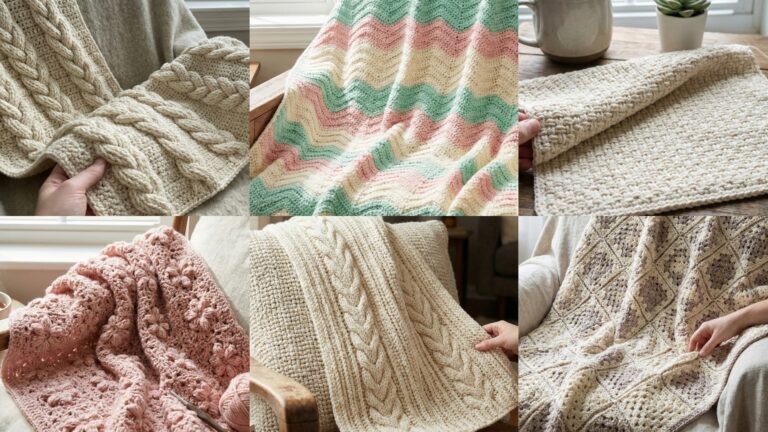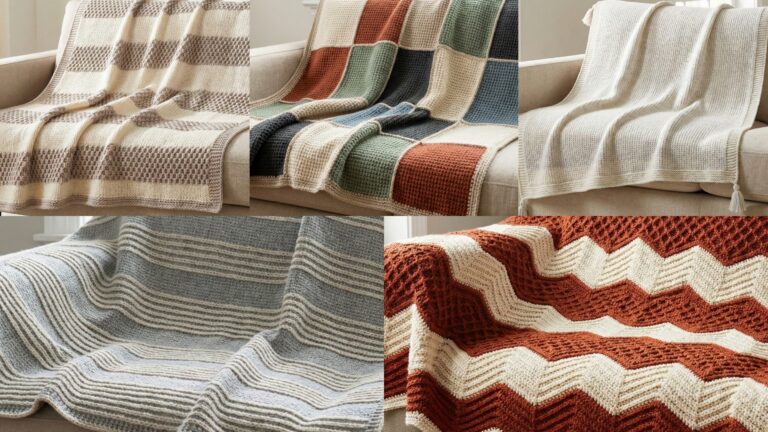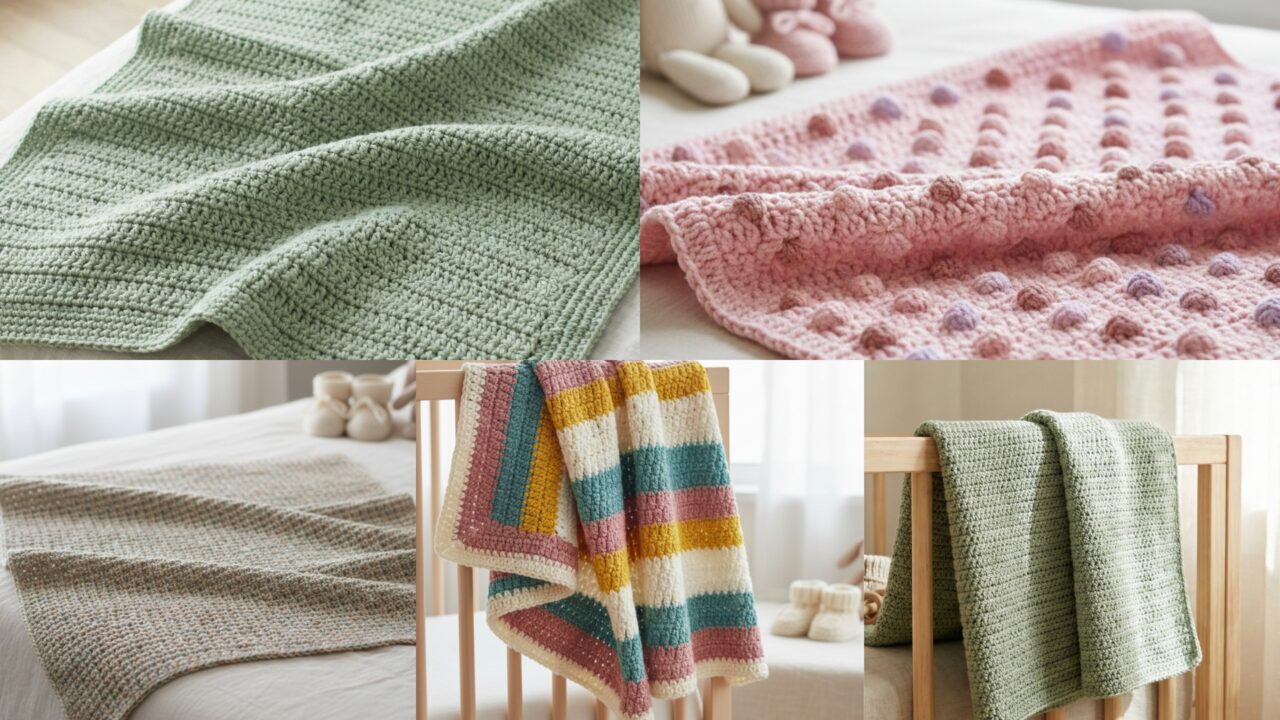
Baby blankets are one of the most loved crochet projects — easy to personalize, perfect for practicing texture and color, and always deeply appreciated as a newborn gift. Below you’ll find a friendly introduction (tools, yarn, suggested sizes and how to calculate stitch counts), followed by five complete, detailed patterns with step-by-step instructions, sample calculations, finishing notes and variations. Each pattern is written so you can follow it start-to-finish and adapt to your preferred yarn, gauge and final size.
Quick essentials — tools, yarn, sizes, gauge & abbreviations
Tools & notions
- Crochet hook(s): for baby blankets you’ll most commonly use 4.0–6.5 mm depending on yarn. I’ll list a suggested hook per pattern but always swatch first.
- Notions: tapestry needle for weaving ends, stitch markers, measuring tape, blocking pins/mat.
Yarn
- For baby blankets choose soft, machine-washable yarn: 100% cotton (cool and breathable), acrylic (easy care), or a soft baby-weight acrylic/bamboo blend. For warmth choose a wool blend that’s machine washable (superwash).
- Weight suggestions: DK/Light Worsted (Category 3) or Worsted (Category 4) are the most versatile.
Sizes (common baby blanket sizes)
- Receiving / Newborn: ~30 × 36 in (76 × 91 cm)
- Stroller / Cradle: ~30 × 40 in (76 × 102 cm)
- Crib / Toddler: ~36 × 52 in (91 × 132 cm)
- Pick the size you want and adjust pattern length/width accordingly.
Gauge & how to convert to stitches
- Always make a 4 in (10 cm) square swatch in the stitch the pattern uses and block it as you would the final blanket.
- Convert your swatch to stitches per inch, then multiply by desired width to get foundation chain.
- Example, using a sample gauge of 12 sc = 4 in → that’s 3 sc per inch.
- Desired width: 36 in (crib size).
- Compute stitches: 3 × 36 = (3 × 30) + (3 × 6) = 90 + 18 = 108 stitches foundation.
- If your stitch repeat requires a multiple (e.g., multiple of 6 + 2), round your computed foundation to the nearest compatible number.
Abbreviations (US)
- ch = chain, sc = single crochet, hdc = half double crochet, dc = double crochet, tr = treble crochet, st(s) = stitch(es), sk = skip, rep = repeat, BLO/FLO = back/front loop only, sl st = slip stitch.
1. Crochet No Holes Baby Blanket Pattern
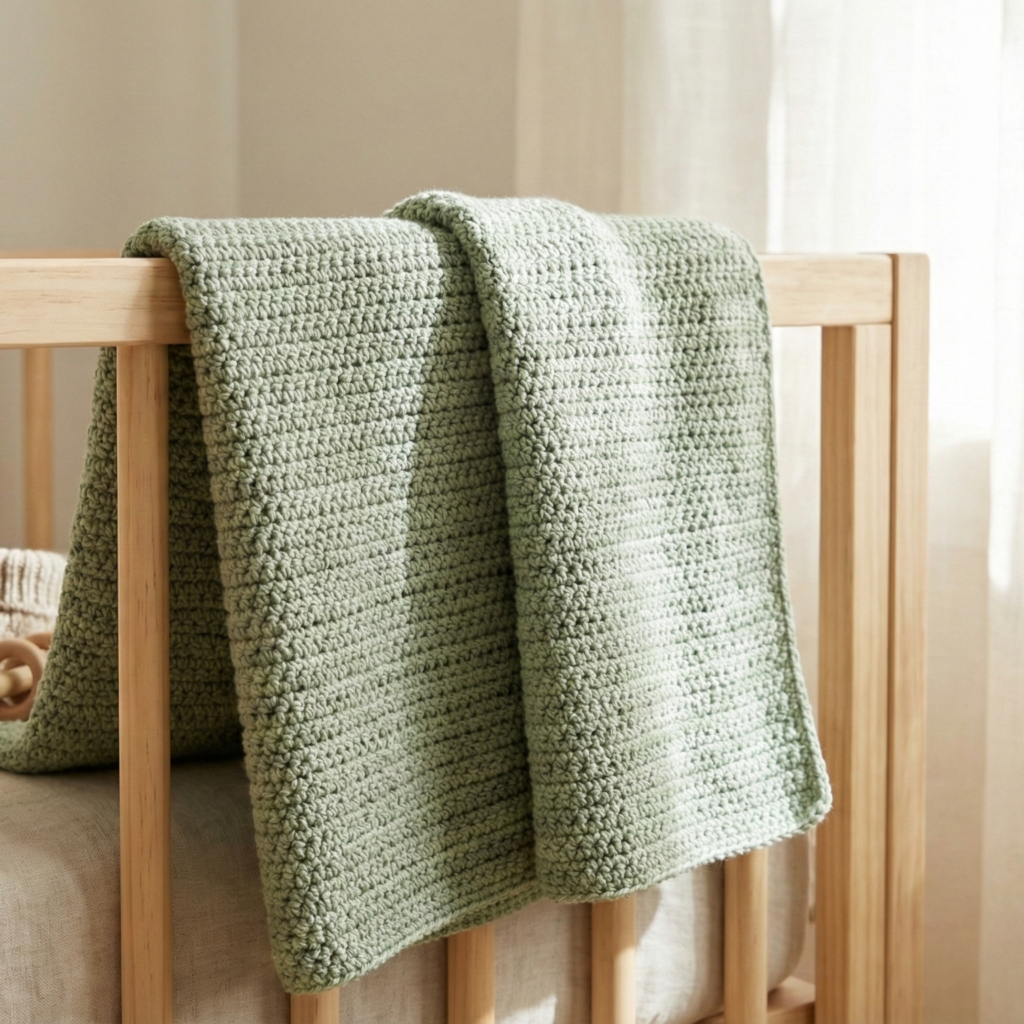
A dense, cozy blanket with minimal gaps — perfect for newborns and cuddly naps.
Skill level: confident beginner
Suggested yarn & hook (sample)
- Worsted weight (Category 4), 1,800–2,200 yd for a 36 × 52 in crib blanket (estimate—depends on yarn & gauge).
- Hook: 5.5 mm (I/9) (adjust to your swatch).
Finished (example)
- Crib blanket: 36 in wide × 52 in long (use the calculations below to scale).
Why “no holes”?
This design uses dense stitches (hdc/sc) and worked edges so the final fabric is solid and warm — excellent for a baby who needs cozy coverage and for machine-washing without snagging.
Stitch concept
Main fabric = alternating rows of hdc and sc (or all hdc worked tightly), with a stable border in sc worked around to close any minor gaps.
Calculation example (digit-by-digit)
Use your swatch to find stitches per inch. If your hdc swatch shows 12 hdc = 4 in, that equals 3 hdc per inch. For a 36 in width:
3 × 36 = (3 × 30) + (3 × 6) = 90 + 18 = 108 foundation stitches.
If you prefer sc gauge and it’s different, use that number — always recalc from your actual swatch.
Step-by-step (crib example using 108 foundation sts)
Foundation
- Ch 108 + 2 turning ch (turning ch 2 counts as first hdc).
Row 1 (establish base): hdc in 3rd ch from hook (counts as hdc), hdc across to end; turn.
Row 2: ch 1, sc in each st across; turn.
Row 3: ch 2, hdc in each st across; turn.
Repeat Rows 2–3 until the blanket measures desired length (here 52 in). Keep track: if your row gauge is, for example, 6 rows = 1 in (measure this in your swatch), you’ll need 6 × 52 = 312 rows — measure as you work.
Border
- When desired length is reached, work a round of sc around the whole rectangle: sc evenly across edges, working 3 sc in each corner to keep it square.
- For a thicker border, do 2–3 rounds of sc (or 1 round sc + 1 round reverse sc/crab stitch for a neat finish).
Finishing
- Weave in ends. Block gently (if needed) to square up edges.
Variations & tips
- For a reversible look, work every row in hdc but change the turning ch method (some rows ch 1 and sc in first st to keep tension consistent).
- Add a subtle stripe every 12 rows by switching colors for 2 rows.
2. Crochet One Stitch Repeat Baby Blanket Pattern
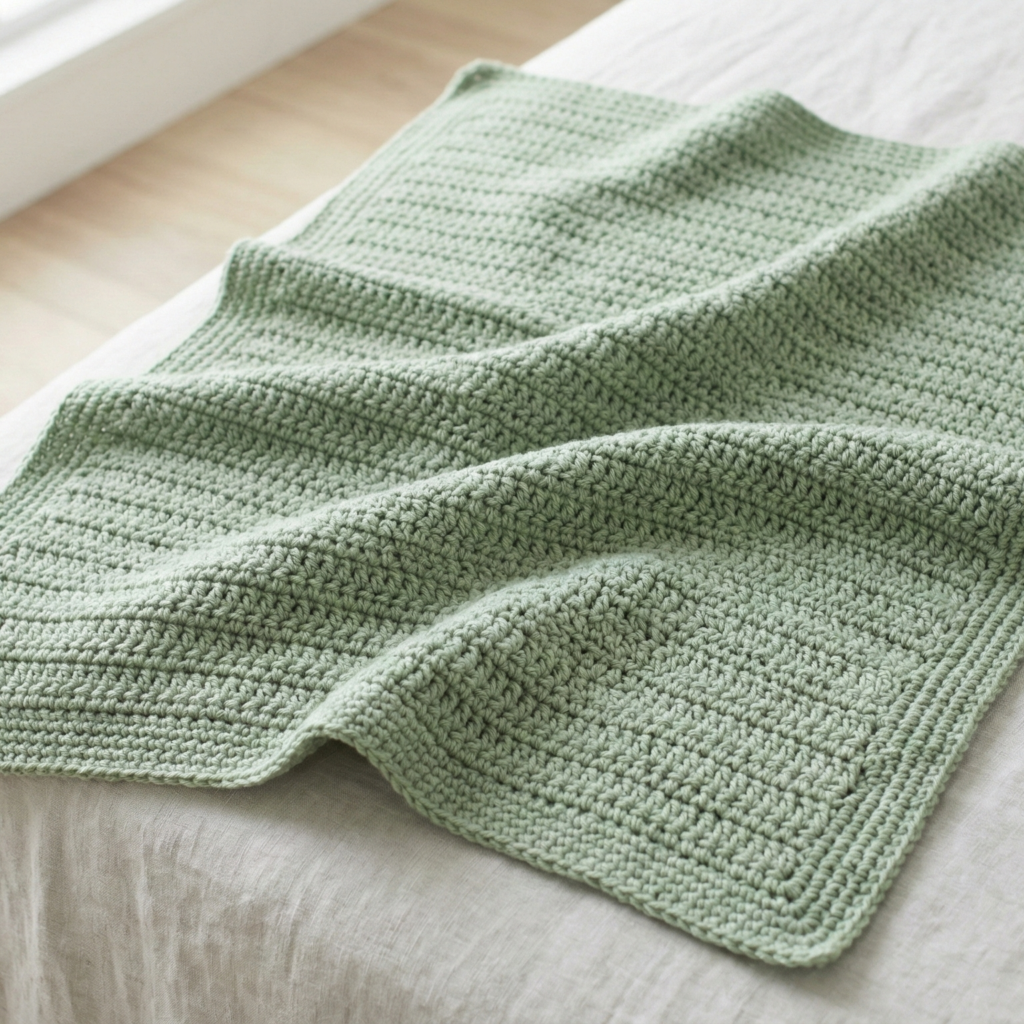
(simple, hypnotic — one stitch repeated across rows for a modern, minimal blanket)
Skill level: beginner
Suggested yarn & hook (sample)
- DK or Worsted depending on final drape — for a warm, cozy feel use worsted.
- Hook: 5.0 mm (H/8) for worsted, or 4.0 mm for DK.
Why this pattern?
A “one stitch repeat” blanket is great for beginners: you memorize a single stitch or a 1-row repeat and relax into the rhythm. Good candidates: all-hdc blanket, all-dc blanket (for drape), or linen stitch (if you want woven look but single simple repeat).
Calculation example (using 3 sc/in sample)
If gauge is 12 sc = 4 in → 3 sc/in and you want 30 in width for a stroller blanket:
3 × 30 = (3 × 30) = 90 foundation stitches.
Step-by-step — all-hdc example (stroller 30 × 40 in)
Foundation
- Ch 90 + 2 ch turning (if using hdc turning ch 2).
Row 1: hdc in 3rd ch from hook and across; turn.
Row 2 onward: ch 2, hdc in each st across, turn.
Repeat Row 2 until blanket reaches ~40 in long (measure as you go).
Border: 1–2 rounds sc around to stabilize edges.
Variation (all-dc for drape): use ch 3 turning and dc rows instead; this yields an airier blanket.
Tips
- If you prefer a textured look while still repeating one stitch, try the front post double crochet (FPDC) every 4th stitch to create subtle ribs while still repeating a single operation: e.g., fpdc, dc, dc, dc repeat across (it’s still a simple, repetitive motion).
3. Crochet Berry Blossom Baby Blanket Pattern
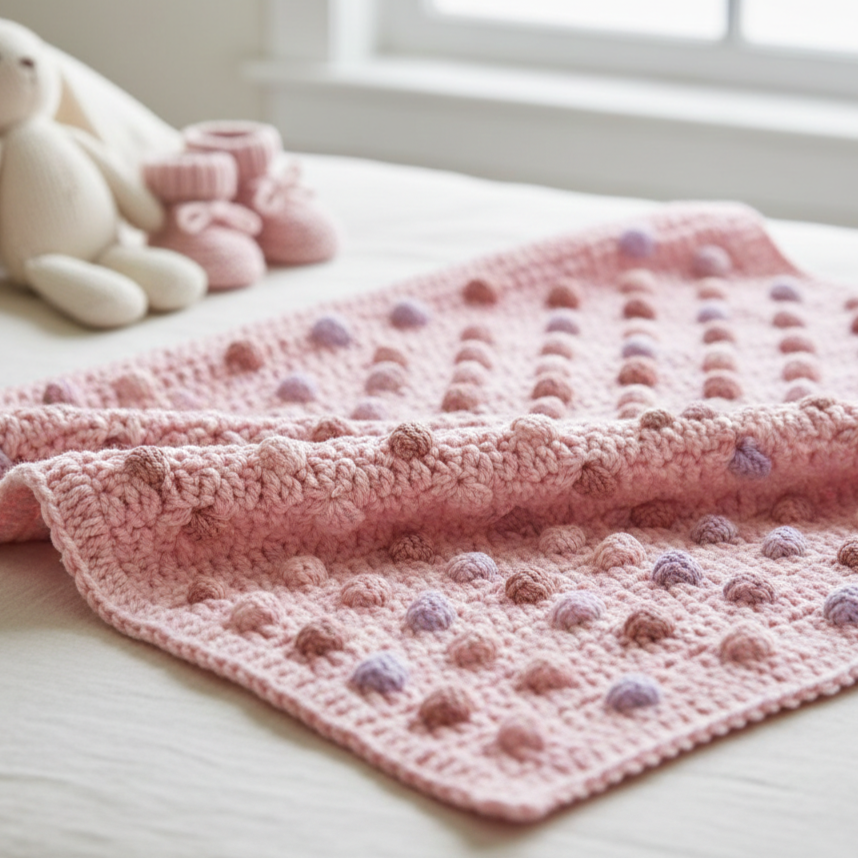
(sweet, raised bobbles that read as tiny flowers across a soft background)
Skill level: intermediate (bobble/stitch clusters)
Suggested yarn & hook
- Worsted or DK — choose soft baby yarn.
- Hook: 5.0–5.5 mm (H/I) depending on yarn.
Finished (example)
- Receiving: 30 × 36 in; crib: 36 × 52 in. Berry clusters add bulk so you’ll use more yarn — allow for 2,000 yd for a crib with bobbles in worsted.
Stitch concept
A textured background (hdc or moss stitch) with evenly spaced bobble clusters (5–dc bobbles) arranged on a grid so the blanket looks like a field of tiny berries.
Sample calculation (digit-by-digit)
If your swatch shows 12 sts = 4 in in your chosen background stitch → 3 sts/in. For 36 in width: 3 × 36 = (3 × 30) + (3 × 6) = 90 + 18 = 108 foundation stitches.
Plan a grid spacing: e.g., place a bobble every 6 sts and every 6 rows. Since 108 ÷ 6 = (108 ÷ 6) = 18 → you’ll have 18 positions across.
Step-by-step (layout & repeats)
Foundation & background
- Ch 108 + turning ch (if using hdc, ch 2).
- Work 3 rounds of hdc (or desired background stitch) to set base.
Row pattern (example mosaic)
- Use a 6-row repeat for rows:
- Rows 1–2: hdc in each st across.
- Row 3: hdc across but make a bobble placeholder every 6 sts: work hdc 5, then ch 2 (or simply mark the st) and continue; (we’ll actually create bobbles on a later row).
- Row 4: hdc across.
- Row 5: bobble row — where marker indicates, work 5-dc bobble: (yo, insert, pull up loop) × 5, yo, pull through 10 loops, sl st to close bobble; secure with a sc after to anchor. Else hdc.
- Row 6: hdc across.
Repeat Rows 1–6 until desired length.
Edges: Work a tidy sc or reverse sc border.
Finishing: Weave ends; steam block to shape. The bobbles will relax; stuffing inside bobble isn’t needed — they’re structural.
Variations & styling
- Use two colors: contrast the bobble color for a polka-dot effect, or hold a halo mohair strand for fuzzy berries.
- For extra softness, use a plush chenille yarn in the background and reserve cotton for bobbles.
4. Crochet Linen Stitch Baby Blanket Pattern
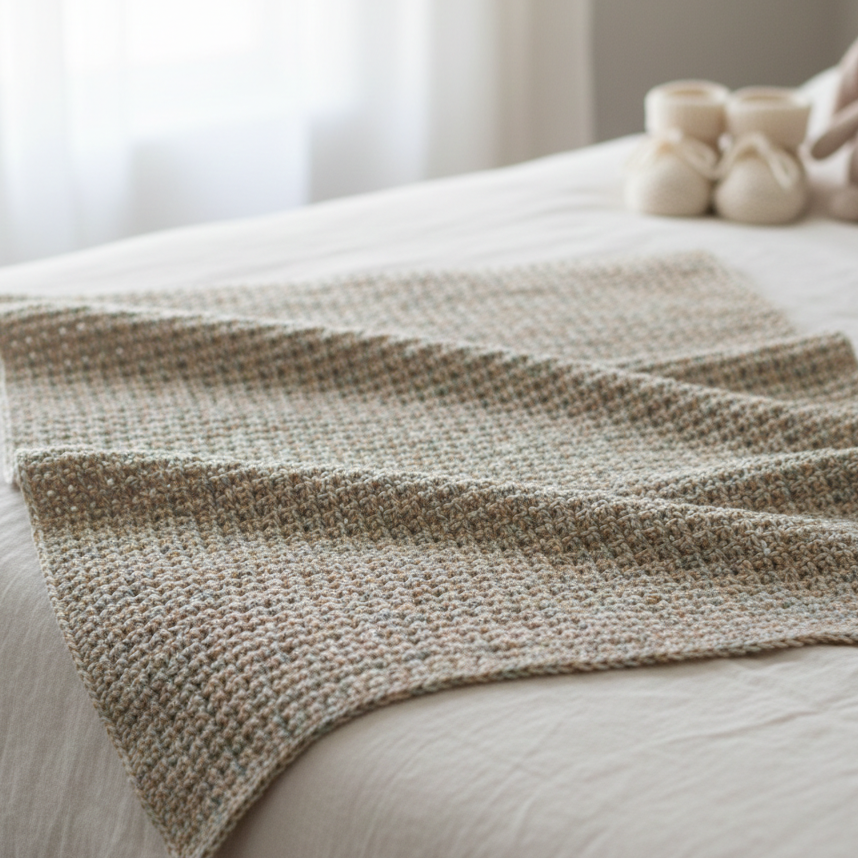
(a refined, woven look that’s soft and drapey — excellent for gender-neutral gifts)
Skill level: confident beginner
Suggested yarn & hook
- DK or light worsted (Category 3/4) soft yarn — 1,400–1,800 yd for crib size in worsted.
- Hook: 4.0–5.0 mm depending on yarn.
Why linen stitch?
The linen (moss) stitch is dense but slightly flexible: it uses sc and ch-1 spaces to create a fabric that looks woven but is still stretchy and lies flat.
Stitch concept
Two-row repeat:
- Row A: sc in next st, ch 1, sk next st, sc in next, ch1 across.
- Row B: sc in each ch-1 space and each sc across (locks the weave).
Calculation example
If gauge is 12 sc = 4 in → 3 sc/in, desired width 36 in → 3 × 36 = (3 × 30) + (3 × 6) = 90 + 18 = 108 foundation chains (plus turning ch if pattern requires).
Step-by-step (crib example)
Foundation
- Ch 109 (for linen stitch you usually chain an odd number; here 108 sc width needs 109 ch to start) — check your stitch multiple: linen stitch works on odd numbers if doing the basic version.
Row 1 (RS): sc in 2nd ch from hook, ch 1, sk next ch, sc in next ch; repeat to end; turn.
Row 2 (WS): ch 1, sc in each ch-1 space and sc across; turn.
Repeat Rows 1–2 until desired length.
Border: a couple rounds of sc around, or a 1-round crab stitch (reverse sc) for a neat, non-curling edge.
Tips & variations
- Linen stitch shows color subtly — variegated yarn gives a watercolor plaited effect.
- For a chunkier blanket, hold two strands of DK together and use a 6.0 mm hook; the same pattern still works.
5. Crochet Beginner Stripes Baby Blanket Pattern
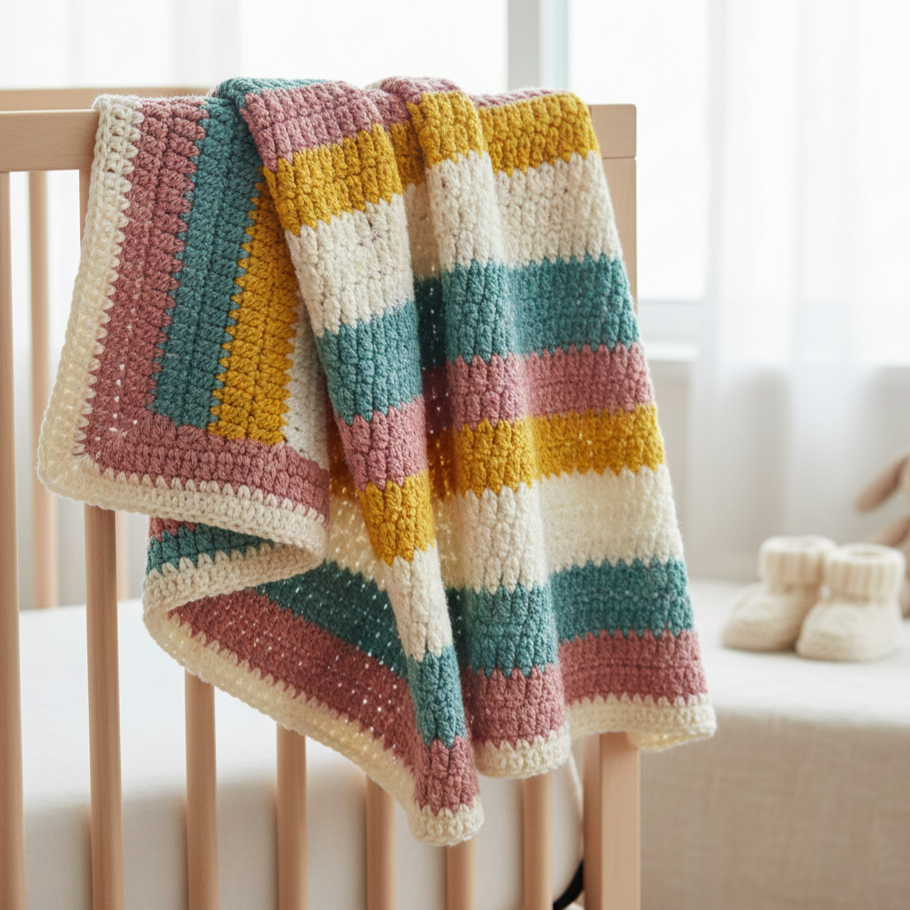
(a cheerful striped blanket — perfect for using up yarn and practicing color changes)
Skill level: beginner
Suggested yarn & hook
- Worsted weight yarn in 3–5 colors; total yardage similar to Pattern 2 depending on size.
- Hook: 5.0–5.5 mm.
Why stripes?
Stripes are beginner-friendly and let you customize color cadence: wide stripes, thin ballerina stripes, or a gradient.
Calculation example
Working in a simple hdc or dc gauge where 12 hdc = 4 in → 3 hdc/in. For stroller width 30 in: 3 × 30 = (3 × 30) = 90 foundation stitches.
Step-by-step (stroller 30 × 40 in example)
Foundation
- Ch 90 + 2 turning ch (for hdc).
Row 1: hdc in 3rd ch from hook and across; turn.
Row 2–N: Work even hdc rows. Change color every X rows for stripe width:
- Narrow stripes: change color every 2 rows.
- Medium stripes: change every 6–8 rows.
- Wide stripes: change every 12–20 rows.
Color change tips
- Fasten off each color and weave tails (neat and lightweight), or carry color up side if floats < 6 in (to avoid big floats).
- To do an invisible color change, on last stitch of old color work up to last yarn-over, yarn over with new color and complete the stitch — this makes color transitions neat.
Border
- When blanket reaches length, work a round of sc in contrast color to frame stripes. Optionally work a scallop border if you prefer a feminine edge.
Finishing
- Weave ends as you go (this saves a ton of finishing). Block to flatten if needed.
Variations & styling
- Alternate textured rows (e.g., every 6th row convert to a linen stitch or a row of shells) to add interest.
- Use a self-striping yarn for no-fuss gradient effect.
Final finishing & care notes (applies to all patterns)
- Weave in ends securely. For baby blankets, bury tails well and tidy knots on the wrong side.
- Blocking: many blanket stitches benefit from gentle blocking — pin to size and steam or wet-block following yarn label. Blocking evens stitches and sets drape.
- Care: choose machine-washable yarn for baby items. Use a gentle detergent and tumble low or air dry per yarn instructions. If you used specialty yarns (mohair, chunky wool), include washing instructions for the recipient.
- Safety: avoid small detachable embellishments (buttons, beads) unless very securely sewn and intended for nursery decor only (not a toy). For newborns avoid ribbons or cords that could be a hazard.
conclusion
Each of these five baby blanket patterns brings a different mood: the No Holes blanket is warm and protective; the One Stitch Repeat blanket is minimalist and perfect for beginners; Berry Blossom is charmingly textured; Linen Stitch is refined and woven; and Beginner Stripes is cheerful and endlessly customizable.
Pick a yarn you love, swatch carefully, compute your foundation with the digit-by-digit method shown above, and follow the step-by-step guide for a blanket that’s both beautiful and practical. Baby blankets are forgiving projects — you can easily scale, swap colors, or combine elements from different patterns (for example, stripe the Linen Stitch blanket) to create a truly unique heirloom. Happy crocheting!