

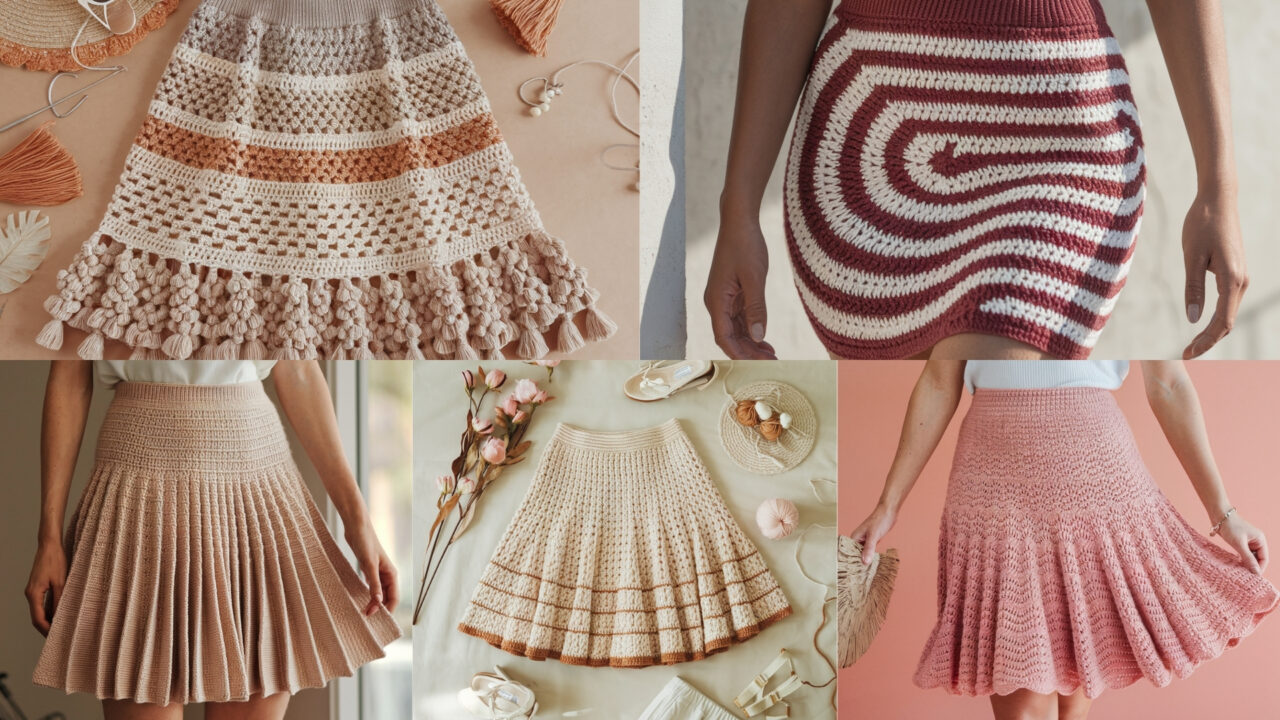
A handmade crochet mini skirt is a fun project that lets you show off stitch texture, play with color and silhouette, and have a one-of-a-kind wardrobe piece. Below are five fully worked concepts — Shell Stitch Mini Skirt, Golden Hour Skirt, Vertigo Spiral Skirt, Boho Mini Skirt, and Pleated Skirt — each with a clear introduction, skill level, yarn & tool recommendations, sizing & gauge guidance, step-by-step construction methods (waistband → body → finishing), fitting notes, variation ideas, and care instructions. I wrote them so you can actually make each skirt: follow the swatch math and the construction notes and you’ll be able to adapt for any size or yarn.
Read the general notes first — they’ll save you time when adjusting fit or changing yarn.
General notes (read before you start)
US crochet terms used throughout. Common abbreviations: ch, sc, hdc, dc, tr, sl st, st(s), rep, inc, dec, BLO/FLO, RS/WS.
Sizing (finished waist circumference recommendations) — choose target finished waist measurement = wearer’s waist circumference + ease (mini skirts usually sit on hips or high waist; pick where you plan to wear it).
Suggested finished waist (inches) — approximate:
- XS: 26–28 in
- S: 28–30 in
- M: 30–33 in
- L: 33–36 in
- XL: 36–40 in
Length (mini) typically 14–17 in from waist depending on how mini you want it. For a low-rise mini, reduce by 1–2 in.
Ease: For fitted miniskirts choose -0.5–0 in ease (very fitted) or +0.5–1 in for comfortable pull-on fit. If using elastic waist choose +1–2 in.
Gauge & swatch: Always make a 4 in × 4 in swatch in the stitch used. Measure stitches per inch (SPI) and rows per inch (RPI). Use that to calculate required number of stitches for circumference:
starting_stitches = round((finished_waist_in_inches) × SPI)
Round to nearest multiple required by your stitch repeat (I indicate repeat multiples for each pattern).
Construction approaches:
- Tube in the round (no seam) — easiest for fitted skirts and professional-looking horizontal stitch patterns.
- Panel method (seamed) — good for worked flat stitches, pleats, panels or vertical shaping.
- Top-down vs bottom-up: All patterns here are top-down (waist first) so you can try on as you go, adjust fit, and easily create waist shaping or raglan-like flares.
Closures: Elastic waist, crocheted drawstring, or hidden zipper (sewn into one side seam) are common. Elastic is fastest and safe in a fitted mini.
Lining: For thin yarns, open lace or mesh, or lightweight clothing fabrics, I recommend lining to prevent transparency and to make the skirt more comfortable. Sew a simple cotton lining or lightweight jersey to the inside.
Safety & comfort: Choose yarn not scratchy against skin (cotton blends, soft acrylic, or wool blends). For hips and thighs choose some elastic content or sizing with small ease to prevent slipping.
1. Crochet Shell Stitch Mini Skirt Pattern
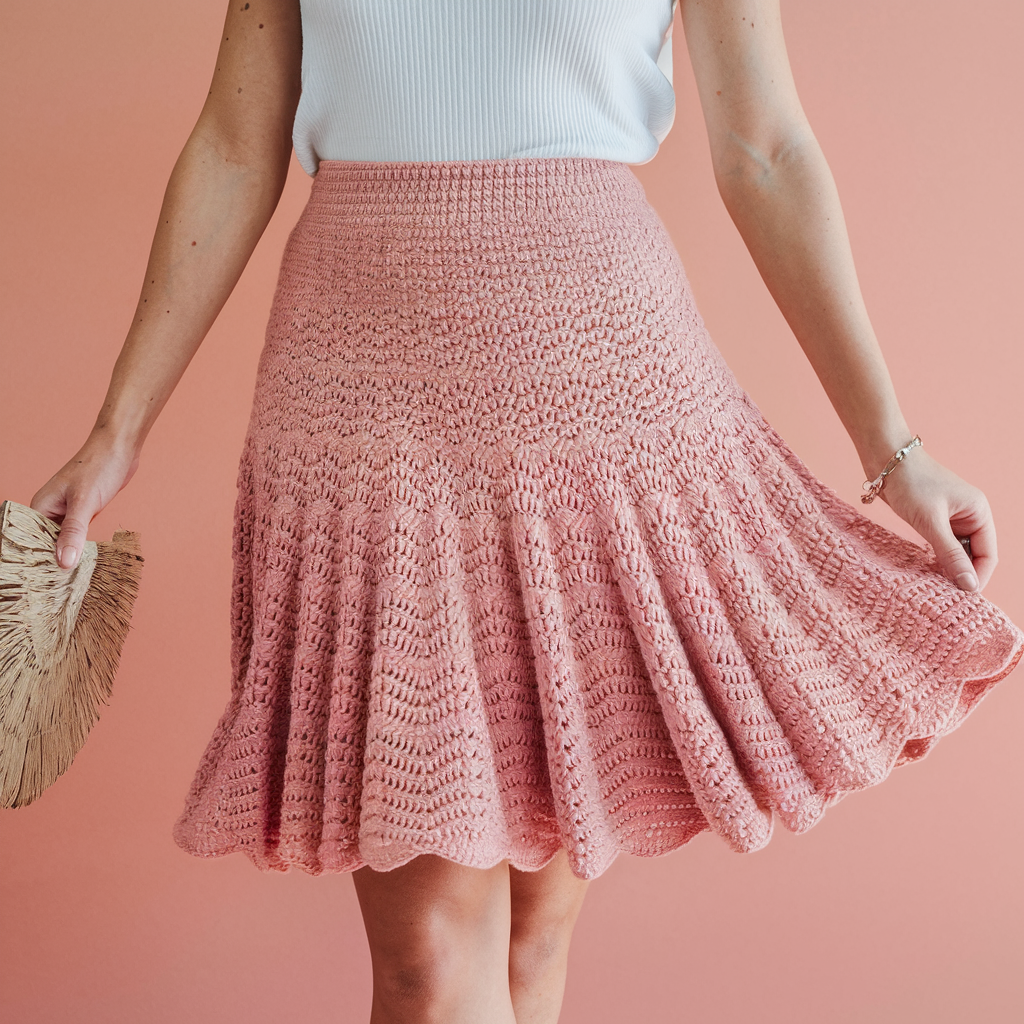
Style & vibe
A feminine, slightly vintage mini skirt with rows of delicate shell stitches that create a flared-but-structured silhouette. Works great in cotton or cotton-blend for warm-weather wear.
Skill level
Confident beginner — shell stitch repeats and working in the round.
Materials & tools (sample for size M)
- Worsted weight cotton or cotton-blend yarn (category 4), ~700–900 yds depending on length.
- Crochet hook 4.5 mm (use hook to match gauge).
- 1 in (2.5 cm) wide elastic = waist circumference minus 1–2 in (for snug fit).
- Tapestry needle, safety pin for threading elastic, stitch marker.
Gauge (example)
- In shell pattern (dc shells), 14 sts × 6 rows = 4 in. Measure your swatch and use SPI.
Stitch repeat & multiple
Classic shell = (5 dc in one st, skip 2). The overall repeat often works on a multiple of 6 or 10 depending on the shell construction — we’ll use a multiple of 6 in this example.
Sizes & starting stitch math (example using 3.5 sts/in SPI)
Finished waist / target stitches (approx):
- S (29 in) → 29 × 3.5 ≈ 102 → round to 102 (multiple of 6 = 102 OK)
- M (32 in) → 112
- L (35 in) → 123 → round to 126 (nearest mult of 6)
Adjust to your swatch.
Construction (top-down tube)
Waistband (elastic casing approach)
- Ch
stitchesto desired waist circumference (e.g., 112 ch for M). Join with sl st to form ring—do not twist. Mark the join. - Round 1: Work 1 round sc in each ch (or use hdc if you want slightly taller casing) to create a firm waist band — this round is the inside top of skirt.
- Work 6–8 rounds sc (or hdc) to build the casing height for elastic (if using 1 in elastic, make casing about 1.25 in tall). Fasten off but leave a tail OR keep working and plan to insert elastic later.
Optional: crocheted waistband (no elastic)
If you prefer a crocheted elastic-like waistband, work 6–8 rounds of BLO hdc for stretch. No casing needed.
Shell body pattern (start right under casing):
Use the shell repeat:
- Round A: skip 2 sts, 5 dc in next st, skip 2 sts, sc in next st — repeat around. (You will be placing shells into single-stitch anchors to create distinct shells.)
- Round B: Sc into center of each shell to anchor; this keeps rows stable.
Work pattern: Repeat Rounds A–B alternately until skirt reaches desired length (e.g., 14 in). Note: Shell rows create vertical flare; if you want a straighter fitted mini, reduce flare by working narrower shells (3 dc instead of 5) or adding occasional decrease rounds.
Shaping tips: If skirt feels too tight at hips, after 3–4 shell repeats, increase evenly 6–12 sts across a round (add inc positions every few repeats) to allow hip ease. Because you’re working top-down, try on periodically.
Hem & finishing:
- Finish with 2 rounds sc in the last round to stabilize hem. Optionally add an outer picot or small shell edge (3 dc shell) for decoration.
- Insert elastic: if you left a casing, thread elastic and sew ends securely, then sew opening closed with ladder stitch.
Lining (optional): Sew a cotton lining to the inside using hand-stitches or machine if you have matching fabric. Attach lining only at waistband for removable lining option.
Styling & variations
- Use 3-dc shells for subtler texture, or 7-dc shells for more dramatic scallops.
- Make skirt colorblocked: change color every 4 shell rows.
- Add a small drawstring within casing for adjustable fit.
2. Crochet Golden Hour Skirt Pattern
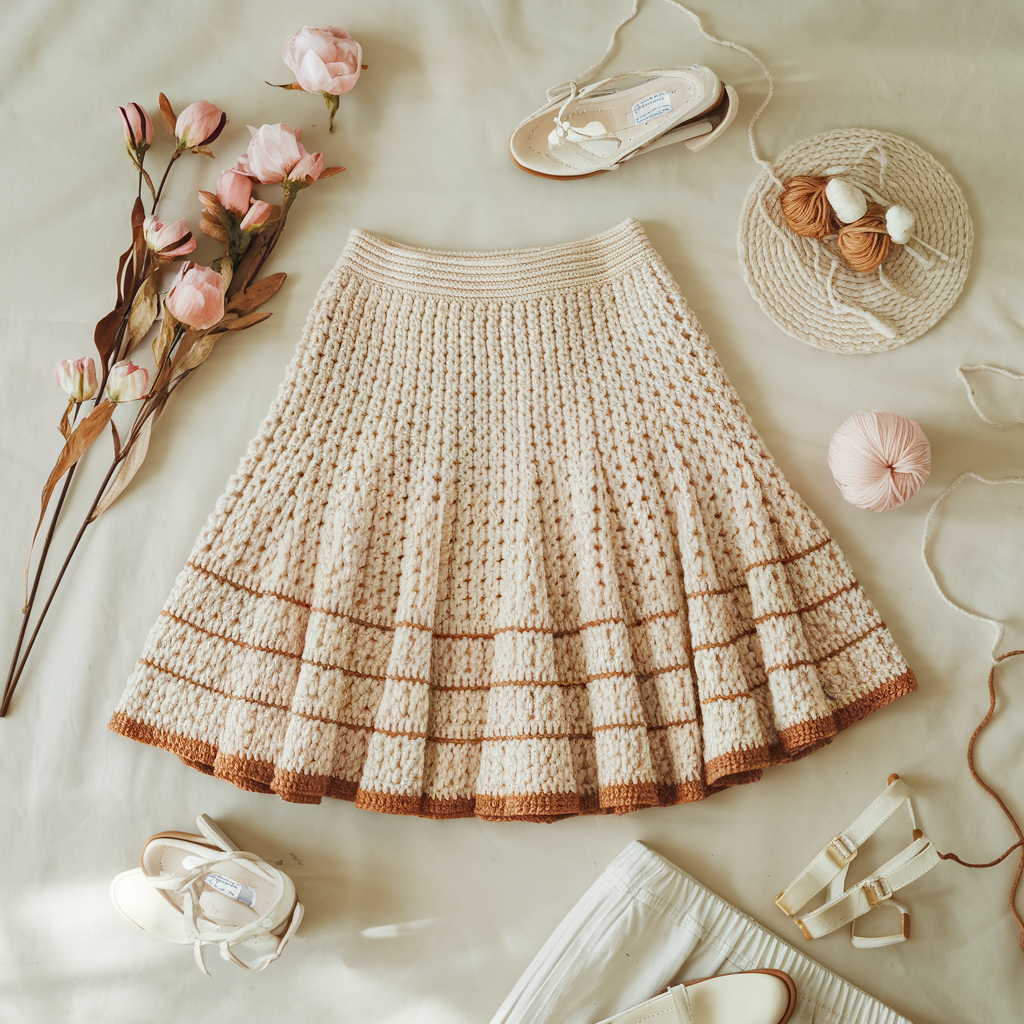
Style & vibe
Gradient-focused skirt that looks like a sunset: worked in rows with long horizontal color transitions or gradient yarn (cake yarn). The body uses a flattering half-double crochet (hdc) rib with gentle A-line shaping.
Skill level
Confident beginner
Materials & tools
- DK/worsted gradient yarn cake or 3 coordinating solids (light → medium → dark), ~900–1100 yds depending on size & length.
- Hook 4.0–4.5 mm (use swatch gauge).
- Optional zipper for side seam or elastic + casing.
- Tapestry needle.
Gauge
- Example: 18 hdc × 8 rows = 4 in in hdc (adjust to your yarn).
Repeat & multiples
Hdc works in any stitch multiple; plan stitches from waist math.
Construction (top-down, slight A-line shaping)
Waistband option: crocheted elastic band (BLO hdc) for comfort and less bulk.
- Ch
stitchesfor waist (calculate as before). Join and work 6 rounds of BLO hdc for a comfy band.
Body (hdc vertical bar rows):
2. From round 7, work in hdc in each st in the round. To add shaping to hips and then gentle A-line, every 6th round add inc 6–10 sts evenly spaced (i.e., hdc, hdc inc at set points). Continue increases until hips are comfortable (measure), then stop increasing and continue straight for the length you want.
Color transitions:
- If using gradient cake, let the yarn flow naturally.
- If using solids, work 6–8 rounds per color; blend edges by alternating A/B rows for 4 rows where A/B alternate to blend without obvious bar.
Optional design detail (sunburst hem):
- After desired length, add an openwork row (e.g., dc, ch2, skip1) to create airy hem reminiscent of sun rays, then finish with a shell round (5 dc shells) as a framed border.
Closure: Elastic band will make it pull-on. For more fitted looks add an invisible side zipper — pick side seam and stitch zipper after finishing.
Fitting tips
- Gradient allows visual slimming; keep vertical hdc for elongation.
- If you want the skirt to sit high on waist, make waistband 2 in narrower.
3. Crochet Vertigo Spiral Skirt Pattern
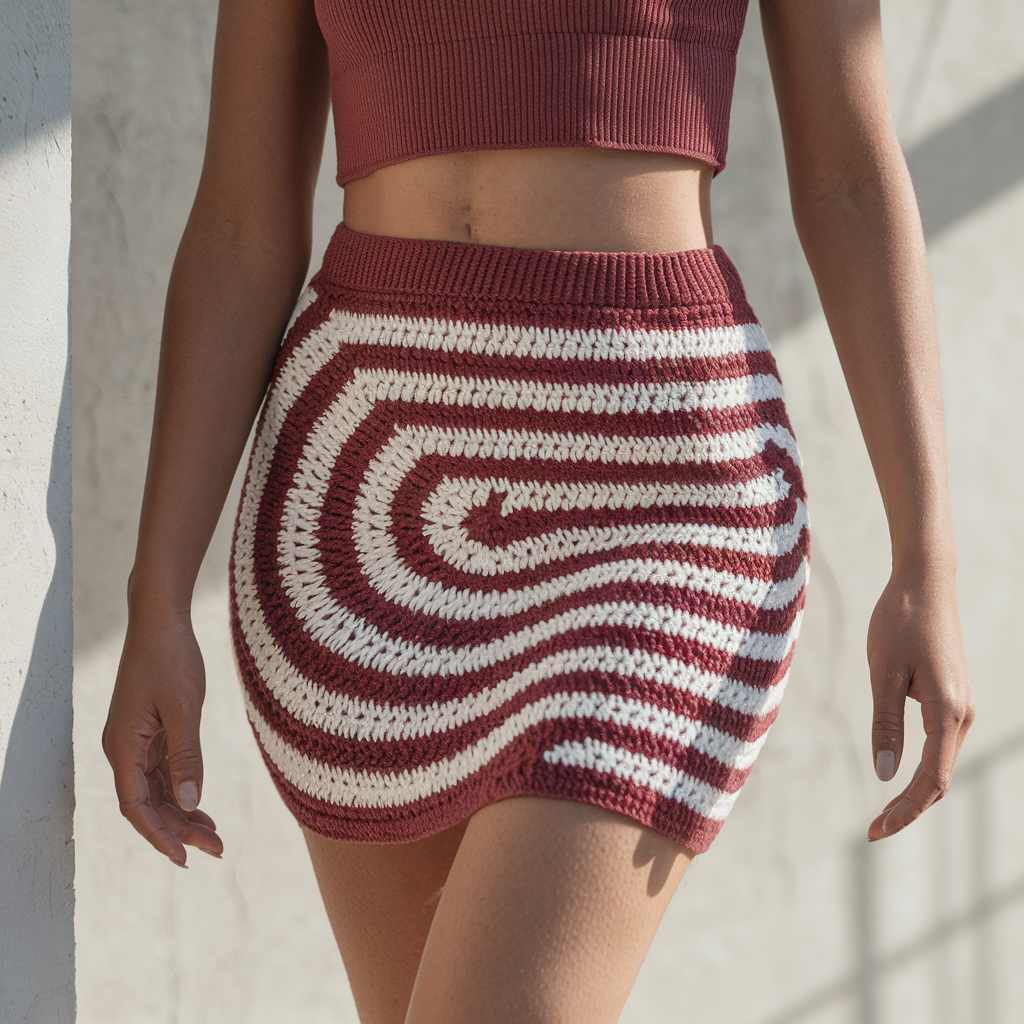
Style & vibe
A dynamic, figure-hugging mini that uses offset increase/decrease placement in successive stripes to create a spiral/vertigo optical effect. Great with high-contrast stripes or two-tone yarn.
Skill level
Intermediate — requires charted increases/decreases and keeping stitch counts consistent.
Materials & tools
- Two solid worsted yarn colors (contrast A & B) OR gradient cake in high-contrast hues; ~850–1000 yds.
- Hook 4.5 mm.
- Elastic for waist or crocheted drawstring.
- Stitch markers.
Key concept
You’ll work in the round and shift the increase/decrease positions along the round every few rows to make a spiral band of visual movement. The skirt is fitted through hip with small gradual flare.
Construction (top-down fitted)
Waistband: Ch stitches and work 8 rounds of BLO hdc or sc. Insert elastic or create casing.
Spiral pattern setup: Decide stripe height (e.g., 2 rounds A then 2 rounds B). We will place short increases (2 inc into same st) on one round and corresponding decreases (sc2tog or dc2tog in shell context) on another round spaced several stitches apart. When you move the position of those increases/decreases by 1–2 sts each stripe, you create a spiral.
Step-by-step sample (conceptual)
- Start round with a marked increase position (marker at stitch #1).
- Round 1–2 (Color A): work even in hdc for 2 rounds.
- Round 3–4 (Color B): place 6 small increases evenly around (hdc inc in same st), they add width in those columns. Continue even elsewhere.
- Round 5–6 (Color A): place 6 small decreases in positions that are offset by 2–3 sts from previous increases. This will cause a band to subtly shift — create spiral movement when repeated.
- On each new stripe move the inc/dec positions by 1 stitch forward (clockwise) — track with markers. The brain sees a spiral movement when colors, incs, and decs shift smoothly.
Work until hips are full and skirt reaches desired mini length. Finish hem with 2 rounds of sc and optional picot edge.
Fitting & math: Because you add and remove stitches via inc/dec, keep overall stitch count stable over a full lace cycle (i.e., make sure increases per cycle ≈ decreases per cycle) so the skirt doesn’t balloon. If you’re unsure, use visual fit testing frequently.
Styling tips
- Use two bold contrasting colors for maximum vertigo; tone-on-tone yields subtler spiral.
- Wear with fitted top to show off the optical effect.
4. Crochet Boho Mini Skirt Pattern
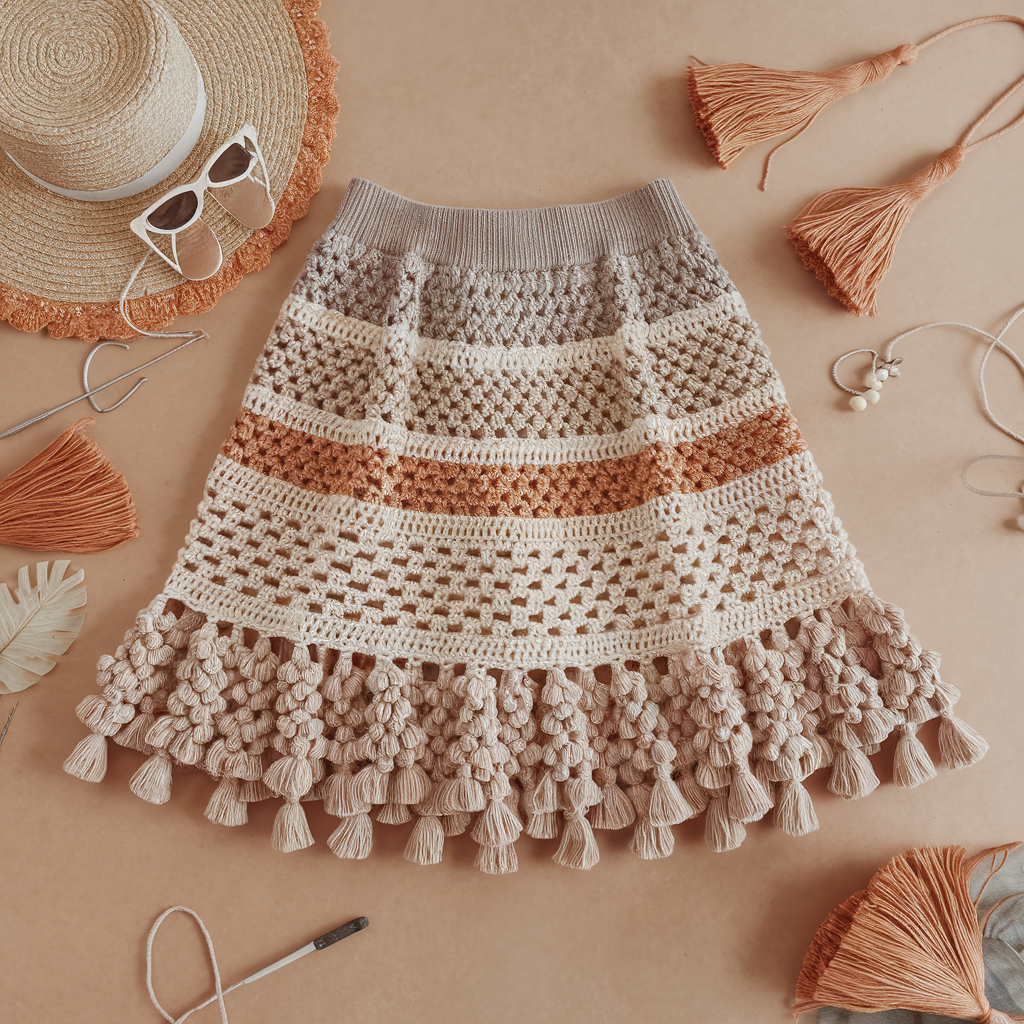
Style & vibe
Relaxed bohemian mini with textured panels, tassel fringe, and optional wrap-over front or tie detail. Great in tweedy or variegated yarns.
Skill level
Confident beginner → intermediate (texture + fringe/tassel finishing)
Materials & tools
- Sport/worsted cotton-blend for drape, ~800–1000 yds.
- Hook: 4.0–5.0 mm.
- Optional leather cord or crocheted tie.
- Tassel maker or cardboard for making tassels.
Construction options
Option A — straight tube with boho panels: Work in the round in alternating textured panels (moss/linen stitch) and openwork rows.
Option B — wrap-front boho: Work front panels and back separately, make sash for tie.
I’ll outline Option A (easier, faster).
Step-by-step (top-down tube with texture strips)
- Determine waist stitches and join in round; work 6–8 rounds sc/hdc as waistband. Consider drawing in with internal tie or elastic.
- Work alternating bands:
- Band 1 (Texture): 6 rounds moss stitch (sc, ch1, skip 1) to create woven look.
- Band 2 (Openwork): 2 rounds of dc, ch2, skip 2 mesh for breathability.
- Band 3 (Popcorn row): Work a row of puff clusters spaced every 6 sts anchored by sc rounds.
- Repeat band sequence to desired length.
- Fringe / Tassel hem:
- After finishing body, fold hem and work 2 rounds sc for base.
- Attach tassels every 3–4 sts around bottom edge (use 6–8 yarn strands per tassel, approx 2–3 in long before folding). For a boho look, vary tassel length slightly.
- Tie & waist finishing (optional): Make a narrow crocheted cord by chaining long length (~60–80 ch), slip stitch back over chain to create rope. Thread through casing or use as wrap tie.
- Lining: Because of openwork bands consider a lightweight jersey lining or shorts to make skirt wearable.
Variations
- Add small shell pockets or macrame-inspired knotted fringe.
- Use metallic thread in tassels for evening looks.
5. Crochet Pleated Skirt Pattern
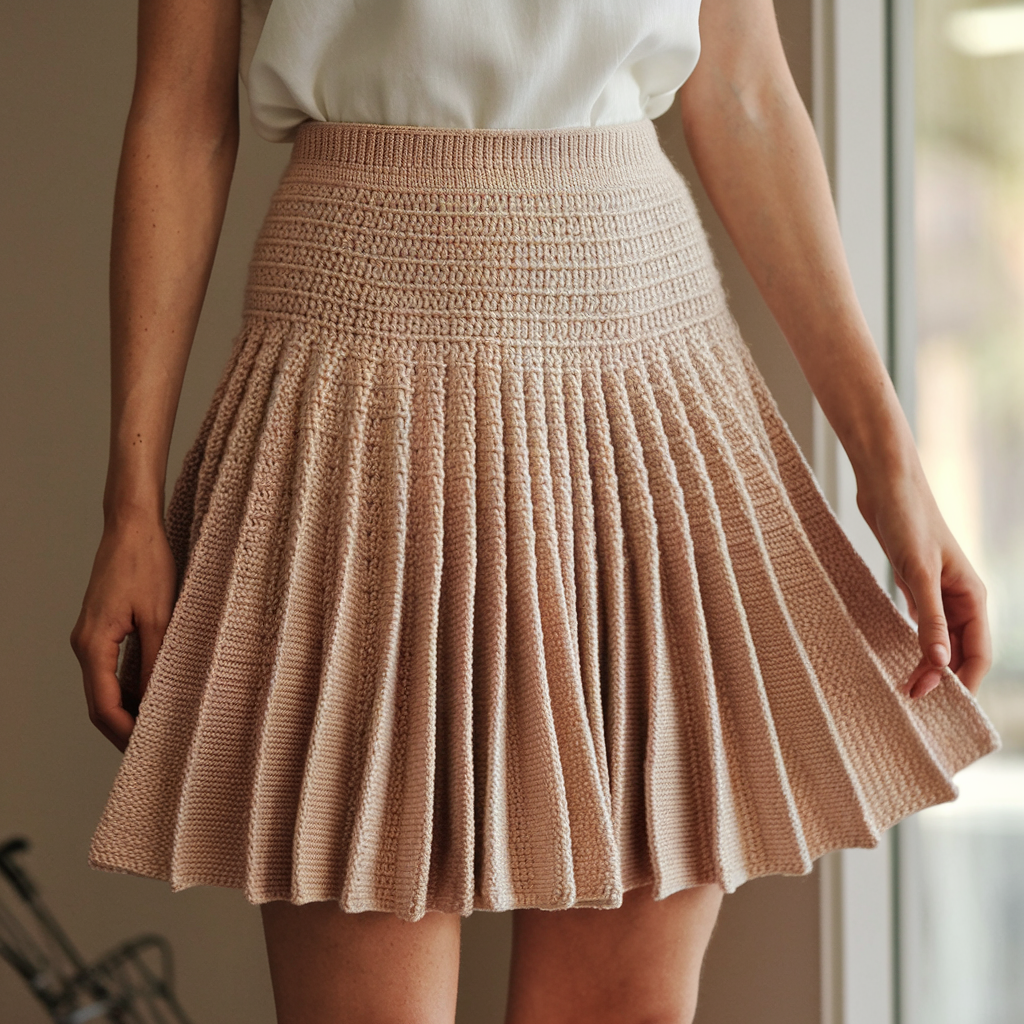
Style & vibe
A sculpted mini that mimics pleats — uses combinations of post stitches and folding to create structured pleats. Slightly more technical but provides ultra-fashion look.
Skill level
Advanced — stitch manipulation and seaming/pressing.
Materials & tools
- Worsted or aran yarn with good memory (cotton/ acrylic blend), ~900–1100 yds.
- Hook 4.5–5.5 mm.
- Optional interfacing for pleat creases (lightweight fusible interfacing if lining with fabric).
- Sewing needle, pins.
Pleat principle
You’ll create vertical pleat panels (rectangular widths) then join them with a folding seam at regular intervals, using short rows or careful post-stitch columns to form crisp folded pleats.
Construction (panel + pleat folding)
Step A – Make panels:
- Decide pleat width and number of pleats across skirt. Example: For waist 32 in, make 8 pleats of 4 in width each (account for fold overlap). Each pleat panel is worked as a flat rectangle approx 4–5 in wide and length = skirt length.
- Work panels in rows of dc or hdc to create a fabric with body. Make 8 panels.
Step B – Forming pleats & joining into skirt:
- Fold each panel at half its width inwards to form a pleat and tack the fold at top and bottom with a few whipstitches inside the seam allowance (or use matching slipstitch to hold fold in place).
- Join panels edge-to-edge so that the folded edges face one direction producing a classic box-pleat series. Use mattress stitch or single crochet seam, keeping pleat folds consistent.
Alternate technique (single-piece box-pleat):
- Work full circumference as wide strip then stitch down every N sts to create pleat tucks. For a crochet-friendly approach, you can create tuck lines by working
FPdccolumns and folding the fabric along those columns, then sewing down fold lines.
Waistband & finishing:
- Add a stable waistband: fold top edge and sew in elastic or make a wide rib band (BLO hdc) double-layered, folded and slip-stitched inside to create a neat top.
- Optionally add zipper at side seam for clean fit.
Pressing & interfacing:
- For crisp pleats, sew a lightweight lining with fusible interfacing fused to underside of pleat creases; press gently (test yarn care) to set pleats.
Tips & variations
- Pleat depth controls fullness — deeper pleats = more volume.
- Make knife pleats (all folds in same direction) for schoolgirl style; box pleats (folds meet center) for tailored look.
Final finishing & care advice (applies to all skirts)
- Try-on as you go: Because skirts are worn on body, try them on frequently and adjust increases/decreases or casing placement.
- Weave in ends & hide tails: Use a tapestry needle and weave at least 3–4 in along seam or pattern rows.
- Blocking: Light blocking helps shells/openwork lie flat; be cautious with elastic or interfacing—don’t soak.
- Lining: For lace/open patterns always consider lining to prevent transparency and improve comfort.
- Wash & care: Follow yarn label — cottons typically machine-wash gentle and dry flat; wools may need handwashing. If adding interfacing or fusible parts, washing instructions may change.
Conclusion
These five mini skirt concepts cover a wide range of aesthetics and techniques: the romantic Shell Stitch mini, sunset-inspired Golden Hour skirt, eye-catching Vertigo Spiral, relaxed Boho mini, and sculpted Pleated skirt. Each pattern is designed to be practical and customizable — choose yarn weight, hook size, length, and closures to match your taste. Because minis are small garments, they’re excellent for experimenting: try a prototype in scrap yarn to confirm fit before committing to pricey fibres.

888slot app sở hữu thư viện game bài đa dạng với hàng trăm lựa chọn, từ các game truyền thống đến phiên bản hiện đại. Dựa trên dữ liệu người chơi, ba thể loại được yêu thích nhất là Baccarat, Poker và Xóc đĩa.
66b uy tín Sảnh game xổ số, lô đề tại đây nổi tiếng với độ uy tín và trả thưởng sòng phẳng, xanh chín. Do vậy mọi người hoàn toàn có thể yên tâm tin tưởng tham gia cá cược thỏa mãn niềm đam mê của mình. Đồng thời tất cả các game đều được chúng tôi sử dụng thuật toán RNG ngẫu nhiên đảm bảo tính công bằng 100%.