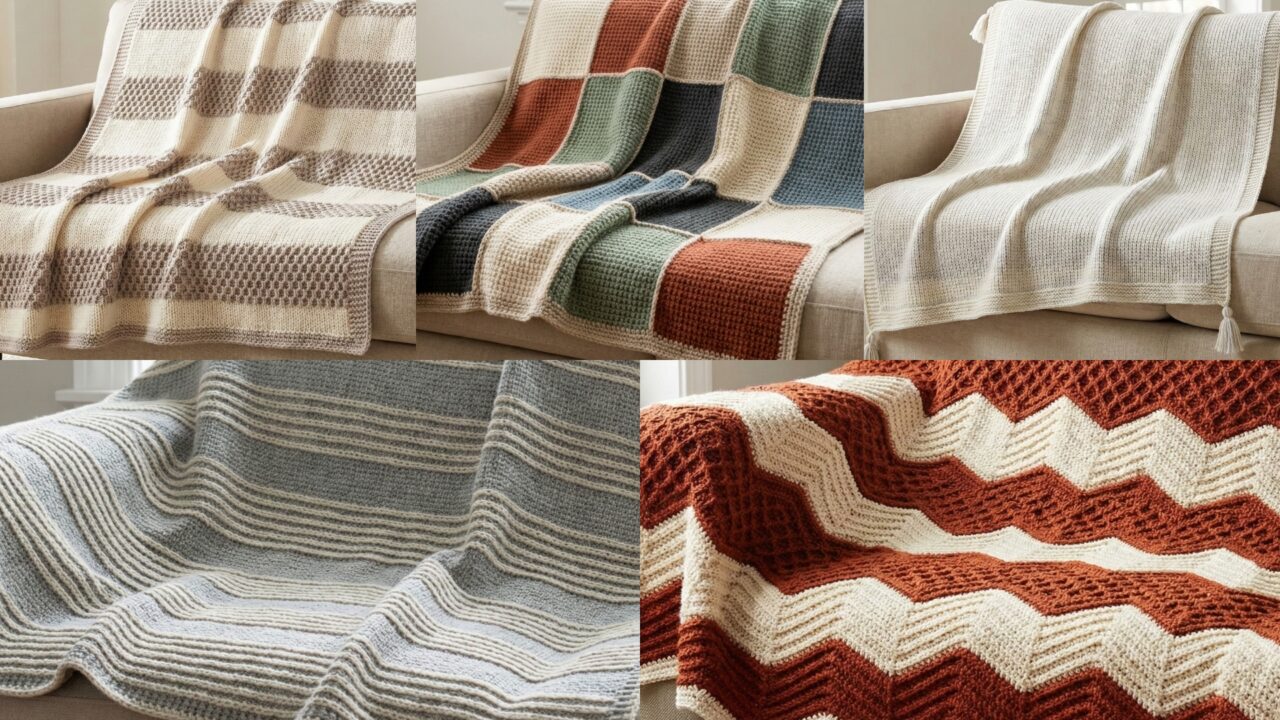
Tunisian crochet produces dense, warm fabric with beautiful stitch definition — a perfect choice for blankets meant to be used and loved. These five patterns range from modular patchwork to classic knit-like throws, each written with full materials lists, sample gauge and sizing math, clear step-by-step construction, finishing instructions, variations, care notes and troubleshooting tips. The language is direct and ready to publish.
Quick essentials (tools, yarn, basic Tunisian workflow)
Tools & yarn
- Tunisian hook (straight or short cable): DK → 6.0–7.0 mm; worsted/aran → 6.5–8.0 mm; bulky → 9.0–12.0 mm.
- Choose washable yarn for gift blankets: acrylic blends, cotton blends, or superwash wool for warmth and easy care.
- Notions: tapestry needle, blocking mats/pins, stitch markers, measuring tape, scissors.
Basic Tunisian forward/return
- Forward pass: pick up one loop in each stitch across the row, leaving loops on hook.
- Return pass: yarn over and pull through two loops repeatedly until one loop remains.
- Repeat forward + return passes for each row.
- Bind off with a Tunisian bind-off or convert remaining loops to regular crochet for a soft edge.
1. Crochet Patchwork Tunisian Half-Double Blanket Pattern
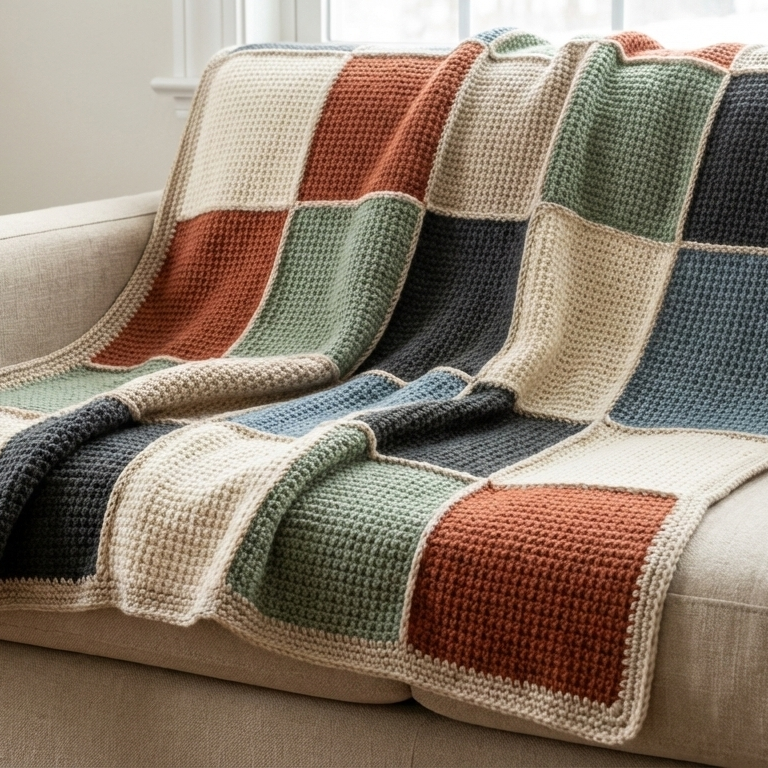
Vibe: modular patchwork made of Tunisian half-double panels; great for colorwork and manageable evening sessions.
Skill level: confident beginner → intermediate.
Sample finished size: 48″ × 60″ (modifiable).
Suggested yarn & hook: worsted/aran; Tunisian 6.5–7.5 mm.
Estimated yardage: ~1,800–2,000 yd total for a 48″ × 60″ throw (depends on number of panels and border).
Gauge & panel math (example)
- Make a 4″ × 4″ swatch in Tunisian Half-Double Stitch (THdc). Suppose the blocked swatch measures 14 sts = 4 in and 12 rows = 4 in.
- Stitches per inch (spi) = 14 ÷ 4 = 3.5 sts/in.
- Rows per inch (rpi) = 12 ÷ 4 = 3 rows/in.
- Target panel: 12 in square. Panel width = 12 × 3.5 = 42 sts. Panel height rows = 12 × 3 = 36 rows.
- For a 48″ × 60″ blanket built from 12″ panels: 4 panels across × 5 panels down = 20 panels.
Materials (example for 12 colors)
- 12 colors × ~150–180 yd each = ~1,800–2,160 yd total.
- Tunisian 6.5 mm hook, tapestry needle, blocking pins.
Panel construction — step by step
- Foundation: chain 42 + 1 turning chain (or use a foundation THdc row of 42 stitches for a neater edge).
- Setup forward pass: pick up loops across (one loop per stitch). Return pass: yarn over and pull through two loops repeatedly until one loop remains. This completes the first row.
- THdc rows: on each forward pass insert the hook under both vertical bars of each stitch and pull up a loop. Return pass as usual. Repeat until panel height = 36 rows (12″ after blocking).
- Finish each panel with a tidy bind-off or convert final loops to sc to create a softer edge for joining. Block panels flat to exact dimensions.
Joining panels
- Use mattress stitch for flat seams: place panels right sides up and weave a tapestry needle under the edge vertical bars alternately between panels. Pull snug but do not pucker. Join panels into rows, then join rows.
Border and finishing
- Pick up loops around the assembled blanket and work 6–8 rounds Tunisian Simple Stitch (TSS) for a firm border, or work 3 rounds of regular crochet (sc, hdc, sc) for a soft frame.
- Weave in ends and block the whole blanket.
Variations
- Alternate THdc panels with Tfs (Full stitch) panels for mixed texture.
- Make rectangle panels (12″ × 16″) to change the layout and reduce seams.
Care
- Machine wash gentle cold for acrylic blends; lay flat to dry. For wool, hand wash cold and dry flat.
Troubleshooting
- Panels slightly different widths: add a narrow sc round to smaller panels before joining.
- Bulky seams: mattress stitch avoids bulk; avoid whipstitch for Tunisian panels.
2. Crochet Tunisian Drew Throw Blanket Pattern
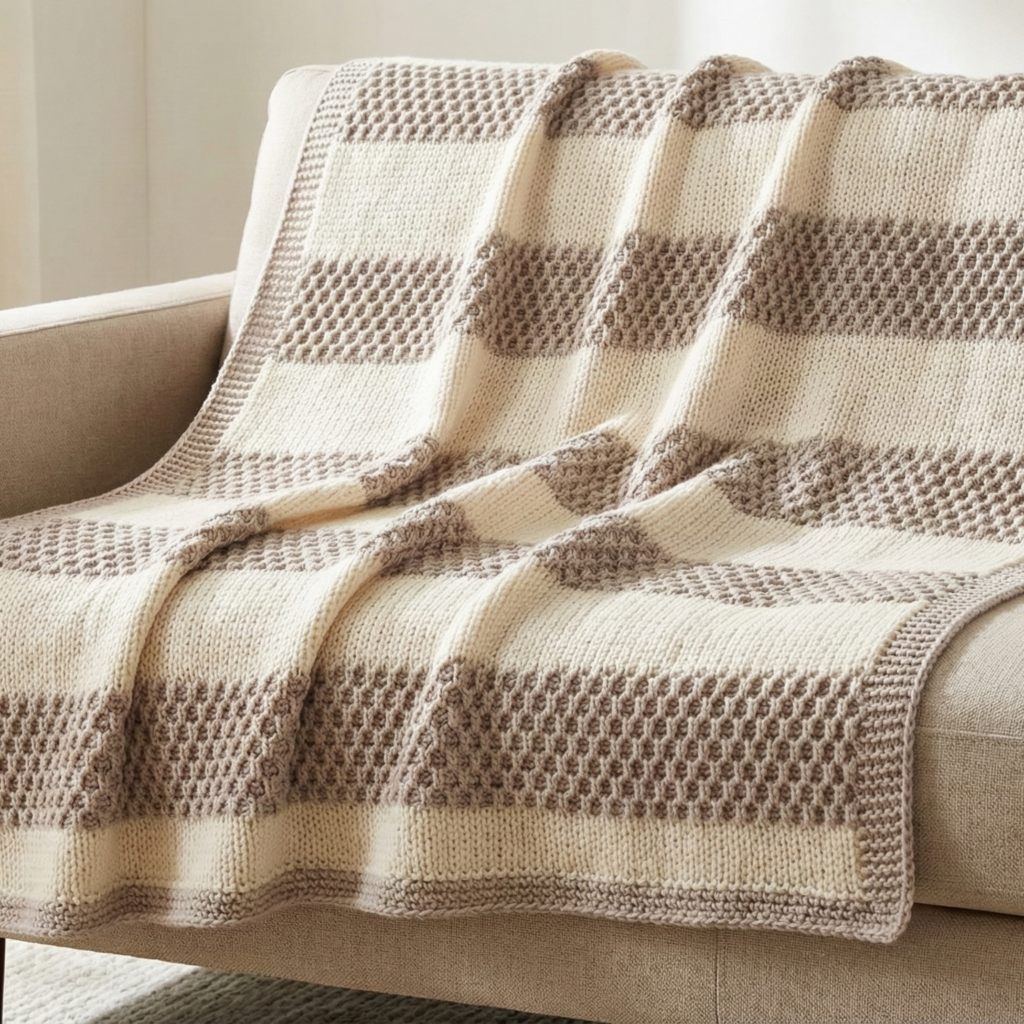
Vibe: polished, reversible throw combining Tunisian Full Stitch (knit-like) bands with textured honeycomb bands.
Skill level: intermediate.
Sample finished size: 50″ × 60″.
Suggested yarn & hook: worsted; Tunisian 7.0 mm.
Estimated yardage: ~1,700–1,900 yd.
Gauge & planning (example)
- Blocked swatch in Tfs: 12 sts = 4 in, 8 rows = 4 in.
- Stitches per inch = 12 ÷ 4 = 3 sts/in.
- Rows per inch = 8 ÷ 4 = 2 rows/in.
- Width calculation: 50 in × 3 sts/in = 150 sts (foundation).
- Length calculation: 60 in × 2 rows/in = 120 rows. If bands are 8 rows Tfs + 8 rows honeycomb = 16 rows per stripe, do 7 or 8 repeats (adjust final edge rows to match exact length).
Stitches used
- Tunisian Full Stitch (Tfs): forward pass insert under both vertical bars for a smooth, knit-like surface.
- Honeycomb band (sample): a 4-row textured repeat using occasional crossed forward-pass insertions to create pocketed honeycomb texture. (A chart can be provided if desired.)
Construction — step by step
- Foundation row: chain 150 + 1 turning chain (or foundation Tfs). Pick up loops across and complete the setup return pass.
- Work 8 rows in Tfs for the first smooth band. (Forward passes under both bars, return passes standard.)
- Work 8 rows of honeycomb repeat: on specified forward rows make crossed inserts (insert hook into next stitch first then current stitch) to form diagonal motifs; return passes as usual. Repeat the honeycomb repeat across the row count.
- Alternate 8-row Tfs bands with 8-row honeycomb bands until you reach total length (~120 rows). Finish with final Tfs rows for a tidy edge.
- Bind off with a loose Tunisian bind-off or convert last row loops to sc and work 3 rounds sc/hdc for a softer edge.
Finishing & variations
- Option: two rounds of color-contrast sc for a clean frame.
- Variation: use tonal yarns for subtle texture; use high contrast for bold stripes.
Care
- Machine wash gentle cold for acrylic blends; reshape and lay flat to dry.
Troubleshooting
- Honeycomb counts not lining up: work a narrow swatch and mark repeats with stitch markers before working the full width.
- Edges curling: add 1–2 rounds sc after bind-off to stabilize.
3. Crochet Honeycomb Ripple Tunisian Blanket Pattern
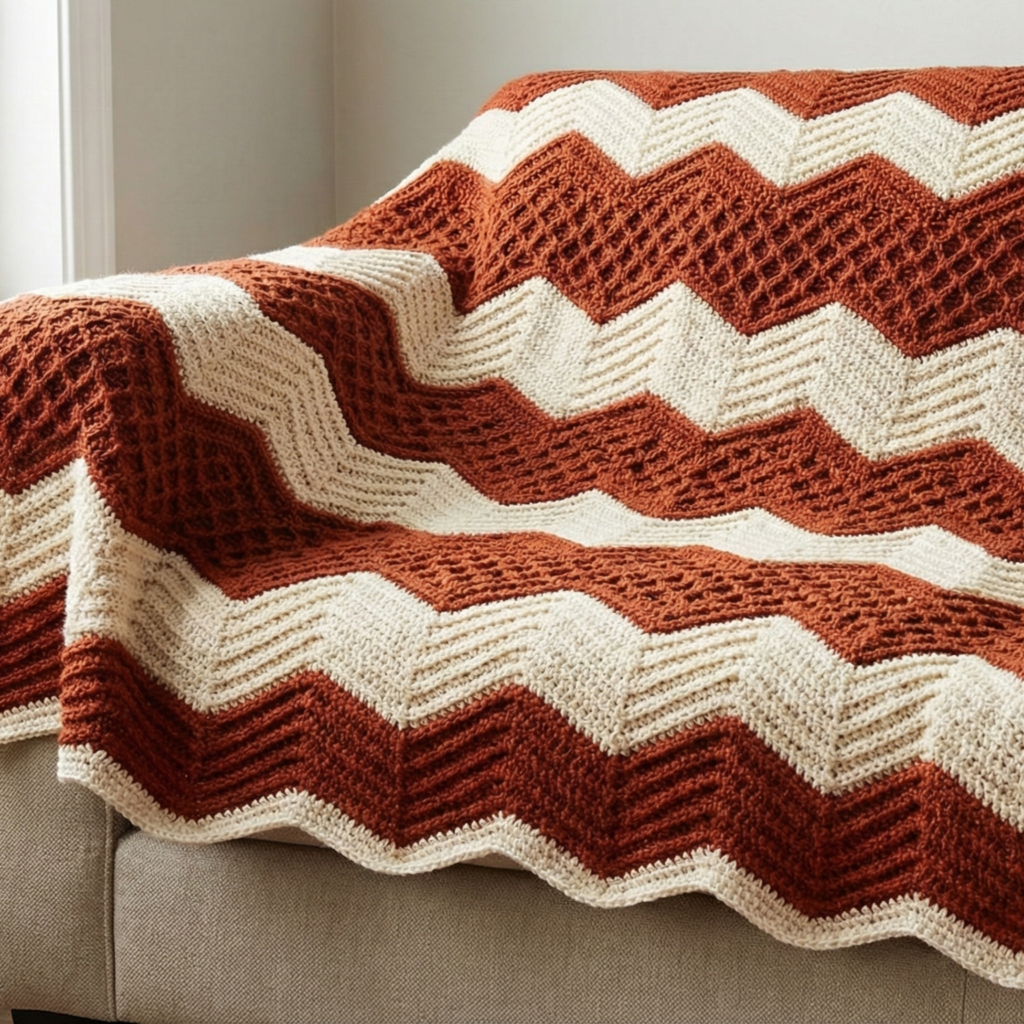
Vibe: bold chevron ripples textured with honeycomb columns; statement throw.
Skill level: intermediate → advanced (two reliable methods provided).
Sample finished size: 48″ × 60″.
Suggested yarn & hook: DK or worsted; Tunisian 6.5–7.0 mm.
Estimated yardage: ~1,600–2,000 yd.
Two construction options
Option A — Full Tunisian shaping (advanced): sculpt peaks and valleys by increasing and decreasing during forward passes. This yields a single-piece rippled honeycomb fabric but requires careful counting and experience with Tunisian shaping.
Option B — Modular bands (recommended): make vertical honeycomb Tunisian panels and regular crochet chevron panels; join them in sequence to create the ripple effect. This is more forgiving and easier to teach.
The step-by-step below uses Option B.
Planning & math (example)
- Swatch gauge in honeycomb: 4 sts/in after blocking. For 48″ width: 48 × 4 = 192 sts equivalent. If honeycomb panels are 24 sts wide, number of honeycomb bands = 192 ÷ 24 = 8 bands. Between each honeycomb band place a ripple panel (regular crochet chevron) of 12 sts width.
Modular band construction — step by step
- Make eight honeycomb panels in Tunisian of width 24 sts and full blanket length (or make shorter bands and join them vertically). Work honeycomb repeat across each band and block flat.
- Make seven ripple chevron panels in regular crochet (dc or hdc chevron pattern) each the full blanket length and 12 sts wide (or width determined by planning).
- Layout panels: alternate honeycomb panel, chevron panel, honeycomb panel, etc., to form full blanket width.
- Join panels: mattress stitch for Tunisian–Tunisian joins; for Tunisian–regular crochet joins use a flat whipstitch or single-crochet join with care to avoid bulk.
- Block assembled blanket to even ripples and flatten seams.
- Add 3 rounds sc or a shell edging to finish.
Variations
- Make chevron panels in contrasting color for strong graphic effect.
- Use variegated yarn for ripple panels to soften lines.
Care
- Machine wash gentle cold for acrylic; for wool, hand wash and dry flat.
Troubleshooting
- Panels slightly different heights: block panels to exact length before joining; add a narrow sc round to shorter panels to match length.
4. Crochet Tunisian Field Stitch Blanket Pattern
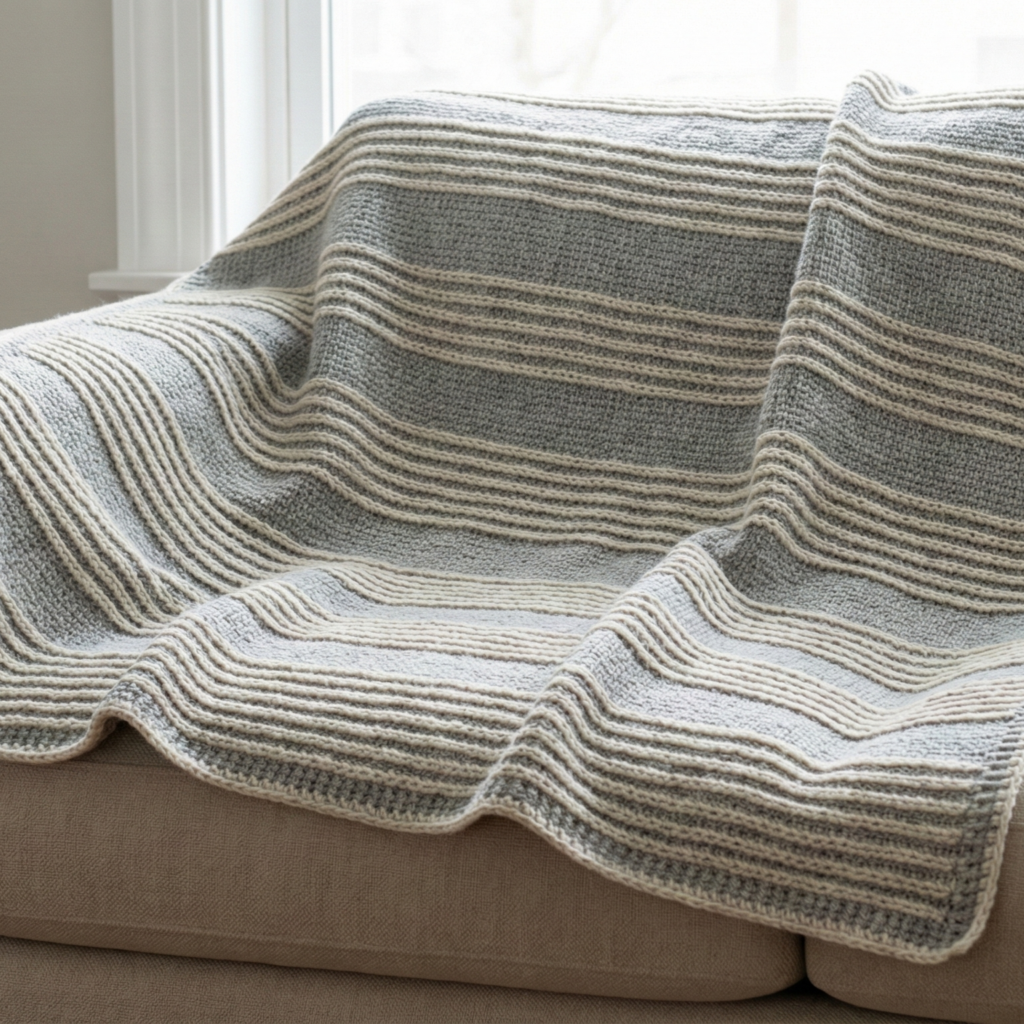
Vibe: calm, modern texture featuring subtle horizontal ridges — ideal for baby blankets and contemporary interiors.
Skill level: confident beginner.
Sample finished size: 40″ × 50″.
Suggested yarn & hook: DK or worsted; Tunisian 6.0–7.0 mm.
Estimated yardage: ~1,200–1,500 yd.
What the Field Stitch does
The Field stitch alternates working into front and back vertical bars to create bands of flat fields and raised ridges. It’s reversible, subtle and easy to memorize.
Planning and calculation (example)
- Swatch yields 3.5 sts/in and 3 rows/in after blocking.
- Width for 40″: 40 × 3.5 = 140 sts foundation.
- Length for 50″: 50 × 3 = 150 rows.
Field stitch repeat — step by step (4-row example)
- Foundation: chain 140 + 1 turning ch (or use foundation method).
- Row 1 (setup forward pass): pick up loops under the front vertical bar (Tss). Return pass.
- Row 2 (forward): repeat Row 1. Return pass.
- Row 3 (forward): pick up loops under the back vertical bar (Tss-rev) to create ridge. Return pass.
- Row 4 (forward): repeat Row 3. Return pass.
- Repeat Rows 1–4 until desired length.
Edge and finishing
- Convert final loops to sc for a soft edge; work 2–3 rounds sc for a neat frame.
- For baby blankets, add a folded sc border (work one round sc, fold, and sc through both layers) for durability.
Variations
- Alternate color blocks every 12–24 rows to create calm stripes.
- Work the field stitch in a soft cotton blend for warmer climates.
Care
- Machine wash on gentle for acrylic/cotton blends; dry flat for natural fibers.
Troubleshooting
- If ridges don’t show: check that forward pass in Row 3 is into the back bar, not the front.
- If width changes after blocking: adjust your final border to compensate or re-block.
5. Crochet Tunisian Full Stitch Blanket Pattern
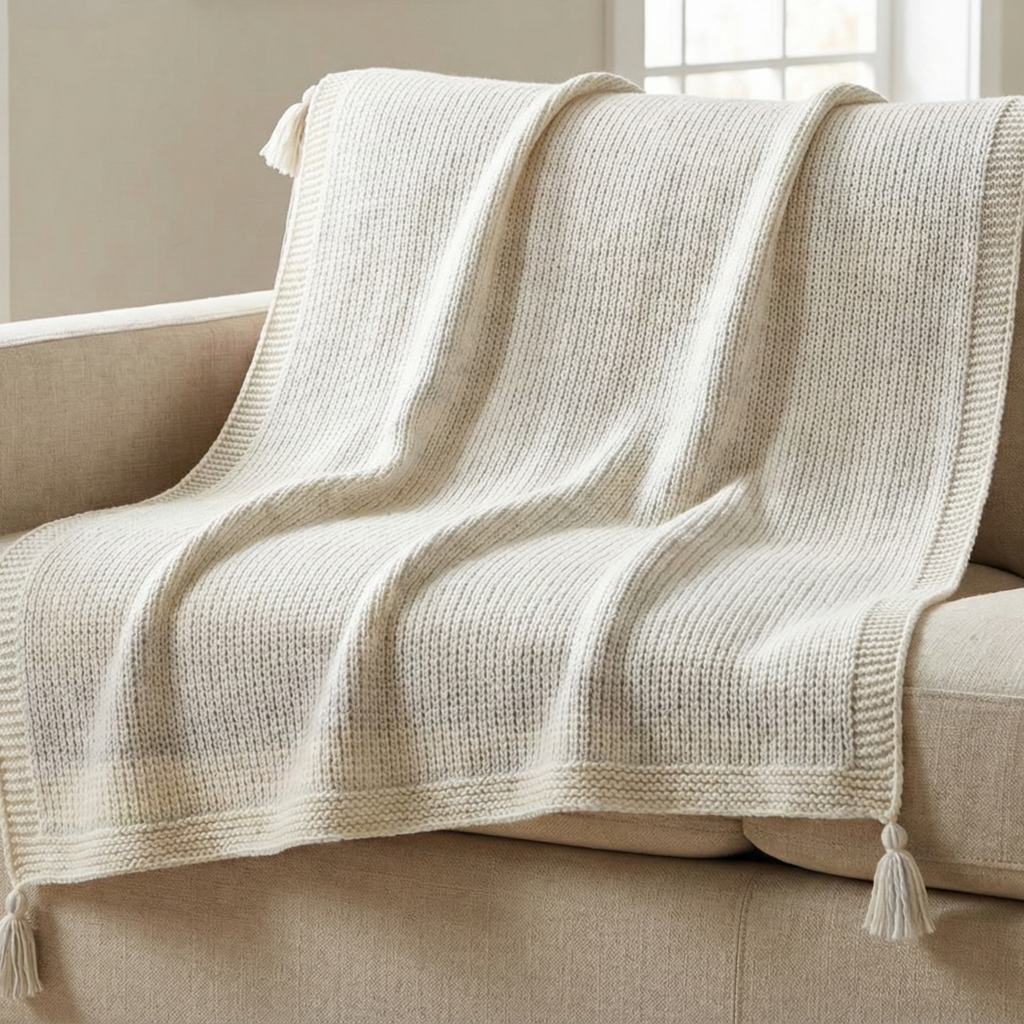
Vibe: classic knit-like throw that’s dense, warm and polished — an excellent first full Tunisian blanket.
Skill level: beginner → confident beginner.
Sample finished size: 48″ × 60″.
Suggested yarn & hook: worsted; Tunisian 7.0–8.0 mm.
Estimated yardage: ~1,600–1,900 yd.
Why the Full Stitch
The Full stitch (Tfs/Tks) produces a smooth, stockinette-like surface that’s forgiving and quick. It’s ideal for straight blankets and easy borders.
Gauge & calculation (example)
- Swatch: 12 Tfs = 4 in, 12 rows = 4 in.
- Stitches per inch = 12 ÷ 4 = 3 sts/in.
- Rows per inch = 12 ÷ 4 = 3 rows/in.
- Width: 48 in × 3 sts/in = 144 sts.
- Length: 60 in × 3 rows/in = 180 rows.
Construction — step by step
- Foundation: chain 144 + 1 turning ch (or foundation Tfs row).
- Setup forward pass: pick up loops across. Return pass: work loops off as usual.
- Tfs rows: on each forward pass insert the hook under both vertical bars of each stitch to pull up loops. Return pass: yarn over and pull through two loops repeatedly. Repeat until you have approx. 180 rows (60″).
- Optional vertical texture: every 8–12 sts, insert a narrow column of Tps to create subtle ribs (optional).
- Bind off: use Tunisian bind-off or convert final loops to sc and add 3 rounds sc/hdc for a soft edge.
Border & refinement
- A contrast 2-round sc border or a delicate shell round complements the smooth surface.
- Add tassels at two or four corners for a casual boho finish; secure tassels by threading through multiple strands and knotting tightly inside the border.
Care
- Machine wash cold gentle for acrylic blends; lay flat to dry for best shape retention.
Troubleshooting
- If blanket feels too stiff: use a slightly larger hook for softer drape or add more regular crochet rounds at the edge.
- If length is off: measure rows per inch on blocked swatch and recalculate; adjust total rows accordingly.
Conclusion
Blocking: pin the finished blanket to measurements and spray lightly; allow to dry fully. Blocking evens stitches, opens texture and sets edges.
Bind-off options:
- Tunisian simple bind-off yields a stable edge (may feel firm).
- Convert final loops to sc for a softer, foldable edge, then work several rounds of regular crochet for added drape.
Care summary: follow yarn label. For gift blankets, prefer machine-washable yarns or clearly label care for delicate fibers.
These five Tunisian blanket patterns are ready to make as gifts: choose the one that fits your schedule and skill level, pick a washable yarn for practical use, and follow the swatch → stitches-per-inch → calculation examples to resize accurately. Each pattern provides a satisfying mix of texture, warmth and handmade quality that recipients will love.