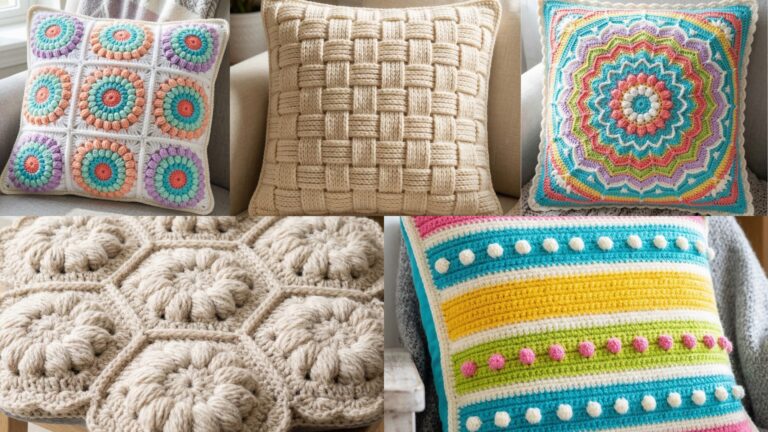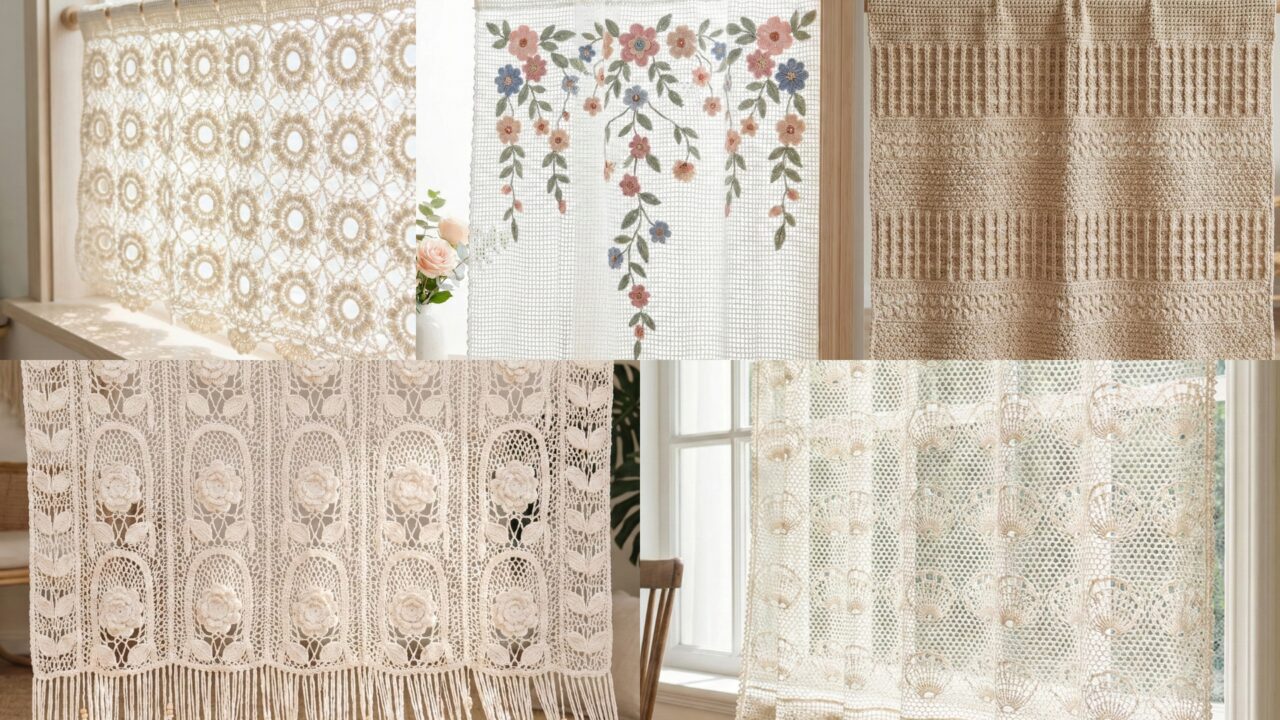
Curtains change everything — they soften light, add texture, and turn a room into a cozy retreat. This post gives you a full introduction (measurements, yarn, hooks, hanging methods, lining and care) and five complete curtain patterns you can follow start-to-finish: Flower Curtain, Boho Leaf & Flower Curtain, Beige Boho Cotton Curtain, Floral Embroidered Curtain, and Vintage Victorian Curtain. Each pattern includes materials, skill level, stitch notes, and a very practical step-by-step guide so you can make panels that actually hang and look polished. Let’s get cozy.
Quick Intro — how to plan before you crochet
1) Measure accurately
- Measure the rod length or window width depending on how you’ll hang the curtains.
- Choose fullness: 1.5× (light gather), 2× (standard), 2.5–3× (full/ruffled).
Example: window = 40″ wide, you want 2× fullness → total fabric width = 80″. If making two panels, each panel = 40″ wide. - Decide length: sill (measure rod → sill), below sill, or floor (rod → floor). Add hem allowance ~2–3″ and top pocket/hem allowance ~2–4″.
2) Yarn & fiber choices
- Mercerized cotton (thread / sport / DK) — classic for lace and sheer curtains (good stitch definition, washable).
- Linen or linen blends — crisp drape and natural look (excellent for boho panels).
- Lightweight cotton-worsted — more body, good for structured panels.
- Avoid very bulky yarns for full curtains — too heavy and blocks light.
3) Hooks & gauge
- Swatch in the pattern stitch to check stitches-per-inch. This is how you size motifs and compute how many repeats you need across a panel.
- Example gauge math (digit-by-digit): if swatch = 4 dc = 1 in and you want a panel 40″ wide, you need 4 × 40 = ? → 4×40 = 160 stitches across (adjust to your stitch repeat multiples).
4) Hanging options
- Rod pocket (folded band) — classic, hides the rod.
- Tabs — crochet tabs or fabric loops sewn to top, casual boho look.
- Grommet band — add a fabric header with metal grommets for modern style (use for heavier panels).
- Clip rings — clip lightweight crochet panels to ring clips for easy removal.
5) Lining & privacy
- Crochet curtains can be sheer; if you want privacy or sun protection, add sewn cotton lining or use a double rod setup (sheer crochet inside + opaque drape outside).
6) Care & finishing
- Cotton: machine-wash gentle or hand-wash; reshape while damp. Mercerized cotton tolerates machine wash better.
- Block lace panels after finishing to open up stitches and get precise measurements.
- Weave in ends and stabilize top band well (multiple rows of sc/hdc) so hanging doesn’t stretch the panel out of shape.
1. Crochet Flower Curtain Pattern
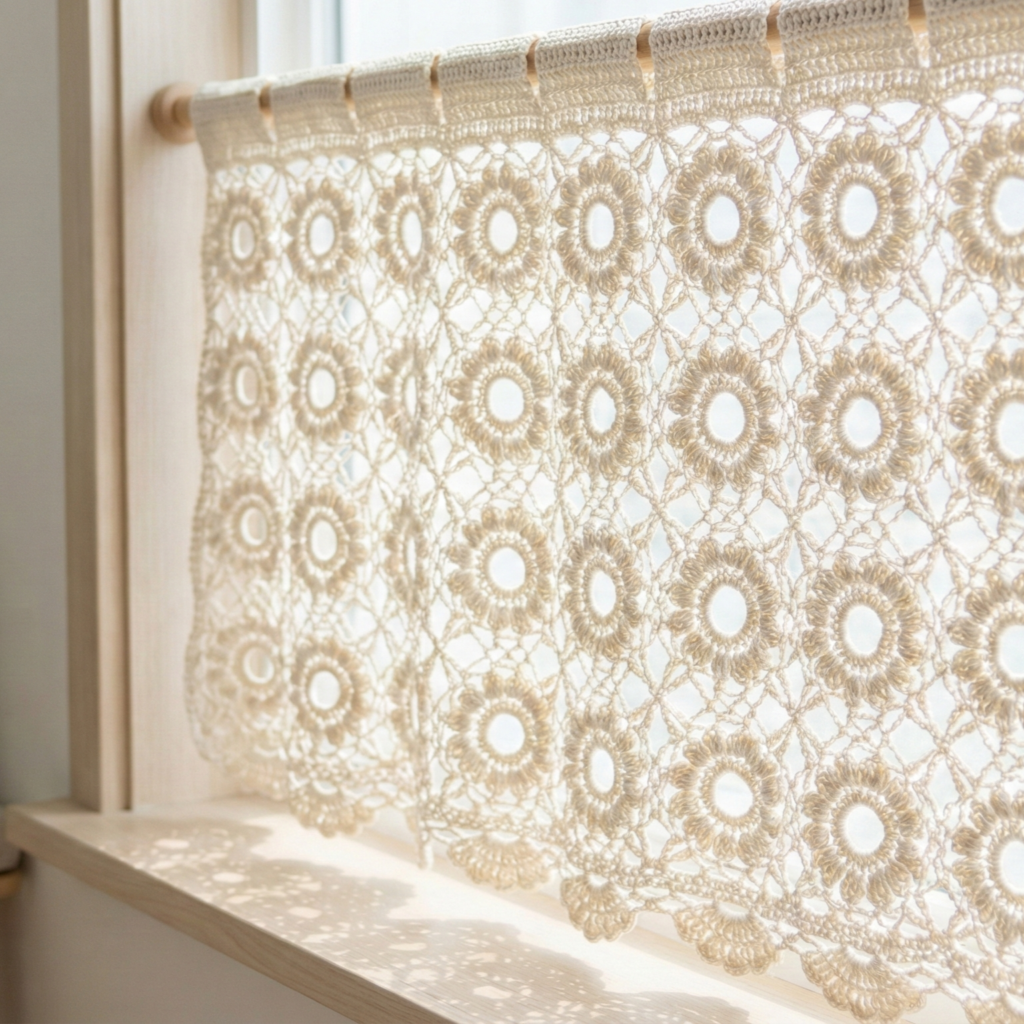
Romantic lacy panels made of repeated flower motifs—great for light-filtering, cottage-style rooms.
Skill level: intermediate (motif making + joining)
Materials (example panel 40″×72″): mercerized cotton DK or sport, 1000–1400 yd; hook 3.0–4.0 mm; blocking pins; tapestry needle.
Finished concept: tile a 3″–3.5″ round flower motif across a rectangle and add a scalloped bottom + rod pocket.
Stitch notes
Motif: center ring → petal round → join arches. Join-as-you-go works well so finishing is minimal.
Step-by-step
A — Make & measure one motif
- MR, ch3, work 12 dc into ring; R2: ch3, 5 dc cluster (shell) in next space, ch3, sl st across to form petals; R3: chain arches (ch5) between petals for join points. Block motif, measure width (example 3.25″).
B — Count motifs
2. Compute motifs across: panel width desired ÷ motif width = number across. Example 40″ ÷ 3.25″ ≈ 12.3 → round to 12 motifs across; adjust fullness multiplier if desired.
C — Make motifs
3. Crochet required number of motifs: columns × rows. Block every motif to uniform size.
D — Join motifs
4. Join-as-you-go on final round: when you reach a side that touches an adjacent, sl st into their corresponding ch-space instead of working a full ch-space; this creates a flat join. Join into rows then join rows.
E — Create top band
5. Along the straight inner edge (top), pick up stitches and work 4–6 rounds of sc or hdc to form a firm band. Fold and whipstitch down to make a rod pocket (allow 1/2″ extra for rod diameter). Alternatively add tabs: ch10 loops evenly spaced and attach to top band.
F — Scalloped edging
6. Along lower outer edge work a decorative shell round: sc, skip 2, 7 dc in next ch-space, skip 2, sc repeat. Add picots on shell peaks if desired. Block to shape.
G — Hang & care
7. Thread rod and hang panels. Hand wash or machine-gentle; reblock damp if needed.
Variations
- Add tiny crocheted leaves between motifs for a denser botanical pattern.
- Use two-toned yarn or dip-dye the bottom row for an ombré floral curtain.
2. Crochet Boho Leaf and Flower Curtain Pattern
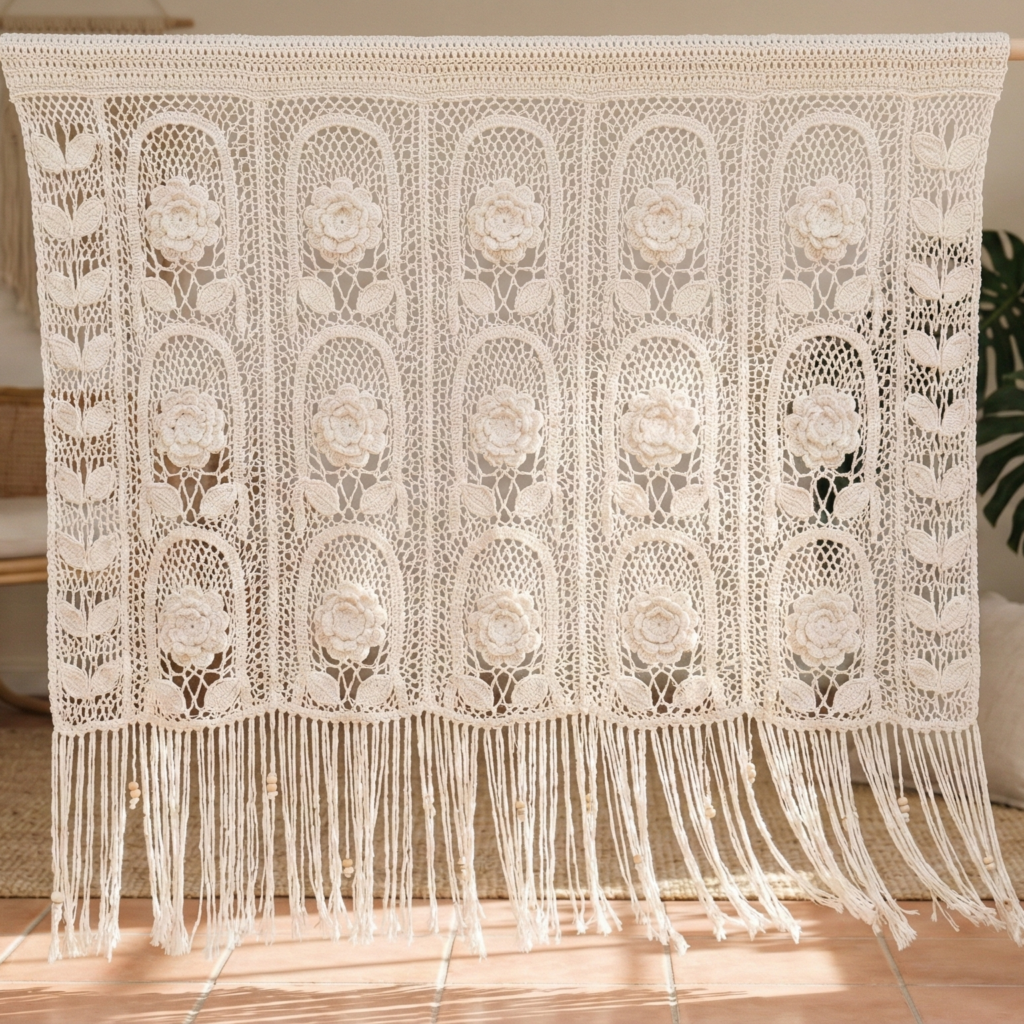
Breezy vertical panels with vine-like leaves and open flower arches — perfect for patios or living rooms.
Skill level: confident beginner → intermediate
Materials (per panel 36″×72″): linen-cotton blend DK, ~800–1,200 yd; hook 4.0–5.0 mm; wooden rod or macramé rings; blocking pins.
Stitch notes
Work repeatable vertical lace columns (leaf clusters + flower arches). Columns are joined side-by-side.
Step-by-step
A — Build a vertical column swatch
- Chain multiple of 10 + 2. Row A (arch row): sc, ch7, skip 6, sc to create tall arches. Row B (flower row): in each ch7 space do (sc, hdc, 5 dc, hdc, sc) to make a flower. Row C (leaf row): offset, work small leaf clusters between the flower rows: ch3, (sl st, dc, sl st) to form tiny leaves rising up the column. Repeat A–C for a tall column. Block and measure column width.
B — Panel width & repeats
2. Decide how many columns across: panel width ÷ column width (add fullness multiplier). Make that many column strips.
C — Join columns
3. Join columns with a joining round: sc across attached edges or join-as-you-go on last round of each new column for a seamless look.
D — Top finishing
4. For boho style make a top band with chunky hdc rows that create a rod pocket, or add macramé loops (crochet 8–10 ch loops) to hang from a dowel.
E — Add fringe
5. Add long fringe (12–18″) across the bottom: fold yarn lengths in half, pull loop through lower edge and knot. Trim ends evenly. Optionally thread wooden beads onto fringe pieces for weight and aesthetic.
F — Hang & maintain
6. Hang via wooden rod or use binder clips on ring hooks for easy removal. Hand-wash or machine-gentle and reblock fringe length while damp.
Styling tips
- Natural beige or sage leaf color works great with houseplants.
- Make a pair and tie back with crocheted tassel ties.
3. Crochet Beige Boho Cotton Curtain Pattern
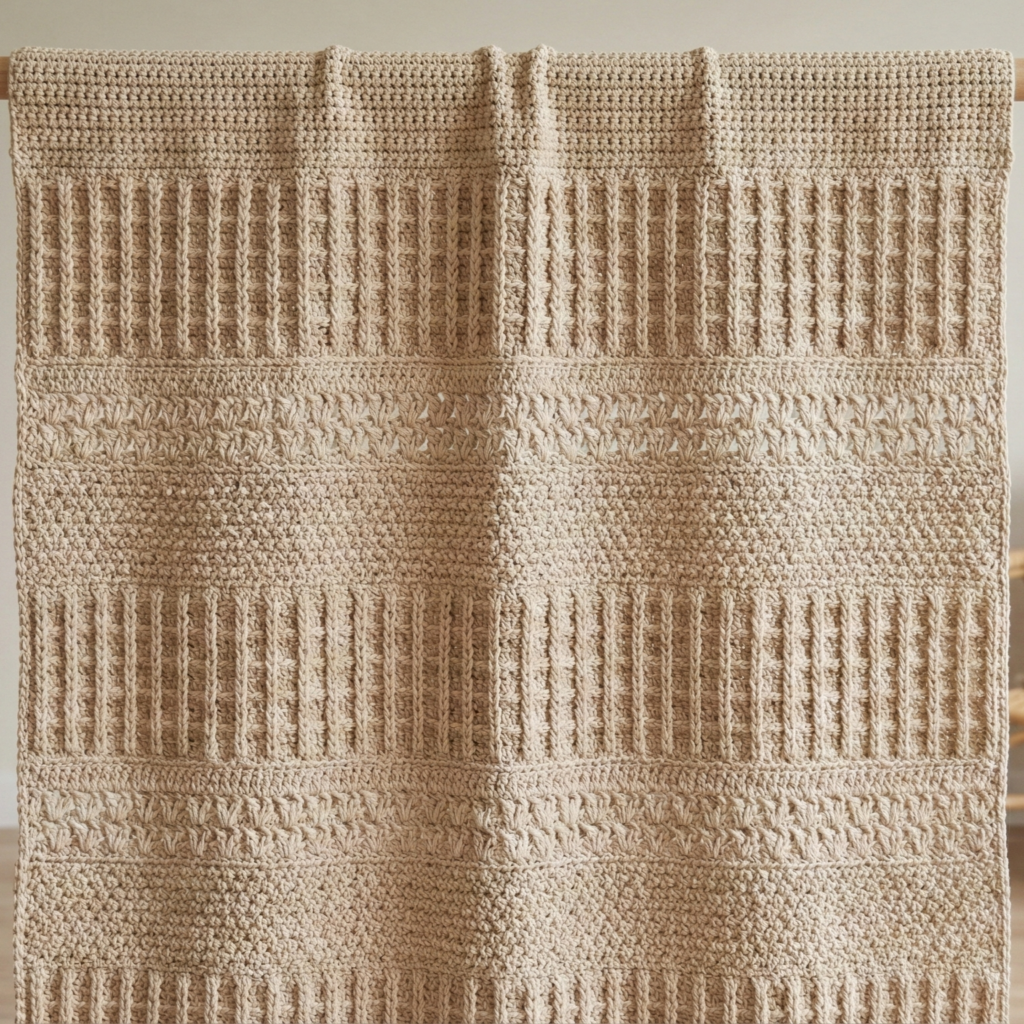
Neutral, textured bands alternate to create a warm, modern-boho panel — minimal and cozy.
Skill level: confident beginner
Materials (per panel 40″×72″): cotton DK or worsted held single, ~900–1,200 yd; hook 4.5–5.5 mm; curtain rings or sewn tabs.
Stitch palette
Alternate bands of waffle stitch (thick texture), V-stitch (openwork), and moss stitch (tight, pebble-like) for a balanced panel.
Step-by-step
A — Plan band sequence
- Choose band heights (example repeat: Waffle 8 rows ≈ 6″, V-stitch 6 rows ≈ 4″, Moss 6 rows ≈ 3″). Repeat sequence until you reach panel length.
B — Foundation chain
2. Chain to match width (adjust for gauge and fullness). Work the band repeats across the whole width in straight rows — you will not join columns here; this is a single flat panel.
C — Waffle band (example)
3. Row 1: dc across, Row 2: fpdc, bpdc across; repeat Row 2 to build vertical waffle ribs.
D — V-stitch band
4. Row 1: dc, ch1, skip 1, dc across to form Vs. Repeat this for several rows.
E — Moss band
5. (sc, ch1) across — a close textured band. Repeat as necessary.
F — Transition & edges
6. Between bands, do one even round of sc to stabilize transitions. Finish top with 6 rows sc, fold down and sew to create rod pocket or attach tabs.
G — Bottom weight
7. Add sewn-in cotton tape or a narrow wooden dowel in a hem for weight so panel hangs well.
Care
- Machine-wash gentle; reshape damp. Neutral tones are fade friendly; consider pre-washing yarn if dye-phase matters.
4. Crochet Floral Embroidered Curtain Pattern
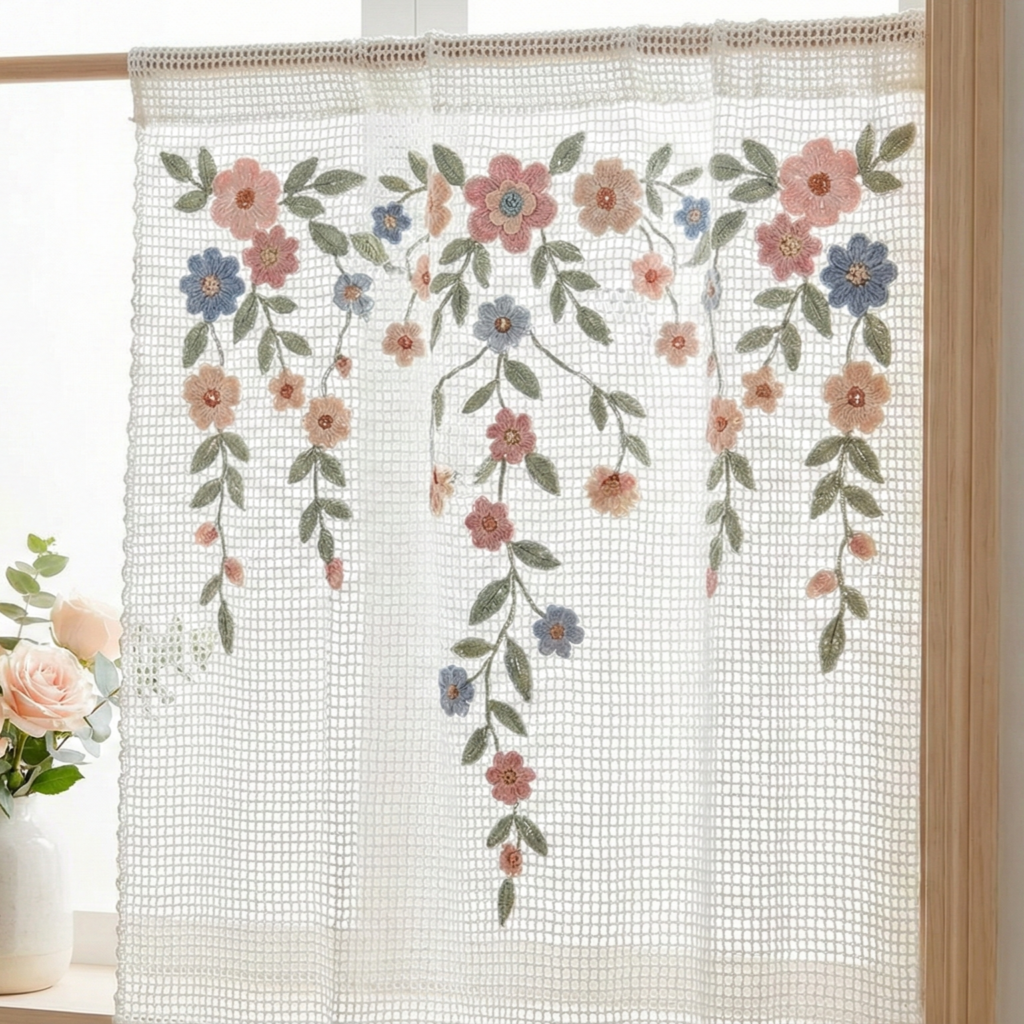
Clean filet or mesh ground with hand-stitched floral appliqué — looks high-end but is straightforward to make.
Skill level: intermediate (crochet + embroidery/appliqué)
Materials (panel 40″×72″): fine-to-DK cotton for ground ~900–1,200 yd; embroidery floss or thin yarn in accents; hook 3.0–4.5 mm; tapestry needle.
Stitch notes
Make a mesh or filet panel, produce small crocheted flowers and leaves as appliqués, and sew or embroider them onto the panel.
Step-by-step
A — Make a mesh/filet ground
- Chain foundation for width. Work filet mesh: dc, ch1, skip 1 across — that’s one row. Repeat rows until panel height reached. Mesh gives structure and nice grid for placing flowers.
B — Plan floral layout
2. Lay panel flat and mark where flowers will go (a band across middle, scattered field, or corner cluster). Use removable pins or thread for placement. Decide scale of flowers so embroidery is proportional.
C — Make crochet flowers & leaves
3. Small flower: MR, 6 sc; next round: in each sc make (ch3, sl st) to form loops; then make petals with (sc, hdc, 3 dc, hdc, sc) in each loop. Make leaves with small pointed shapes (ch6, sc back).
D — Attach appliqués
4. Sew each flower and leaf to the mesh with small invisible stitches. For added detail use embroidery floss to add seed stitch centers or satin-stitch dots.
E — Top & edges
5. Finish top with a sturdy band (4–6 rounds sc), fold to create rod pocket, or attach grommet header for modern hanging.
F — Care
6. Hand-wash recommended if using thin embroidery or multiple colors. If machine-washing, secure appliqués and use a laundry bag.
Styling
- Crisp white mesh with pastel flowers is perfect for kitchens or nurseries. Use tonal embroidery for subtle elegance or bright primaries for cheerful rooms.
5. Crochet Vintage Victorian Curtain Pattern
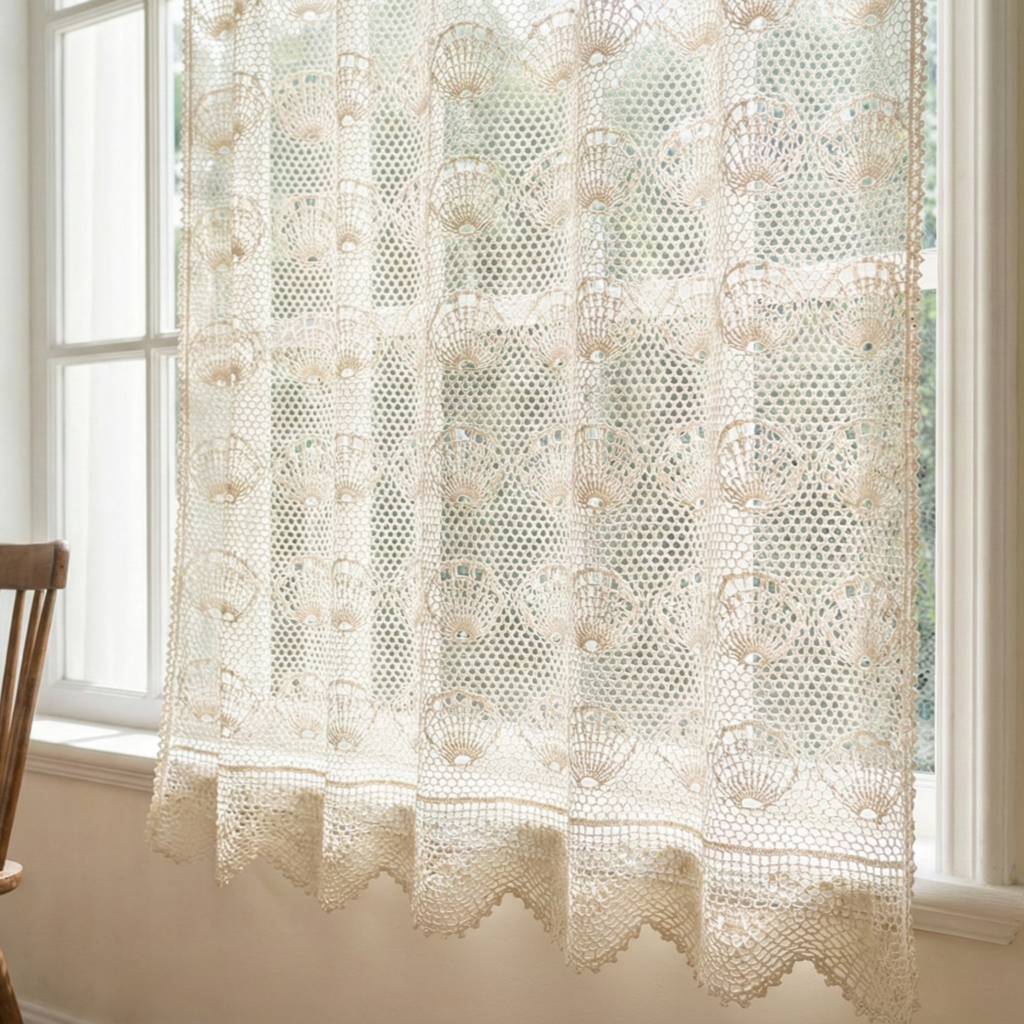
Heirloom-quality lace in fine thread — ornate motifs, picot points and a scalloped bottom for a dramatic, classic look.
Skill level: advanced (fine thread, many repeats, heavy blocking)
Materials (panel full-length): size 10 crochet thread or fingering cotton, many yards (expect 1500 yd+ for floor-length panels), hooks 1.5–2.5 mm, large blocking surface and pins.
Stitch notes
Combines fan motifs, miniature shells, spider clusters and picot points for a heavily textured lace. Because it’s fine thread work, blocking is essential.
Step-by-step
A — Swatch & repeat math
- Swatch a small lace repeat (e.g., an 8-row motif). Measure how many repeats you need across and compute for fullness. Victorian lace often uses much smaller repeats so this will be yardage intensive.
B — Work lace field
2. Repeat pattern rows:
- Row 1: tiny shell row (sc, ch3, 5 dc, ch3, sc) spaced evenly.
- Row 2: chain arches bridged by small spider clusters (cluster of 5 tiny loops anchored into arches).
- Row 3: fan clusters that build scalloped rows.
Repeat rows A–C to build panel height.
C — Join panels (if making multiple)
3. If you can’t crochet one large panel, divide into motif strips and join with invisible seaming or join-as-you-go. Always block each section before joining.
D — Ornate scalloped bottom
4. Create a multi-row scalloped border: first row of deep 9–11 dc shells, second row creating picot peaks on shell centers (sc, ch3, sl st into first ch for picot). Pin each picot out squarely during blocking.
E — Top finishing
5. Work a triple-fold rod pocket (6–8 rounds sc) and add tiny loop tabs for tiebacks or preserve original Victorian aesthetic with delicate crocheted tie back loops.
F — Blocking
6. Soak gently and block heavily: pin each scallop peak and motif point to open lace. Allow to dry fully — this is what turns a scrunched fabric into crisp heirloom lace.
Care
- Hand-wash or very gentle machine on mesh bag; reshape and block while damp. Consider adding a fabric lining behind lace to protect it and provide privacy.
conclusion
You now have five full curtain approaches to choose from:
- Flower Curtain for romantic cottage charm,
- Boho Leaf & Flower for relaxed, plant-friendly style,
- Beige Boho Cotton for neutral textured warmth,
- Floral Embroidered for a custom, hand-stitched look,
- Vintage Victorian for heirloom lace drama.